United Tax Liens

How to Recognize Overvalued Properties Before Bidding

Overvalued properties at auction are one of the fastest ways to lose money in tax lien and tax deed investing. A deal might look great on the surface, but without proper evaluation, it can quietly drain your profits.

The challenge is that auctions move fast, and competition can push prices beyond what a property is actually worth. Investors who don’t recognize this early often end up overpaying, leaving little room for profit—or worse, creating a loss.

The goal isn’t just to find deals. It’s to avoid the wrong ones.


Why Good Deals Can Still Be Bad Investments

One of the biggest traps investors fall into is assuming that a property at auction is automatically a good deal. The reality is that many overvalued properties at auction attract attention because they look appealing—good location, decent condition, or strong resale potential.

But price matters more than appearance.

If bidding pushes the price too close to market value, your margin disappears. Once you factor in closing costs, potential repairs, and holding time, what looked like a solid deal can quickly become a poor investment.


Understand True Market Value First

The foundation of avoiding overvalued properties at auction is knowing what a property is actually worth—not what it looks like it’s worth.

This means:

  • Reviewing comparable sales (comps)
  • Checking recent market trends
  • Understanding price per square foot in the area

Without this baseline, you’re bidding blindly.

Experienced investors always calculate their maximum bid before the auction starts. They don’t adjust based on emotion or competition—they stick to the numbers.


Watch the Bidding Behavior

Auctions are driven by psychology as much as numbers. When multiple investors compete, prices can rise quickly beyond reasonable levels.

This is where overvalued properties at auction become most dangerous.

If bidding starts to exceed your calculated value, the deal is no longer worth pursuing. Chasing a property just to win the auction is one of the most common—and costly—mistakes.

Discipline matters more than opportunity in these moments.


Factor in All Hidden Costs

Another reason investors overpay is failing to account for the full cost of the deal.

Beyond the purchase price, you need to consider:

  • Repairs and renovations
  • Legal or foreclosure costs
  • Holding costs like taxes and maintenance
  • Potential title issues

For example, additional costs like foreclosure or title work can significantly impact your final investment, especially if the process becomes more complex than expected .

A property that seems profitable at first glance can quickly become overvalued once these factors are included.


Look Beyond the Surface

Some of the most misleading deals are the ones that look the best.

Clean photos, good neighborhoods, and strong resale potential can create the illusion of value. But experienced investors know that appearance doesn’t determine profitability—numbers do.

Always evaluate the deal based on:

  • Purchase price vs. market value
  • Total investment required
  • Realistic resale or income potential

If the numbers don’t work, the deal doesn’t work.


Set Your Maximum Bid—and Stick to It

Avoiding overvalued properties at auction ultimately comes down to discipline. Before the auction begins, you should have a clear maximum bid based on your analysis.

Once bidding exceeds that number, you walk away.

No exceptions.

This approach protects your capital and ensures that every deal you pursue has a real chance of producing a return.


Protect Your Profits by Avoiding Bad Deals

The most successful investors aren’t the ones who win the most auctions—they’re the ones who avoid the most mistakes.

By focusing on accurate valuation, accounting for all costs, and maintaining strict bidding discipline, you can avoid overvalued properties at auction and build a portfolio that performs consistently over time.

Because in this business, a great-looking deal can still be a bad investment—and knowing the difference is what separates profit from loss.

This blog is for informational purposes only and should not be relied upon as financial or investment advice. Real estate investing carries risks, and individual results will vary. Always consult with your team of professionals before making investment decisions. The authors and distributors of this material are not liable for any losses or damages that may occur as a result of relying on this information.

Scaling Tax Lien Investments Safely

Scaling tax lien investments requires more than simply buying more liens. As your portfolio grows, so does the need for structure, discipline, and control. Without that foundation, growth can quickly introduce risk instead of improving returns.

Many investors run into trouble not because they choose bad deals, but because they try to grow too quickly without adjusting their process. What works with a small number of liens becomes difficult to manage at scale, and small mistakes begin to add up.


Build Structure Before You Grow

The key to long-term success is consistency. Every deal should go through the same evaluation process, regardless of how many you’re managing. This ensures that your decisions remain disciplined and repeatable.

One of the most valuable indicators to focus on is tax payment history. Patterns in how property owners pay can help you predict whether a lien is likely to redeem or move toward foreclosure. Using this kind of data allows you to make better decisions as your portfolio expands .

Without a system, growth becomes reactive instead of strategic.


Focus on Better Deals, Not More Deals

A common mistake when scaling tax lien investments is assuming that more deals will lead to better results. In reality, spreading your capital across too many average liens often reduces performance.

A stronger approach is to focus on quality. Prioritize liens backed by solid property value and clear upside potential. In many cases, the real opportunity isn’t the interest rate—it’s the chance to acquire the property at a significant discount .

This shift in thinking allows you to grow your portfolio while maintaining stronger returns.


Define Your Exit Before You Invest

Growth without direction creates unnecessary risk. Before adding any lien to your portfolio, you should already understand how it fits into your overall strategy.

If the lien redeems, what’s your expected return? If it goes to foreclosure, what’s your next move?

Successful investors rely on clear exit strategies to guide their decisions. Whether the plan is to sell, hold, or generate income from the asset, having a defined path reduces uncertainty and keeps your growth aligned with your goals .


Maintain Control as Your Portfolio Expands

As you grow, management becomes just as important as acquisition. Each lien comes with responsibilities—tracking redemption periods, monitoring deadlines, and handling required payments.

Missing something as simple as a subsequent tax payment can put your position at risk, regardless of how strong the deal was initially .

This is why organization matters. Systems, whether digital or manual, help ensure that your portfolio remains manageable as it scales.


Grow with Discipline, Not Speed

Scaling tax lien investments successfully comes down to discipline. It’s not about how fast you grow, but how well you manage that growth.

By focusing on:

  • Consistent deal evaluation
  • Strategic capital allocation
  • Clear exit planning
  • Strong portfolio oversight

…you create a structure that allows your investments to grow without increasing risk.

This blog is for informational purposes only and should not be relied upon as financial or investment advice. Real estate investing carries risks, and individual results will vary. Always consult with your team of professionals before making investment decisions. The authors and distributors of this material are not liable for any losses or damages that may occur as a result of relying on this information.

After Winning a Tax Lien, the Real Process Begins

After winning a tax lien, most investors feel like they’ve crossed the finish line.

In reality, you’ve just stepped onto the track.

Winning the lien is only step one. What happens next determines whether you make a solid return, acquire property, or end up frustrated.

And this is where a lot of new investors get caught off guard—because nothing happens immediately.

The First Phase: Hurry Up and Wait

Once you’ve won the lien, there’s no flipping, no quick resale, and no immediate payoff.

You’re entering what’s called the redemption period.

This is the window of time the property owner has to pay you back—plus interest.

Depending on the state, this could be:

  • A few months
  • A year
  • Or several years

During this time, your role is simple:

You wait.

But that doesn’t mean you do nothing.

What You’re Actually Earning

After winning a tax lien, your return comes from interest on the unpaid taxes.

If the property owner redeems, they pay:

  • The original tax amount
  • Your interest (based on your bid)
  • Any additional eligible costs

Sounds simple—but competitive markets change the math.

Interest rates are often bid down, which means your real return depends more on your strategy than the headline rate.

The Critical Step Most Investors Miss

After winning a tax lien, one of the most important responsibilities is staying current on subsequent taxes.

If new taxes come due and you don’t pay them, you risk losing your position.

In many states, another investor can step in and purchase those new taxes—potentially putting your investment at risk.

On the flip side, paying those taxes can:

  • Protect your lien position
  • Increase your total return
  • Strengthen your path to foreclosure if it gets that far

This is one of the least talked about—but most important—parts of the process.

Two Possible Outcomes

After winning a tax lien, every deal typically ends in one of two ways.

1. The Property Owner Pays You Back

This is the most common outcome.

The owner catches up on their taxes, and you receive:

  • Your original investment
  • Plus interest

It’s clean, predictable, and low effort.

But it’s also why many investors describe liens as more of an “income play” than a property play.

2. The Property Doesn’t Redeem

This is where things get interesting.

If the owner doesn’t pay within the redemption period, you may have the right to begin foreclosure.

That process can eventually lead to owning the property—often at a significant discount.

But it’s not automatic.

It requires action.

The Foreclosure Phase

If your lien goes unredeemed, you’ll need to initiate foreclosure (depending on the state).

This usually involves:

  • Hiring an attorney
  • Filing legal notices
  • Waiting through required timelines

It’s not complicated—but it is procedural.

And it’s where your investment can shift from an interest play to a property acquisition.

Timing Expectations Matter

One of the biggest mistakes investors make after winning a tax lien is expecting fast results.

This is not a quick-turn strategy.

You could:

  • Get paid back in a few months
  • Or wait years before seeing an outcome

Both are normal.

If you don’t expect that timeline going in, it’s easy to feel like nothing is happening—even when everything is going exactly as it should.

Managing Your Portfolio After Winning a Tax Lien

If you’re holding multiple liens, things can get more active.

You’ll need to track:

  • Redemption statuses
  • Payment deadlines
  • Subsequent tax obligations

This is where organization becomes critical.

Because missing a step isn’t just inconvenient—it can cost you your position.

Where Strategy Actually Shows Up

Most people think strategy happens at the auction.

It doesn’t.

It shows up after winning a tax lien.

It shows up in:

  • Which liens you continue to support with additional payments
  • Which ones you let go
  • When you initiate foreclosure
  • And how you plan your exit if you acquire the property

That’s where the real decisions are made.

The Long Game Mindset

After winning a tax lien, patience becomes one of your biggest advantages.

This is not about constant action—it’s about consistent positioning.

Some liens will pay off quickly. Others will take time. A few may turn into properties.

The investors who succeed are the ones who stay engaged through the entire cycle.

Final Thought

After winning a tax lien, it’s easy to feel like the hard part is over.

But the truth is, the real work is just beginning.

This phase determines your outcome.

If you understand the process, stay organized, and manage your expectations, you put yourself in a position to win—whether that means steady returns or acquiring property.

Because in this business, winning the lien isn’t the goal.

What happens after is.

This blog is for informational purposes only and should not be relied upon as financial or investment advice. Real estate investing carries risks, and individual results will vary. Always consult with your team of professionals before making investment decisions. The authors and distributors of this material are not liable for any losses or damages that may occur as a result of relying on this information.

Every year, millions of property owners across the United States fall behind on their property taxes. Counties depend on that revenue to fund schools, fire departments, and basic infrastructure — so when payments stop coming in, those local governments need a way to recover the money fast. That is where you come in.

A tax lien certificate is the financial instrument that bridges the gap between a delinquent property owner and a county that needs to keep the lights on. As an investor, you pay the unpaid taxes on behalf of the owner, and in exchange you receive a legal claim against the property — plus a statutory interest rate that can range anywhere from 8% to 36% depending on the state.

This guide covers everything you need to understand tax lien certificates before you put a single dollar at risk. We will walk through what a certificate actually is, how the full lifecycle plays out from delinquency to redemption (or foreclosure), how to buy one in 2026 through online and in-person channels, what kind of returns you can realistically expect, and the risks most beginner guides quietly skip over.

By the end, you will know whether tax lien certificates are the right fit for your situation — and if they are, you will have a clear map of what to learn next.

What Is a Tax Lien Certificate?

A tax lien certificate is a document issued by a county or municipal government that gives the holder the right to collect unpaid property taxes — plus interest and fees — from a delinquent property owner. It is a financial claim against the property, not ownership of the property itself.

Here is how the basic setup works. A property owner stops paying their property taxes. After a defined waiting period (which varies by state, typically one to three years), the county runs an auction where investors compete to pay those back taxes on the owner's behalf. The winning investor receives the tax lien certificate. The county gets its tax revenue immediately. And the property owner now owes the investor the original tax amount plus a statutory interest rate that accrues until they pay.

If the owner pays — and most of them do — the investor receives their original investment back plus interest. If the owner does not pay within the state's redemption period, the investor typically has the right to start foreclosure proceedings and take ownership of the property.

It is important to be clear about what you are buying:

  • You are not buying the property
  • You are not buying a deed
  • You are not assuming a mortgage
  • You are buying a secured claim that pays interest until satisfied or until the redemption window closes

This distinction matters because the marketing around tax lien investing often blurs the two. A tax lien certificate is a paper asset secured by real property. A tax deed is the property itself. They are related but mechanically very different — and we will cover the comparison in detail later in this guide.

Why does this market exist? Counties have a cash flow problem. They have budgeted around property tax revenue, and they cannot wait two or three years for a delinquent owner to maybe pay. By selling tax lien certificates, counties offload the collection problem to private investors who are willing to wait — in exchange for interest. It is a structured workaround that has existed in some form in the United States for over a century.

Roughly 30 states plus Washington D.C. sell tax lien certificates. The other states (and a few hybrid states) use tax deed sales instead, where the property itself is auctioned after the redemption period. A handful of states use a hybrid approach called redeemable deeds, which sit somewhere between the two.

You will also see the term tax lien certificate shortened to TLC in industry forums and educational materials. The legal name on the actual document varies by state — you may see “certificate of purchase,” “certificate of sale,” or simply “tax certificate” — but the underlying instrument is the same.

How Tax Lien Certificates Work: The Full Lifecycle

The lifecycle of a tax lien certificate has six distinct stages, and understanding each one is the difference between knowing the theory and being able to invest with confidence.

Stage 1 — Property Owner Falls Behind

Every property tax bill has a due date. When the owner misses that date by a defined margin (often by the end of the tax year), the property is officially classified as delinquent. The county adds penalties and interest to the unpaid balance and begins the process of preparing the lien for sale.

In most states, the property does not go to auction immediately. There is typically a waiting period of 12 to 36 months during which the owner can still pay and avoid the sale. During this window, the county will send notices, post public records, and in some cases place advertisements in local newspapers.

Stage 2 — The Auction Is Scheduled

Once the waiting period closes without payment, the county schedules the tax lien certificate auction. These are usually held annually or semi-annually, and the schedule is publicly posted weeks or months in advance.

The county will publish a list of properties going to auction, including parcel numbers, addresses, assessed values, and the unpaid tax amounts. This list is the starting point for your due diligence as an investor.

Stage 3 — Bidding

At the auction itself, investors compete for each certificate. The bidding method varies by state. Some of the most common are:

  • Bid Down the Interest Rate: The auction starts at the maximum statutory rate (say, 18%) and investors bid the rate down. The investor willing to accept the lowest interest rate wins. This is common in Florida and Arizona.
  • Premium Bidding: Investors bid an additional amount on top of the tax owed. The highest premium wins, but the investor only earns interest on the base tax amount — not the premium. This is common in Colorado.
  • Random Selection: Bidders are drawn randomly to claim certificates at the statutory rate. Common in Illinois.
  • Rotational Bidding: Bidders take turns selecting certificates in order. Used in some smaller counties.

The bidding method dramatically affects your effective return, so it is a state-by-state detail you need to know before you participate.

Stage 4 — You Win the Certificate

When you win a bid, you pay the county the full tax amount plus any required fees, usually within 24 to 72 hours. The county issues you the tax lien certificate. You are now the legal holder of the lien, and interest begins accruing in your favor against the delinquent owner.

Stage 5 — The Redemption Period

This is the waiting phase. The redemption period is the window during which the property owner can pay you back — the original tax plus accrued interest and fees — and reclaim a clear title. Redemption periods vary widely:

  • Florida: 2 years
  • Arizona: 3 years
  • Iowa: 1 year and 9 months
  • Illinois: 2 to 2.5 years (varies by property type)
  • Maryland: 6 months minimum

During this window, you do nothing except wait. The interest accrues automatically based on the statutory rate, and the county manages the collection process when the owner eventually pays.

You may also have the right (and sometimes the obligation) to pay subsequent years' taxes if the owner remains delinquent. These “sub-taxes” usually accrue the same interest rate as the original certificate, which is one of the ways savvy investors compound their position.

Stage 6 — Redemption or Foreclosure

Roughly 95% of tax lien certificates are redeemed within the redemption period. When that happens, you receive your principal back plus all accrued interest, paid out by the county.

In the remaining 5% of cases — when the owner does not redeem — you have the right (in most states) to begin foreclosure proceedings. This is where the upside scenario gets interesting and complicated at the same time. Successful foreclosure means you can take ownership of the property for the cost of your investment plus legal fees, which can mean acquiring real estate for pennies on the dollar. But the process can be expensive, slow, and uncertain, and we will dig into that in the risks section below.

How to Buy a Tax Lien Certificate

There are three primary ways to buy a tax lien certificate in 2026: live in-person county auctions, online county auctions, and over-the-counter sales of unsold certificates from previous auctions. For a deeper breakdown of the format differences and which is better for beginners, see our companion guide on the differences between online and in-person tax lien auctions.

Live County Auctions

These are the traditional format. You show up at the county courthouse or a designated venue, sit through the bidding, and compete with other investors in person. Live auctions still happen in many smaller counties and in some larger jurisdictions that have not transitioned to online platforms.

The advantages: you can read the room, see who else is bidding, and make decisions on the fly. The disadvantages: you have to physically travel to the auction, which limits how many you can attend per year and restricts you to your local area unless you are willing to fly.

Online County Auctions

This is where most of the market has moved. States like Florida and Arizona run nearly all their tax lien sales through online platforms (often Realauction or Grant Street Group), letting investors from anywhere in the country bid from a laptop.

The buying process for an online auction is structured but state-specific. For the full step-by-step walkthrough — from picking a county to settling your first certificate — see our companion guide on how to invest in tax liens online. At a high level, you will:

  • Identify the county and auction date. County tax collector websites publish their schedules.
  • Register on the auction platform. This usually requires providing identification and depositing a percentage of your intended bid amount.
  • Review the property list. Counties publish full lists of certificates going to auction, including parcel numbers, addresses, and tax amounts.
  • Do your due diligence. Research the underlying properties using assessor records, satellite imagery, and public records.
  • Fund your account. Online auctions require pre-funded accounts. You cannot bid more than you have deposited.
  • Place your bids. Depending on the auction format, you will bid down the interest rate, place a premium, or use a proxy bidding system that auto-bids on your behalf up to a set limit.
  • Settle and receive your certificate. Winning bidders are charged automatically, and certificates are issued either electronically or by mail.

Online auctions have made tax lien investing far more accessible — but they have also crowded the market and compressed yields. The high-volume Florida and Arizona auctions, for example, regularly see interest rates bid down to 0% or low single digits, especially on properties in desirable areas.

Over-the-Counter (OTC) Sales

When certificates do not sell at auction — either because no one bid or because the bidder failed to settle — they typically become available for purchase over the counter. These are often called “struck-off” certificates.

OTC sales let you buy certificates at the maximum statutory interest rate without competing in an auction. The trade-off is selection: OTC certificates are the ones nobody else wanted, often because the underlying property has serious issues (uninhabitable, contaminated, landlocked, or in a location with weak market value). They can be excellent opportunities for experienced investors who know how to spot the diamonds, but they require more due diligence than auction certificates.

Before You Buy: Essential Due Diligence

Whatever channel you use, the same due diligence basics apply. Before bidding on any certificate, you should verify:

  • The property exists and is identifiable on the parcel map
  • The address corresponds to a real, usable property (not a sliver of land or a road)
  • The property's assessed value is reasonably proportional to the tax owed
  • There are no other major liens that would take priority (IRS liens, mortgages in some states, prior tax liens)
  • The property is not subject to environmental hazards or condemnation
  • The owner of record is not deceased without an estate, or in active bankruptcy

Skipping due diligence is the single most common beginner mistake. The interest rate looks good, the property looks fine in a photo, and the investor wires the money — only to find out months later that the property is on a flood plain, has no road access, or is owned by a deceased person whose estate is in probate. The lien itself is still valid, but the path to either redemption or foreclosure becomes long and expensive.

This is also why structured tax lien investing education matters. The state-by-state variations in rules, bidding methods, and redemption periods are substantial — and learning the framework before you bid will save you far more than the cost of education. United Tax Liens offers a self-paced online training program built specifically for new investors that covers the full due diligence framework with state-by-state breakdowns.

Tax Lien Certificate Returns: What You Actually Earn

The headline interest rates on tax lien certificates are eye-catching. Some states list statutory rates as high as 36%. This is one of the reasons tax lien investing draws so much attention from investors hunting for yield. But the headline rate is not what most investors actually earn — and understanding the gap between the two is essential.

Statutory Rates by State

The interest rate you can earn is set by state law. Here are some of the more commonly referenced rates:

  • Illinois: up to 36% (18% per six-month period, in many counties)
  • Iowa: up to 24%
  • Florida: up to 18%
  • Arizona: up to 16%
  • Maryland: varies by county, typically 12% to 24%
  • New Jersey: up to 18%
  • Colorado: 9% above the federal discount rate (variable)
  • Texas: 25% penalty in the first year (Texas is technically a redeemable deed state)

These are statutory maximums — the legal ceiling. The actual rate you earn depends on the bidding format and how aggressive the competition is in that particular auction.

How Bidding Lowers Your Real Rate

In bid-down-the-interest-rate states (like Florida and Arizona), the auction starts at the statutory maximum and competing investors bid the rate down. The investor willing to accept the lowest rate wins the certificate. In hot markets — especially for high-value properties in desirable counties — rates routinely get bid down to 1% to 5%, sometimes even 0.25% on the most competitive certificates.

In premium-bidding states, investors pay above the tax owed for the privilege of holding the certificate. The premium itself does not earn interest, which means a $1,000 tax certificate purchased for a $200 premium effectively yields the statutory rate on $1,000 over a total investment of $1,200 — meaningfully lower than the headline rate.

In random selection or rotational states, the rate is fixed at the statutory maximum but the investor has no control over which specific certificates they end up holding.

The Hidden Math of Subsequent Taxes

A factor most beginner guides skip: subsequent taxes. If the property owner remains delinquent in the years following your purchase, you typically have the option (or in some states, the obligation) to pay those subsequent years' taxes on the owner's behalf. Those payments are added to your certificate and accrue the same interest rate.

This is a way to compound your position. A $2,000 certificate at 12% over three years where you pay two subsequent tax bills of $1,500 each can result in a significantly larger redemption payout than the original investment would suggest.

The downside is capital lock-up. Once you have committed to subsequent taxes, your money is tied up until the certificate is redeemed or foreclosed.

Realistic Expected Returns

Across most online auctions in popular states, realistic returns for new investors in 2026 fall in the 3% to 8% range — meaningfully lower than the statutory headlines. To earn rates closer to the maximums, you generally need to:

  • Buy in less competitive counties or rural areas
  • Participate in OTC sales of struck-off certificates
  • Buy in states where the bidding format protects the statutory rate (random selection or rotational)
  • Take on certificates with higher due diligence complexity

The 12% to 18% headline rates exist — but they are earned by investors who have done the work to identify and pursue them. They are not the default outcome of showing up at a Florida online auction with a credit card.

Tax Lien Certificates vs. Tax Deeds: Key Differences

The two most common confusions in this space are believing that a tax lien certificate gives you the property, and believing that a tax deed sale is just a different version of a lien auction. Neither is true. They are mechanically different transactions that suit different investor profiles.

Feature Tax Lien Certificate Tax Deed
What you buy A legal claim against the property for unpaid taxes The property itself, after the redemption period closes
Cash outlay Tax owed plus fees — typically smaller Full bid amount at the deed auction — typically larger
Return mechanism Interest paid when the owner redeems Profit from selling, renting, or holding the property
Time to outcome Weeks to years (depending on redemption) Immediate (you own it after the sale settles)
Foreclosure risk High — you may need to foreclose if the owner does not redeem None — you already hold the deed
Property condition risk Indirect (only matters if you end up foreclosing) Direct (you own whatever you bought)
Ideal investor profile Passive paper-asset investor focused on yield Active real estate investor focused on property
State examples Florida, Arizona, Illinois, Iowa, Maryland California, Texas, Pennsylvania, Michigan
Typical capital required $500 to $50,000 per certificate $5,000 to several hundred thousand per deed


The strategic difference matters more than the mechanical difference. A tax lien certificate is a yield play — you are earning interest on a secured loan, with a small chance of converting to property ownership through foreclosure. A tax deed is a real estate play — you are buying property at a discount, often sight-unseen, and your return depends on the property's actual market value and condition.

About 30 states plus Washington D.C. run tax lien certificate sales. The remainder use tax deed sales, with a few hybrid states using redeemable deeds — a deed that the previous owner can buy back during a defined window, similar to a lien-style redemption.

The right choice between the two depends on your goals, your capital base, and your risk tolerance. Certificates are typically better for investors who want predictable yield, are comfortable waiting, and do not want to manage real estate. Deeds are better for investors who already understand local real estate markets, have the capital to handle property ownership, and are willing to put in active work for higher potential returns.

Many experienced tax lien investors do both — using certificate income to fund deed acquisitions, or building a portfolio that includes both lien certificates and outright deeds from states that allow both. But for beginners, choosing one path and learning it well is far more productive than trying to do everything at once.

Risks and Pitfalls of Tax Lien Certificates

The phrase “secured by real property” makes tax lien certificates sound bulletproof. They are not. Several categories of risk can turn a profitable-looking certificate into a money pit, and you need to understand them before you put capital at risk. For a balanced look at both sides of the trade-off, see our breakdown of the pros and cons of tax lien investing.

Worthless or Problem Properties

The single biggest risk is the underlying property. A tax lien certificate is only as good as the asset securing it. If the property is uninhabitable, contaminated, on land that cannot be developed, or located somewhere with effectively zero market value, your certificate is in trouble.

When the owner redeems, this does not matter — you get your money back plus interest regardless. But when the owner does not redeem and you proceed to foreclosure, you end up owning whatever is there. Investors have foreclosed on properties to discover they have taken ownership of a landlocked sliver, a contaminated industrial lot, or a strip of land under a power line.

Senior Lien Wipeout

IRS liens, federal liens, and certain state liens can take priority over your tax lien certificate. In a foreclosure scenario, these senior liens have to be paid before you see any equity. If the senior debt exceeds the property value, your certificate is effectively worthless.

This is why title work matters. Before bidding on any high-value certificate, you should know what other liens exist against the property — and run the math on what your position looks like in a worst-case foreclosure.

Owner Bankruptcy

When a property owner files for bankruptcy, collection on the tax lien certificate gets paused under an automatic stay. The interest may continue to accrue depending on the type of bankruptcy and state law, but you cannot take any collection action — including foreclosure — until the bankruptcy court approves it or the case closes.

For investors with patient capital, this is annoying but survivable. For investors who need the money back on a defined timeline, it can be a serious problem.

Foreclosure Cost and Complexity

In the 5% of cases where you end up needing to foreclose, the process is rarely the simple “you get the property” picture sometimes painted by marketing materials. Foreclosure typically requires:

  • Filing legal action in the appropriate court
  • Notifying all interested parties (owners, mortgagees, other lienholders)
  • Waiting through statutory notice periods
  • Quiet title action to clear the deed
  • Court costs and attorney fees, often $2,000 to $10,000

The math can still work — acquiring a property worth $80,000 for a $3,000 lien plus $5,000 in foreclosure costs is still a good outcome. But the timeline can stretch to 6 to 18 months from missed redemption to clear deed, and the legal work is not optional.

Yield Compression in Competitive Markets

The popularity of online tax lien auctions has driven yields down significantly in major states. Florida online auctions, for example, regularly settle at 1% to 3% interest rates on competitive certificates — not the 18% statutory maximum that headlines suggest. Investors expecting double-digit yields in these markets are routinely disappointed.

Capital Tie-Up

Your money is locked up until the certificate is redeemed or foreclosed. That can mean anywhere from a few months to several years. Tax lien certificates are not a liquid investment. If you need access to your capital on a defined timeline, this is the wrong instrument.

Understanding these risks does not mean avoiding tax lien certificates — it means going in with realistic expectations and a plan for the scenarios that will not go according to the marketing.

Who Should Buy Tax Lien Certificates? (And Who Shouldn't)

Tax lien certificates are not a universally good investment, and they are not universally bad. They suit certain investor profiles well and other profiles poorly.

Good Fit

You are likely a good candidate for tax lien certificate investing if:

  • You have capital you do not need to access in the next 1 to 3 years
  • You are comfortable studying state-specific rules and doing due diligence
  • You want a yield-focused investment that is secured by real property
  • You are patient enough to wait through redemption periods
  • You can stomach the rare foreclosure scenario and the legal work it requires
  • You are looking to diversify away from purely market-correlated assets

Not a Good Fit

You are probably better off looking elsewhere if:

  • You need predictable monthly cash flow
  • You are expecting truly hands-off, set-and-forget passive income
  • You are investing on a short horizon (under 12 months)
  • You are not willing to do property-level due diligence
  • You want to be in real estate without studying real estate
  • You are looking for the high-yield certificates without the work that finding them requires

The honest framing: tax lien certificates are passive in cash flow but active in learning. Once you have bought a certificate, you do not do anything until redemption — that is the passive part. But the buying decision itself requires research, judgment, and a working understanding of the rules in whatever state you are investing in. The investors who treat it as a “set up an auction account and buy whatever's available” strategy generally underperform the ones who treat it as a discipline.

How to Learn Tax Lien Investing the Right Way

The patchwork of state-by-state rules is the single biggest barrier to entry in tax lien investing. The bidding format that wins in Florida will not work in Illinois. The due diligence approach that works for Maryland residential properties will not translate to Arizona desert parcels. The redemption period assumptions you build in Iowa do not apply in Colorado.

Most investors who fail at tax lien investing fail not because the strategy is broken, but because they tried to learn it piece by piece from forums, scattered YouTube videos, and a few county website FAQs — and then bid real money before they understood the framework.

A structured education path solves that. Working through the full investing process — from market selection to due diligence to bidding strategy to post-purchase management — before you risk capital is one of the highest-ROI things a new investor can do in this space.

United Tax Liens is built specifically for this. The self-paced video curriculum walks through the full tax lien and tax deed investing process, state-by-state variations, and the due diligence frameworks used by experienced investors. It is designed for investors who want to learn at their own pace and apply the material in their own time. You can also read student outcomes and results from investors who have completed the program.

For investors who learn better in a room with other investors and a live instructor, our partner brand Tax Lien Wealth Builders runs in-person tax lien investing events covering the same material in a workshop format. Both paths cover similar core material — the right choice is mostly a question of how you learn best.

Whichever route you take, the principle is the same: learn the framework before you bid. The cost of a structured education is far smaller than the cost of a single foreclosure on a property you did not properly research.

Frequently Asked Questions

How much money do I need to start buying tax lien certificates?

You can start with as little as $500 to $1,000 in some counties, though most experienced investors recommend $5,000 to $10,000 to diversify across multiple certificates. Online auctions in popular states often have certificates in the $200 to $2,000 range, while certificates on higher-value properties can run $10,000 to $50,000 or more. Starting smaller is fine — the most expensive way to learn is by buying a single large certificate on a property you did not fully research.

Is buying a tax lien certificate the same as buying the property?

No. A tax lien certificate gives you a legal claim against the property, not ownership of it. You earn interest until the owner pays you back. If the owner does not pay within the redemption period, you typically have the right to foreclose — and only at that point, after a successful foreclosure process, do you potentially become the property owner. Roughly 95% of certificates are redeemed, meaning most lien investors never end up owning the underlying property.

Which states are best for tax lien certificate investing?

There is no single best state — the answer depends on your goals, your capital base, and where you live. Florida and Arizona dominate the online auction market and are popular starting points because of their accessibility, though competitive bidding has compressed yields significantly. Iowa, Illinois, and Maryland offer higher statutory rates but with different rules and competitive dynamics. States like New Jersey and Colorado have specific quirks worth studying before participating. The right starting state is the one where you have taken time to learn the rules properly.

Can I lose money on a tax lien certificate?

Yes. The most common ways are: bidding the interest rate down too aggressively (which can result in negative real returns after fees), buying a certificate on a worthless property and being forced to foreclose only to take ownership of something with no value, being wiped out by senior liens like IRS claims in a foreclosure scenario, or paying expensive legal fees to chase a foreclosure that ends in marginal recovery. Like any investment, due diligence is what separates the wins from the losses.

How long does it take to see a return on a tax lien certificate?

If the owner redeems during the redemption period, you receive your principal back plus accrued interest at the time of redemption. Owners can redeem at any time during the window, so you might see a return in a few weeks or you might wait the full redemption period (commonly 1 to 3 years). If the owner does not redeem and you foreclose, add another 6 to 18 months for the foreclosure process.

Do I need a license to buy tax lien certificates?

No. Tax lien certificate investing does not require any real estate license, securities license, or other professional credential in any state. You simply need to register for the specific county or state auction, satisfy any deposit requirements, and follow the bidding rules. Some auction platforms require basic identity verification, but there is no specialized licensure barrier to entry.

Can I buy tax lien certificates with my IRA or retirement account?

Yes, through a self-directed IRA. Self-directed IRAs are retirement accounts held by specialized custodians that allow you to invest in alternative assets like tax lien certificates, real estate, and private businesses. The certificate is held in the name of the IRA, and all proceeds (interest payments or property if you foreclose) flow back into the retirement account tax-deferred or tax-free depending on whether it is a traditional or Roth IRA. This is a popular strategy for investors using retirement capital for tax lien investing.

Final Thoughts: Is Tax Lien Investing Right for You?

Tax lien certificates sit in a specific corner of the investing world — secured by real property, paying interest at rates that often beat fixed-income alternatives, and accessible to investors who are willing to learn the rules. They are not a get-rich-quick strategy, and they are not truly passive. But for investors with patient capital and a willingness to study state-by-state variations, they offer a yield profile that is hard to replicate elsewhere.

The single biggest determinant of success in tax lien investing is not capital, geography, or timing — it is preparation. The investors who do well are the ones who learned the framework before they bid, did proper due diligence on every certificate, and understood the risks well enough to walk away from bad opportunities.

Ready to learn the full framework? Explore UTL's self-paced tax lien investing courses to start at your own pace, or speak with a tax lien investing coach for direct guidance on getting started.
Avoiding Investor Burnout Starts Here

Avoiding investor burnout is one of the most overlooked skills in competitive markets. Most investors assume they’ll fail because of money—not enough capital, not enough deals, not enough opportunity.

But that’s rarely what actually takes people out.

It’s burnout.

Burnout is what makes you stop logging into auctions. It’s what turns due diligence into something you “get to later.” It’s what makes you hesitate on deals you already understand.

And the dangerous part is that it doesn’t feel dramatic when it’s happening. It just feels like you’re tired, frustrated, or stuck—until one day you realize you’ve lost momentum.

The Pressure of Competitive Markets

When a market heats up, everything starts moving faster.

There are more bidders, fewer obvious deals, and constant pressure to act quickly. You start seeing interest rates get bid down, margins shrink, and opportunities feel harder to find.

That’s when most investors make a critical mistake—they try to compensate by doing more.

More deals. More research. More bidding. More time at the screen.

But the harder you push, the more exhausting it becomes—especially when your results don’t immediately improve.

That’s how burnout starts to build.

Where Things Start to Break

Burnout doesn’t just make you tired—it changes how you invest.

You start cutting corners. You skip steps you know matter. You chase deals you normally wouldn’t touch just to feel like you’re making progress.

Or you go the other direction entirely—you stop participating.

Neither one works.

The reality is, this business rewards consistency and discipline far more than intensity. And burnout destroys both.

The Shift That Changes Everything

The investors who last in competitive markets don’t try to outwork everyone.

They simplify.

They narrow their focus instead of expanding it. They decide exactly what they’re looking for—and ignore everything else.

Instead of analyzing hundreds of properties, they look at a small, defined group. Instead of chasing every opportunity, they stick to a specific strategy.

That one shift alone removes a huge amount of mental load.

Because now you’re not constantly deciding what to do—you already know.

Process Over Emotion

Another major source of burnout is inconsistency.

If every deal requires you to start from scratch, you’ll drain yourself quickly. But when you build a repeatable process, everything gets easier.

You’re no longer guessing—you’re following steps.

You know what to check. You know what matters. You know when something qualifies and when it doesn’t.

That kind of structure does more than save time—it protects your energy.

And energy is what keeps you in the game long enough to actually see results.

Stop Fighting Over Small Wins

Competitive markets have a way of pulling you into battles that don’t really matter.

You start focusing on small differences—slightly better rates, slightly better positions, slightly better outcomes.

And you end up spending a lot of effort for very little return.

The better approach is to zoom out.

Ask yourself what actually moves the needle.

Is it squeezing out another percentage point?

Or is it finding deals that fit your strategy, executing consistently, and positioning yourself for the bigger outcomes?

When you shift your focus like that, a lot of the stress disappears.

You’re Not Supposed to Win Everything

This is the part most people struggle with.

Losing bids feels like failure. Watching deals go to someone else feels like you’re falling behind.

But that’s not what’s happening.

If you’re disciplined, you’re going to lose more than you win. That’s part of the process.

In fact, winning too often usually means you’re being too aggressive.

The investors who stay consistent are the ones who are comfortable walking away.

They don’t need to win every auction—they just need to win the right ones.

Playing the Right Timeline

Another major cause of burnout is mismatched expectations.

A lot of investors come in expecting quick results from strategies that take time to play out.

Then frustration builds when things don’t happen fast enough.

But this is a long game.

Some deals take months. Others take years. And that’s normal.

When you align your expectations with reality, you stop fighting the timeline—and that alone reduces a lot of pressure.

Protecting Your Energy

Most investors are careful with their money.

Very few are careful with their energy.

But energy is what allows you to show up consistently, make good decisions, and stay engaged over time.

If you’re constantly drained, it doesn’t matter how good the opportunities are—you won’t take advantage of them.

That’s why pacing matters.

You don’t need to analyze everything. You don’t need to be in every market. You don’t need to chase every deal.

You just need to stay consistent.

The Real Advantage

In a competitive market, the biggest advantage isn’t speed or aggression.

It’s sustainability.

Because most people won’t last.

They’ll burn out after a tough stretch. They’ll step away after a few bad auctions. They’ll lose focus when results take longer than expected.

If you can avoid that—if you can stay steady while others fall off—you put yourself in a completely different position.

Final Thought

Burnout doesn’t wipe you out all at once.

It slowly pulls you away from the actions that create results.

And in a competitive market, that’s all it takes.

So the goal isn’t just to work harder or move faster.

It’s to build a system you can sustain.

Because the investors who succeed long-term aren’t the ones who go the hardest for a short period of time.

They’re the ones who are still showing up when everyone else is gone.

This blog is for informational purposes only and should not be relied upon as financial or investment advice. Real estate investing carries risks, and individual results will vary. Always consult with your team of professionals before making investment decisions. The authors and distributors of this material are not liable for any losses or damages that may occur as a result of relying on this information.

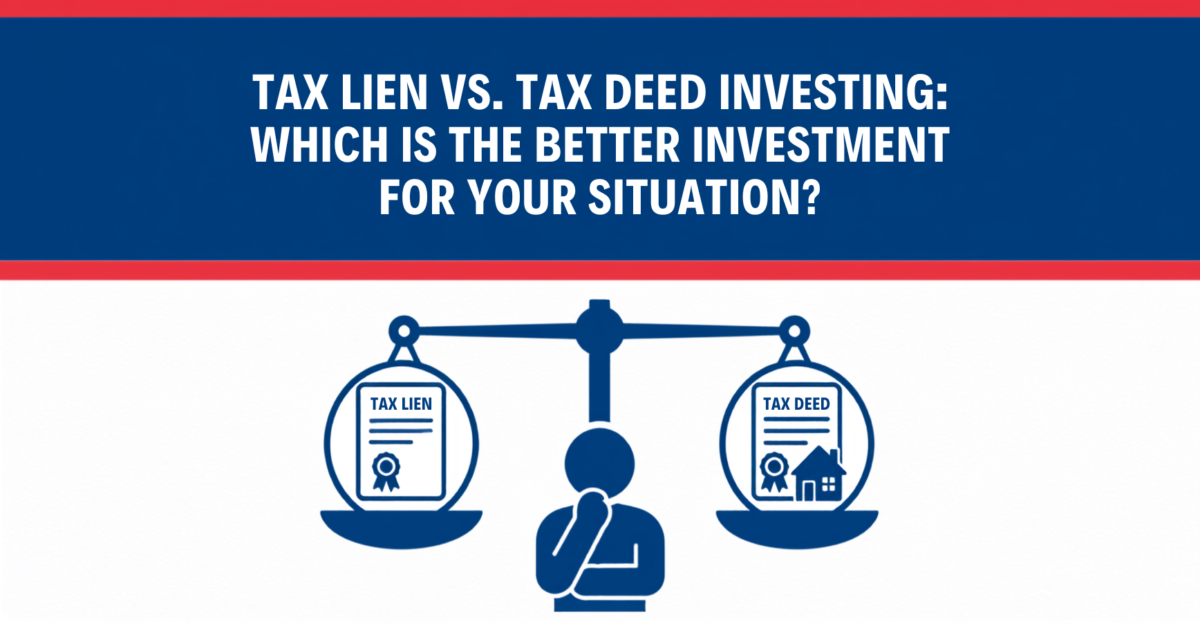
If you have spent any time researching delinquent property tax investing, you have almost certainly come across the terms tax lien states and tax deed states. These terms describe two fundamentally different systems that governments use to recover unpaid property taxes, and the investment model that flows from each one is equally different.

Many beginners assume these two paths are variations of the same strategy. They are not. Buying a tax lien certificate is a debt-based investment that generates interest income. Buying a tax deed means you are acquiring direct ownership of a property. The capital requirements, risk profiles, due diligence processes, and exit strategies are distinct enough that confusing the two before your first auction can lead to costly mistakes.

This guide explains both systems clearly, compares them across every dimension that matters to investors, and helps you determine which path fits your goals. If you want to explore what structured tax lien investing looks like in practice before reading further, the team at United Tax Liens works specifically with investors in the tax lien certificate model.

What Are Tax Lien States?

In a tax lien state, when a property owner fails to pay their property taxes, the local government does not immediately take the property. Instead, it places a legal claim against it called a tax lien and sells that claim to private investors at a public auction.

The investor pays the outstanding tax debt to the government and receives a tax lien certificate in return. That certificate entitles the investor to collect the original tax amount plus interest and penalties when the property owner eventually repays the debt. The property owner retains ownership during this period and has a legally defined window of time called the redemption period to pay back what is owed.

If the owner fails to repay within the redemption period, the certificate holder may gain the right to initiate foreclosure proceedings and potentially acquire the property through a legal process. However, the primary investment thesis in tax lien states is interest income, not property acquisition. Most certificates redeem without ever reaching foreclosure.

How the Tax Lien Certificate Model Works

The mechanics of tax lien investing follow a structured sequence that is consistent across most tax lien states, with variation in specific rates, timelines, and auction formats.

  • Property owner fails to pay property taxes by the due date
  • Local government records a tax lien against the property
  • County schedules a public auction to sell the lien to investors
  • Investor purchases the certificate by paying the outstanding tax debt
  • Investor earns interest at the state-defined rate during the redemption period
  • Property owner repays the debt and the investor receives principal plus interest
  • If the owner does not pay, the investor may pursue foreclosure rights

This model is what platforms like United Tax Liens are built around — helping investors participate in the certificate market with structured research, coaching, and operational support.

Key Characteristics of Tax Lien States

  • Investor purchases a debt claim, not the property itself
  • Returns are generated through interest and penalties during the redemption period
  • Capital requirements are typically lower than direct property acquisition
  • No property management responsibilities during the certificate holding period
  • Foreclosure is a possible but secondary outcome, not the primary investment goal

Primary tax lien states include Arizona, Florida, Illinois, New Jersey, Indiana, Iowa, Colorado, Maryland, Nebraska, and several others. For a full breakdown of which states operate this way, the United Tax Liens blog covers state classification in detail.

What Are Tax Deed States?

In a tax deed state, the government takes a more direct approach to recovering unpaid property taxes. Instead of selling the debt to investors, the government waits until the delinquency reaches a legal threshold, seizes the property from the owner, and then auctions the property itself to the highest bidder.

The investor in a tax deed state is buying the property outright, not a certificate against it. This means the investment requires significantly more capital, involves direct real estate ownership from day one, and carries a completely different due diligence burden. There is no redemption period in the traditional sense — once the deed is transferred, the original owner typically has limited or no recourse.

How Tax Deed Sales Work

The tax deed process follows a different sequence from the lien model, and the investor's role in that process is fundamentally different.

  • Property owner fails to pay property taxes for an extended delinquency period
  • Government initiates a legal process to seize the property
  • County schedules a tax deed auction for the seized property
  • Investors bid on the property itself, with the highest bid winning
  • Winning bidder receives a tax deed transferring ownership of the property
  • Investor now owns the property and must manage, sell, or develop it

The investor in a tax deed auction is making a real estate acquisition decision, not a debt investment decision. The research required, the capital deployed, and the post-purchase responsibilities are all significantly more complex than holding a tax lien certificate.

Key Characteristics of Tax Deed States

  • Investor purchases the property directly at auction
  • Returns come from resale, rental income, or property development
  • Capital requirements are substantially higher than tax lien certificate investing
  • Immediate property management or disposition responsibility upon winning
  • Title issues and property condition risks are absorbed by the buyer

Primary tax deed states include California, Michigan, Minnesota, Nevada, New York, Oregon, Washington, and Wisconsin, among others. Some of these states conduct what are called over-the-counter sales for properties that did not sell at auction, which can offer additional acquisition opportunities for real estate investors.

Not sure which investment model fits your situation? Talk to a United Tax Liens coach to get a direct answer based on your goals, capital, and timeline.

Hybrid States: Redeemable Tax Deeds

A third category exists that many investors overlook: states that use a hybrid system called redeemable tax deeds. These states combine elements of both the lien and deed models in a way that creates a distinct investment dynamic.

In a redeemable deed state, the investor purchases a deed to the property at auction — similar to a tax deed state — but the original property owner retains the right to reclaim the property within a defined redemption period by paying the purchase price plus a penalty or premium. This redemption right means the investor does not immediately have full, unchallenged ownership.

How Redeemable Deed States Work

The process in a redeemable deed state sits between a pure lien state and a pure deed state.

  • Government auctions the property after a delinquency period
  • Investor wins the auction and receives a deed to the property
  • Original owner has a redemption window — typically six months to two years — to buy back the property
  • If the owner redeems, the investor receives their purchase price plus the redemption penalty
  • If the owner does not redeem, the investor retains full ownership of the property

Georgia and Texas are the two most prominent redeemable deed states. Georgia has a one-year redemption period with a 20% premium penalty. Texas has a redemption period that varies by property type with penalties that can reach 25% or more.

What Makes Redeemable Deeds Different from Both Systems

Redeemable deeds carry more risk than pure tax lien certificates because the investor is taking on a form of property ownership from the moment of purchase. Title issues, property condition problems, and encumbrances can all affect the investment in ways that a simple certificate would not. At the same time, the penalty-based return structure can generate attractive short-term returns if the owner redeems quickly.

Investors interested in redeemable deed markets should approach them with the due diligence standards of real estate acquisition, not the lighter research burden appropriate for certificate investing. The Tax Lien Wealth Builders blog covers the strategic differences between certificate and deed investing for investors who want to understand both models before choosing.

Tax Lien vs Tax Deed: A Direct Comparison

The following comparison covers every dimension that matters to investors evaluating these two systems. Understanding each factor helps you make a decision based on your actual situation, not on which name sounds more appealing.

Capital Requirements

Tax lien certificates can often be purchased for a few hundred dollars in lower-value markets, and even certificates in mid-range counties rarely require the same upfront capital as purchasing a property outright. The entry point for tax deed investing is the property's auction price, which typically reflects a discount to market value but still requires significantly more capital per investment.

For investors with limited starting capital who want to diversify across multiple positions, the tax lien certificate model offers a much lower barrier to entry. United Tax Liens works with investors across different capital levels and can help structure a realistic starting portfolio.

Risk Profile

Tax lien certificates carry risk primarily around property quality and legal compliance. If the property underlying a certificate is worthless — a condemned structure, a landlocked lot, a property with environmental contamination — and the owner never redeems, the investor may end up holding a certificate against an asset that produces no recovery value even after foreclosure.

Tax deed investing carries all of those risks plus the additional complexity of direct ownership: title defects that survive the tax sale, property condition issues, existing occupants who may need to be evicted, and carrying costs during the period before resale or development. The due diligence burden in a tax deed state is substantially higher.

Return Structure

Tax lien certificates generate returns through interest payments at state-regulated rates, typically ranging from 8% to 36% annually depending on the state and auction outcome. The return is predictable in structure even if variable in rate.

Tax deed investing generates returns through property resale, rental income, or development. The upside can be higher than certificate interest rates in the right market, but the variability is also much greater. A property purchased at a tax deed auction may need significant rehabilitation before it can be sold or rented, which adds cost and time to the return equation.

Investors who want the predictability of interest-based returns with government-backed legal structure generally prefer the tax lien model. Those who are comfortable with direct real estate ownership and the associated complexity may find tax deed opportunities more suitable. The United Tax Liens services page outlines how the certificate model generates returns at each stage of the investment cycle.

Due Diligence Requirements

Research in both systems starts with the property, but the depth of investigation required differs significantly.

For tax lien certificates, investors need to verify that the underlying property has enough value to justify the certificate cost if foreclosure becomes necessary. This means checking estimated market value, basic property condition, and the presence of any superior liens that would survive or complicate the investment. For most certificates that redeem normally, even modest due diligence is sufficient.

For tax deed purchases, the due diligence requirement is much closer to a full real estate acquisition. Investors need to assess title clarity, physical condition, existing occupants, zoning restrictions, environmental issues, and local market conditions for resale. Skipping any of these steps in a tax deed auction can mean inheriting major problems with the property.

Time Commitment

Holding a tax lien certificate is largely passive. Once the certificate is purchased and any required maintenance payments are made, the investor waits for redemption. There are no tenants to manage, no property maintenance to coordinate, and no active decisions to make until either the certificate redeems or the foreclosure process begins.

Tax deed ownership is active from day one. The investor either needs to manage the property, coordinate rehabilitation, or list it for resale — all of which require ongoing time and decision-making. This is a meaningful distinction for investors who are looking for passive income rather than another active real estate management responsibility.

For investors specifically looking for a more passive income structure, reading about how other investors have experienced the tax lien model can help set realistic expectations about the actual time commitment involved.

Legal Complexity

Both systems involve legal complexity, but of different kinds. Tax lien certificate investing requires understanding and complying with state-specific rules around notice requirements, certificate maintenance, and foreclosure procedures. Getting these wrong can cost you the certificate or the foreclosure right.

Tax deed investing introduces additional legal risks around title. Properties sold at tax deed auctions are often sold with a tax deed rather than a warranty deed, which means the government is not guaranteeing the title is clean. Investors may discover after purchase that the property carries liens, judgments, or other encumbrances that were not extinguished by the tax sale. Title insurance is often unavailable or limited for tax deed purchases, adding to the legal risk.

The United Tax Liens coaching team helps investors understand the specific legal requirements in their target states so compliance errors do not undermine otherwise sound investments.

Want to understand the legal requirements in your target state before you invest? Explore the United Tax Liens services page to see how structured support helps investors stay compliant from day one.

Which System Is Right for You?

The answer depends on four things: your available capital, your risk tolerance, how much time you want to spend managing your investments, and what kind of return structure you are looking for.

Choose Tax Lien Investing If:

  • You are starting with limited capital and want to diversify across multiple positions
  • You want predictable, interest-based returns rather than variable real estate appreciation
  • You prefer a passive investment structure without property management responsibilities
  • You are new to real estate investing and want a lower-complexity entry point
  • You want government-backed legal structure protecting your investment position


The tax lien certificate model is designed specifically for investors who match this profile. United Tax Liens provides the research tools, coaching support, and structured guidance that helps investors in this category build a functioning portfolio without having to figure out everything independently.

Choose Tax Deed Investing If:

  • You have sufficient capital to purchase properties outright at auction prices
  • You have experience with real estate acquisition, rehabilitation, and resale
  • You are comfortable managing properties or coordinating with contractors and property managers
  • You are looking for equity upside rather than interest income
  • You have the capacity to conduct thorough title and property condition research before bidding

Tax deed investing is closer to traditional real estate acquisition than it is to the interest-income model of tax lien certificates. Investors who are already active in real estate and want to source discounted properties through the tax deed channel may find it complements their existing skill set. Tax Lien Wealth Builders offers educational resources that help investors understand both models before committing to either.

Consider Redeemable Deed States If:

  • You want the potential for property acquisition but with a defined redemption window that generates a return even without taking ownership
  • You are experienced with real estate due diligence and understand the title risks involved
  • You are targeting markets like Georgia or Texas where the redeemable deed model is well-established
  • You have the capital to purchase at auction and hold the property through the redemption period if needed

Redeemable deed states offer a middle path, but they require a more sophisticated investor who understands the nuances of both systems. The Tax Lien Wealth Builders services page includes resources on evaluating hybrid markets for investors who want to explore that option.

Common Misconceptions About Tax Lien and Tax Deed Investing

Misconception 1: Tax Lien Investing Guarantees You Will Get the Property

Most tax lien certificates redeem without ever reaching foreclosure. The majority of property owners pay their delinquent taxes before the redemption period expires. Investors who enter the tax lien market expecting to routinely acquire properties through foreclosure will often be disappointed. The primary return mechanism is interest income on the certificate, not property acquisition.

That said, foreclosure does happen when owners cannot or do not pay. Understanding the foreclosure process in your target state is important even if you never expect to use it. A United Tax Liens coach can walk you through exactly how foreclosure works in the states you are considering.

Misconception 2: Tax Deed Investing Is Always Cheaper Than Buying Normally

Tax deed auctions do sometimes produce properties at significant discounts to market value. But the discount has to be understood in context. Properties sold at tax deed auctions often have deferred maintenance, unclear title, or other issues that reduce their actual value. Competition at auction in popular markets can also drive prices close to or even above comparable retail values for desirable properties.

The discount at a tax deed auction is real in the right circumstances, but it is not guaranteed and it is not automatic. Thorough research before bidding is what separates investors who find genuine value from those who overpay for a problem property.

Misconception 3: You Can Ignore Due Diligence If the Price Is Low

This misconception affects both systems. In tax lien investing, a cheap certificate tied to a worthless property is still a bad investment. In tax deed investing, a low auction price does not compensate for a property with title defects, environmental issues, or structural problems that cost more to resolve than the discount provides.

Due diligence is not optional in either system. The United Tax Liens blog regularly publishes research frameworks that help investors evaluate properties before committing capital at auction.

Misconception 4: These Systems Are the Same Everywhere

State and county-level rules create enormous variation in how both systems actually operate. A Florida tax lien auction is conducted entirely online. An Illinois auction may require in-person attendance. A Georgia redeemable deed carries specific redemption penalties that differ from Texas. Treating any state's rules as interchangeable with another's is a reliable way to make compliance errors.

Always research the specific rules for each state and county you plan to invest in. Tax Lien Wealth Builders covers state-specific rules in its educational content for investors who want current, actionable information.

Getting Started: Practical Next Steps

Once you have decided which model fits your situation, the path to your first investment follows a consistent sequence regardless of which system you choose.

Step 1: Confirm Your State's Classification

Before researching counties or individual opportunities, verify that your target state is actually a tax lien state, a tax deed state, or a hybrid. This single step prevents wasted research effort and ensures you are using the right due diligence framework from the start. United Tax Liens provides state classification information as part of its investor onboarding resources.

Step 2: Learn the Specific Rules for Your Target State

Interest rates, redemption periods, auction formats, notice requirements, and foreclosure procedures all vary by state. Investing in a state you do not understand operationally is the most common source of avoidable losses in both tax lien and tax deed investing. Take the time to understand the rules before the auction, not after.

Step 3: Build a Property Research Process

Whether you are buying a certificate or a deed, the quality of your property research determines the quality of your outcomes. Develop a consistent checklist that covers property value, condition, title status, and any competing claims before you commit capital to any investment.

Investors who work with United Tax Liens get access to structured research frameworks that systematize this process and reduce the risk of missing critical information before a bid.

Step 4: Start Small and Build Experience

In tax lien investing, this means targeting smaller certificates in less competitive counties on your first few auctions. In tax deed investing, it means starting with lower-priced properties in markets you understand before scaling up. Experience in the auction environment itself is valuable and cannot be fully replicated through research alone.

Step 5: Connect With Structured Support

Both systems reward investors who have access to good information, legal guidance, and market knowledge. Going fully independent from day one is possible, but it extends the learning curve and increases the probability of early mistakes. Educational programs like Tax Lien Wealth Builders and platforms like United Tax Liens are designed to shorten that curve significantly.

Ready to move from research to your first investment? Visit the United Tax Liens services page to explore how structured coaching and research support helps investors get started with confidence.

Final Thoughts: Tax Lien vs Tax Deed

Tax lien states and tax deed states represent two different paths into the delinquent property tax investing space. They share a common origin — unpaid property taxes — but diverge significantly in what the investor actually buys, how returns are generated, and what risks are involved.

Tax lien certificate investing is a debt-based, interest-income model. It is more accessible, more passive, and lower in capital requirements than direct property acquisition. The legal framework is government-backed and the return structure is predictable. For investors who are new to real estate investing, looking for passive income, or working with limited starting capital, it is generally the more appropriate entry point.

Tax deed investing is a property acquisition model. It offers the potential for equity upside and significant discounts on real estate, but it requires more capital, more due diligence, more active management, and a higher tolerance for legal and property condition risk. It is better suited to investors who already have real estate experience and want to add a distressed property channel to an existing strategy.

Redeemable deed states occupy a middle ground that can work well for experienced investors who understand both models, but they are not the right starting point for beginners.

If the tax lien certificate model matches your goals, United Tax Liens is a platform built specifically to support investors in that space — from market selection through certificate management and beyond. For broader educational content on both systems, the Tax Lien Wealth Builders blog is one of the most comprehensive resources currently available for self-directed investors.

Take the next step toward your first tax lien investment. Contact the United Tax Liens team today and get personalized guidance on the market, strategy, and first steps that fit your situation.

Most tax lien investors think the hard part is buying the lien.

It’s not.

Best Systems for Tracking Tax Lien Redemptions

The real work—and where the money is either made or quietly lost—happens after the purchase. Because once you own a lien, you’re no longer just an investor. You’re now managing timelines, tracking money, and staying ahead of decisions that don’t always announce themselves.

And here’s the uncomfortable reality:
If you’re not tracking your liens intentionally, you’re probably missing something.

Not in an obvious, dramatic way. But in small, costly ways that compound over time.

When your portfolio is small, it’s easy to stay on top of things. One or two liens, maybe even five—you can remember details. You know roughly when they were purchased, what the interest rate is, and what you expect to happen.

But that simplicity doesn’t last.

As soon as you scale—even a little—you’re dealing with different counties, different timelines, and different rules. Some liens redeem quickly. Others sit for years. Some require additional payments to maintain your position. Others don’t. And suddenly, what felt manageable becomes fragmented.

That’s where most investors fall into trouble. Not because they don’t understand tax liens, but because they don’t have a clear system to see what’s happening.

Professional investors approach this differently.

They don’t rely on memory or scattered notes. They build visibility into their portfolio so they can answer simple but critical questions at any time: What’s active? What’s close to a decision point? Where is more money required? What has already paid off?

That clarity changes everything.

Because instead of reacting late, they act early. Instead of guessing, they know.

At the center of this is something deceptively simple: a tracking system.

Not a complicated one. Not expensive software. Just a structured way to organize what matters.

Every lien you own represents a timeline. It has a beginning—the day you purchased it—and a potential end, whether that’s redemption or foreclosure. In between, interest accrues, deadlines approach, and in some cases, additional taxes must be paid to protect your position.

If you’re not actively watching that timeline, it’s easy to miss key moments.

For example, some states require you to pay subsequent taxes to maintain your lien position. If you don’t, your lien can be resold, effectively erasing your investment advantage.

That’s not a complicated mistake. It’s a tracking mistake.

The same goes for redemptions themselves.

Investors often assume they’ll automatically know when a lien redeems and exactly what they’re owed. But depending on the county, the process isn’t always that clean. Payments can come in, interest calculations can vary, and without your own records, you’re relying entirely on someone else’s system to be perfect.

Experienced investors don’t do that.

They maintain their own numbers—what they invested, what they expect back, and when it should happen. Not because they don’t trust the system, but because they understand that clarity equals control.

What’s interesting is that once you start tracking properly, something shifts.

You begin to see your portfolio differently.

Instead of a collection of random liens, it becomes a structured set of positions—each with its own timeline, return profile, and next action. You start noticing patterns. Which liens redeem quickly. Which ones drag out. Which types of properties behave in predictable ways.

And that insight feeds better decisions going forward.

There’s also a psychological benefit that doesn’t get talked about enough.

Untracked investments create low-level stress. You’re always wondering if you’re missing something. If a deadline is approaching. If a payment came through. If you forgot to act somewhere.

But when everything is clearly laid out—even in something as simple as a spreadsheet—that uncertainty disappears.

You know where you stand.

And in investing, that kind of clarity is incredibly valuable.

None of this requires anything complicated.

A basic system that tracks your purchase details, timelines, total investment, and current status is more than enough to operate at a high level. The power isn’t in the tool—it’s in the consistency of using it.

Because the investors who do well long-term aren’t just good at finding deals.

They’re good at managing what happens after the deal.

At the end of the day, tax lien investing rewards patience, but it also rewards attention.

The money doesn’t just show up because you bought correctly. It shows up because you stayed engaged, monitored your positions, and acted when needed.

And that brings us back to the principle that separates amateurs from professionals:

You only collect what you intentionally monitor.

This blog is for informational purposes only and should not be relied upon as financial or investment advice. Real estate investing carries risks, and individual results will vary. Always consult with your team of professionals before making investment decisions. The authors and distributors of this material are not liable for any losses or damages that may occur as a result of relying on this information.

Emotional discipline in investing is what separates successful investors from those who constantly chase bad deals. In real estate—especially tax lien investing—emotions like fear, greed, and impatience can quietly destroy your returns. In this article, you’ll learn how mastering emotional discipline leads to smarter decisions and long-term success.

Most investors spend years trying to find better deals.

Better markets.
Better data.
Better strategies.

But the uncomfortable truth is this:

Your results are usually capped by your behavior—not your knowledge.

Two investors can look at the exact same deal and walk away with completely different outcomes. Not because one is smarter—but because one stayed disciplined while the other didn’t.

The Deal You Shouldn’t Have Won

Almost every investor has a story like this.

You went into an auction, negotiation, or offer situation with a clear plan:

  • A max bid
  • A target return
  • A defined exit

And then… something shifted.

Another bidder pushed higher.
The agent said there were multiple offers.
You felt that subtle pressure: “Just a little more…”

So you stretched.

And maybe you won.

But winning didn’t feel like winning—it felt like relief.

That’s the moment emotional investing sneaks in. Not when you lose control completely—but when you slightly bend your rules.

And those small bends? They’re expensive.

Discipline Isn’t About Being Cold—It’s About Being Consistent

There’s a misconception that emotional discipline means removing all feeling.

It doesn’t.

It means not letting temporary emotions override long-term standards.

A disciplined investor still feels:

  • Excitement when a deal looks good
  • Frustration when they lose
  • Doubt when things take longer than expected

The difference is they don’t act on those feelings impulsively.

They rely on:

  • Predefined criteria
  • Numbers that don’t change mid-deal
  • Processes they trust

Because in real estate, consistency beats intensity every time.

Where Investors Actually Lose Money

Not in obvious ways.

It’s rarely the deal that blows up overnight.
It’s the slow erosion of discipline across multiple decisions:

  • Paying a little too much
  • Skipping one layer of due diligence
  • Assuming “it’ll probably be fine”
  • Delaying a tough decision

Each one seems harmless.

But stacked together, they quietly destroy returns.

And here’s the part most people miss:

You don’t notice it happening until the numbers force you to.

The Power of Sitting Out

One of the hardest skills to develop in real estate is doing nothing.

  • Not bidding.
  • Not chasing.
  • Not forcing a deal.

Because inactivity feels like falling behind.

But disciplined investors understand something counterintuitive:

The deals you don’t do often matter more than the ones you do.

They’re willing to:

  • Let others overpay
  • Walk away from “almost good” deals
  • Wait longer than feels comfortable

And when the right opportunity shows up—they’re ready.

Emotional Discipline Compounds

Just like money, discipline compounds over time.

When you consistently:

  • Stick to your numbers
  • Follow your process
  • Avoid reaction-based decisions

You start to see patterns:

  • Better deal selection
  • Fewer surprises
  • More predictable outcomes

It’s not flashy.
It doesn’t make for great stories.

But it builds something far more valuable:

Reliability in your results.

The Real Edge Most Investors Ignore

Everyone is looking for an edge:

  • Better data
  • Better tools
  • Better markets

But those advantages are accessible to almost everyone now.

What’s not?

Emotional control under pressure.

That’s the separator.

Because when things get competitive, uncertain, or stressful:

Most investors tighten up or chase
A few stay steady

And over time, those small differences create massive gaps in performance.

Final Thought

You don’t need to outsmart the market to win in real estate.

You need to out-discipline it.

Because while strategies change and markets shift, one thing stays constant:

The investor who can stay calm, consistent, and controlled will always outperform the one who can’t.

This blog is for informational purposes only and should not be relied upon as financial or investment advice. Real estate investing carries risks, and individual results will vary. Always consult with your team of professionals before making investment decisions. The authors and distributors of this material are not liable for any losses or damages that may occur as a result of relying on this information.

Believing myths is one of the fastest ways to lose money in tax lien investing.

It’s a space filled with half-truths, outdated advice, and “guru” promises that make it sound far easier—and safer—than it really is. The reality? Tax lien investing can be incredibly profitable, but only if you understand how it actually works.

Let’s break down the most common tax lien myths and replace them with the facts that serious investors rely on.

Myth #1: “Tax Liens Are Guaranteed, Risk-Free Investments”

The Truth: There is no such thing as a risk-free investment.

Yes, tax liens are often marketed as “safe” because they’re backed by real estate. But that doesn’t mean every lien is a good deal.

Here’s what can go wrong:

The property could be worthless (think swampland or landlocked parcels)
The owner may redeem quickly, limiting your return
You may never reach foreclosure
You could overpay or bid your return down to near zero

Even experienced investors stress due diligence—looking at property value, location, and tax payment history—before bidding.

👉 Bottom line: Tax liens are secured, not guaranteed. There’s a big difference.

Myth #2: “You Always Get High Interest Rates”

The Truth: You can get high rates—but you often won’t.

Many states advertise rates like 16%, 18%, or even higher. But in competitive auctions, those rates are often bid down.

For example:

Investors compete by lowering the interest rate they’ll accept
Winning bids can drop to single digits—or even 0% in some cases

Why would anyone accept 0%?

Because experienced investors aren’t just chasing interest—they’re targeting the property itself.

👉 Bottom line: The advertised rate is the ceiling, not the reality.

Myth #3: “You’ll Easily Get Properties for Pennies”

The Truth: Most liens never turn into properties.

This is one of the biggest misconceptions.

In reality:

The majority of property owners redeem (pay back the taxes)
Only a small percentage of liens ever reach foreclosure (often just a few percent)

That means:

Most of your investments will return interest, not property
You need volume and strategy to hit those rare deals

👉 Bottom line: Getting property is possible—but it’s not the norm.

Myth #4: “You Don’t Need Much Money to Start”

The Truth: You can start small—but scaling requires capital.

It’s true—you can buy tax liens for relatively low amounts. Some investors even start with under $100 per lien.

But here’s what beginners overlook:

You may need to pay subsequent taxes to maintain your position
Legal costs (especially foreclosure) can run thousands
Building a portfolio requires multiple liens

As one investor example shows, a small lien can grow into a larger investment over time due to ongoing tax payments.

👉 Bottom line: Entry is accessible—but serious returns require capital.

Myth #5: “All Tax Liens Are Good Deals”

The Truth: Many liens are bad—and some are terrible.

Not all properties are created equal.

Common pitfalls include:

Vacant land with no access
Properties with environmental issues
Homes in undesirable or declining areas
Owners who consistently redeem late (killing your foreclosure chances)

One of the most valuable insights from experienced investors:

Tax payment history is one of the strongest indicators of what will happen next.

👉 Bottom line: The lien is only as good as the property behind it.

Myth #6: “Foreclosure Is Simple and Cheap”

The Truth: It’s often complex, time-consuming, and expensive.

If you make it to foreclosure:

You’ll likely need an attorney
The process can take months
Costs can reach $3,000+ depending on complexity

There’s also a learning curve—understanding title issues, legal notices, and court procedures is essential.

👉 Bottom line: Foreclosure is where profits are made—but also where mistakes get expensive.

Myth #7: “Tax Lien Investing Is Passive Income”

The Truth: It’s only passive after you do the work.

Before you ever earn a return, you need to:

Research properties
Analyze payment history
Understand local laws
Monitor deadlines and subsequent taxes

Even after buying:

You must track redemptions
Stay on top of required payments
Plan your exit strategy

👉 Bottom line: It can become passive—but only after active, informed decisions.

Final Thoughts: Why These Myths Matter

Believing these myths doesn’t just lead to disappointment—it can lead to real financial loss.

Successful tax lien investors think differently:

They treat it like a business, not a shortcut
They focus on data and due diligence, not hype
They understand that strategy beats luck

If you take away one thing from this:

The biggest risk in tax lien investing isn’t the market—it’s misinformation.

This blog is for informational purposes only and should not be relied upon as financial or investment advice. Real estate investing carries risks, and individual results will vary. Always consult with your team of professionals before making investment decisions. The authors and distributors of this material are not liable for any losses or damages that may occur as a result of relying on this information.

Not every tax lien state is created equal. The difference between a market that generates consistent, predictable returns and one that ties up your capital with minimal upside often comes down to a handful of factors: interest rate structure, redemption period length, auction competition, and legal clarity.

This guide ranks and evaluates the best tax lien states based on those factors. It is written for investors who already understand the basics of how tax lien certificates work and want an opinionated, practical breakdown of where to put their money and why. If you are newer to the model and want a foundational overview first, the team at United Tax Liens has resources designed for investors at every stage.

The goal here is not to list every state alphabetically. It is to give you a strategic framework for comparing markets and making a confident decision about where to start or where to expand.</span>

How to Define the Best Tax Lien States

Investors often default to chasing the highest interest rate ceiling when evaluating tax lien states. That instinct is understandable but incomplete. A state with a 36% ceiling can produce lower actual returns than a state with a 16% ceiling if competition is intense, auctions are poorly organized, or the legal foreclosure process is complicated enough to make enforcement expensive.</span>

The best tax lien states for a given investor depend on four variables working together.

Variable 1: Effective Interest Rate After Auction Dynamics

The legal maximum interest rate tells you the ceiling, not the floor. In bid-down interest states, investors compete by offering lower and lower rates until one bidder accepts the least. In heavily traded counties, this can push returns well below the state maximum. In premium bidding states, the upfront cost of the premium directly reduces your effective return.

The best markets are ones where the actual rates achieved at auction remain meaningful after competitive pressure. This usually means either targeting less saturated counties within a high-rate state or finding states where institutional competition is lower. The United Tax Liens services page breaks down how auction dynamics affect investor returns across different market types.

Variable 2: Redemption Period and Capital Efficiency

style=”font-weight: 400;”>A longer redemption period means more interest accrues on your certificate, but it also means your capital is locked up for a longer time. A shorter redemption period gives you faster liquidity and the ability to redeploy capital into new certificates, but limits total interest income on any single investment.</span>

The right redemption timeline depends on your investment goals. Investors building passive income over the long term may prefer states with two to three year periods. Investors focused on capital velocity and rapid portfolio growth may prefer states with one year or shorter timelines.

Variable 3: Legal Clarity and Foreclosure Path

If a property owner never pays, the investor has the legal right to pursue foreclosure in most tax lien states. But the path to get there varies dramatically. Some states have a relatively streamlined process. Others require multiple court filings, attorney involvement, extended waiting periods, and strict notice requirements that can stretch the timeline by years.</span>

Investors who plan to rely on foreclosure as part of their strategy need to understand this path before they bid. The United Tax Liens coaching program helps investors map out the legal path for their target states before committing capital.

Variable 4: Market Access and Auction Infrastructure

Some states have fully migrated to online auction platforms, making it possible to participate in multiple counties from anywhere in the country. Others still require in-person attendance, limiting access for remote investors. The quality of publicly available data, the reliability of auction schedules, and the ease of registration all affect how efficiently an investor can operate in a given market.</span>

Want guidance on selecting the right market for your situation? Connect with a United Tax Liens coach to get a personalized market recommendation based on your goals, budget, and timeline.

The Best Tax Lien States Ranked by Investor Profile

Rather than ranking states purely by interest rate, this section evaluates the top markets based on which type of investor each state best serves. The United Tax Liens blog covers individual state guides in more detail for investors who want to go deeper on specific markets.</span>

Best for Beginners: Arizona

Arizona consistently earns its reputation as the most beginner-friendly tax lien state in the country. The interest rate ceiling is 16%, which is competitive without being driven primarily by speculative bidding. The auction process is organized at the county level with clear procedures, transparent lien listings, and predictable schedules.

The three-year redemption period gives investors time to earn interest without the uncertainty of very long holding periods. The legal framework for foreclosure, while not the simplest in the country, is well-documented and manageable for investors who do their preparation.</span>

Why Arizona Works for New Investors

  • 16% maximum interest rate with less competitive bidding than larger markets
  • County-level auction organization is transparent and investor-accessible
  • Three-year redemption period balances liquidity with income potential
  • Strong inventory of residential and commercial liens across multiple counties
  • Legal framework is well-documented and foreclosure procedures are established

Investors who want to understand what starting in Arizona actually looks like in practice can read real investor experiences from people who have gone through the process.</span>

Best for Online Access: Florida</h3>

Florida is the most accessible tax lien state for remote investors. The majority of Florida counties have migrated to fully online auction systems, which means an investor in another s

tate or country can register, research, bid, and manage certificates entirely through digital platforms.</span>

The interest ra

te ceiling is 18%, and the state has a well-established auction calendar with regular sale dates throughout the year. Florida's inventory is large, which means there are opportunities across a wide range of property types and price points.

Florida's Key Advantages

  • Fully online auctions in most counties eliminates travel requirements
  • 18% interest rate ceiling with a large, active market
  • Regular auction schedule provides consistent deal flow throughout the year
  • High inventory across residential, commercial, and vacant land categories
  • Redemption period of two years provides balanced timeline

The tradeoff in Florida is competition. The state's accessibility and reputation attract institutional investors and well-funded bidders who can bid rates down aggressively in high-visibility counties. Investors who target less prominent counties or specialize in specific property types often find better margins. The Tax Lien Wealth Builders blog covers county-level strategy in Florida for investors who want to go beyond the basics.

Best for High Rate Potential: Illinois

Illinois has the highest interest rate ceiling of any tax lien state in the country at up to 36%. The state uses a penalty-based system where the high rate is applied as a penalty on the delinquent tax amount rather than a simple annual interest structure. This creates the potential for very high returns on certificates that redeem within the first year.

The Cook County market, which includes Chicago, is large and active but draws significant institutional competition. Investors who target smaller downstate counties often find less competition and more predictable auction outcomes.

Understanding the Illinois Model

  • Up to 36% interest rate through a penalty structure applied to the tax amount
  • Two to three year redemption period in most counties
  • Bid-down interest auction format requires strategic bidding discipline
  • Cook County is the largest market but also the most competitive
  • Downstate counties offer less competition with smaller but more accessible deals

Illinois requires more strategic sophistication than Arizona or Florida, particularly around auction bidding and county selection. Investors who want structured guidance on approaching the Illinois market can explore the Tax Lien Wealth Builders services for educational resources built around high-rate markets.</span>

Best for Premium Bidding Strategy: New Jersey

style=”font-weight: 400;”>New Jersey operates on a premium bidding system, which works differently from bid-down interest states. Investors compete by offering the highest premium above the tax debt, and the interest rate is fixed by state law at up to 18%. The investor who pays the most above the owed amount wins the certificate.

What makes New Jersey distinctive is the subsequent lien feature. After winning a certificate, investors can pay future tax bills on the same property and add them to their certificate balance, compounding the total investment and the associated interest without competing at auction again.</span>

New Jersey Investor Considerations

  • Premium bidding format requires a different return calculation model
  • Subsequent lien rights allow investors to grow certificate value over time
  • Interest rate fixed at up to 18% regardless of bidding competition
  • Foreclosure process is well-established but requires strict legal compliance
  • Strong legal protections for certificate holders during the redemption period

New Jersey works best for investors who are comfortable with a more complex return model and who want to build larger positions in individual properties over time. United Tax Liens can connect investors with resources that explain how to model returns in premium bidding environments accurately.

Best for Less Competition: Iowa and Nebraska

Iowa and Nebraska are tax lien states that receive significantly less national investor attention than Florida, Illinois, or Arizona. This lower visibility translates into less auction competition, which can mean more opportunities to win certificates at favorable rates without aggressive bidding wars.</span>

Both states have straightforward auction processes, reasonable interest rate structures, and clear legal frameworks for certificate management. They are not glamorous markets, but for investors who prioritize consistent, predictable returns over high-rate potential, they are worth serious consideration.</span>

The United Tax Liens blog</a> includes educational content on evaluating less prominent markets and building a research process that works in lower-inventory states.</span>

Interested in a market that fits your specific investment profile? Explore the United Tax Liens services page to learn how structured investment support helps investors make confident market decisions.

Tax Lien Rates by State: Reading the Numbers Correctly

One of the most common mistakes new investors make is treating the legal maximum interest rate as the expected return. The gap between the ceiling and the actual outcome can be significant, and understanding why is essential before you evaluate any market.</span>

Why the Ceiling Is Not the Return

In a bid-down interest state like Illinois or Florida, every investor in the room is competing to win the same certificate. The bidding process starts at the legal maximum and investors successively offer lower rates. In a county with ten investors chasing the same lien, the winning rate might be 2% or 3% even in a state with an 18% ceiling.</span>

In a premium bidding state like New Jersey, the premium you pay is a sunk cost. If you pay $300 in premium to win a $1,000 certificate at 18% interest, your actual return on the $1,300 total investment is considerably lower than 18%.</span>

This is why experienced investors focus on effective yield — the actual return on total invested capital — rather than headline rate ceilings. The United Tax Liens coaching team helps investors build accurate return models before they participate in their first auction.

State Rate Comparison: What to Expect in Practice

Here is a realistic comparison of what investors typically experience in major tax lien states, accounting for auction competition:

  • Illinois: ceiling 36%, but competitive counties often see effective rates of 18% to 24% after bidding
  • Florida: ceiling 18%, competitive urban counties may yield 5% to 12% after bid-down; rural counties closer to ceiling
  • Arizona: ceiling 16%, moderate competition in most counties, effective rates often 10% to 14%
  • New Jersey: fixed rate up to 18%, but premium cost reduces effective yield depending on competition
  • Iowa and Nebraska: lower ceilings but less competition means effective rates closer to the legal maximum

The key insight here is that a market with a lower ceiling and less competition can outperform a market with a higher ceiling and intense bidding. Tax Lien Wealth Builders teaches investors how to evaluate markets based on effective yield rather than headline rates.

The Role of Redemption Speed in Total Return

How quickly a property owner redeems the lien also affects your annualized return. If a certificate redeems in three months on a state with a 16% annual rate, your annualized return on that certificate is effectively 16%, but your actual dollar income is only four percent of the face amount — because you only held it for a quarter of the year.</span>

Conversely, a certificate that holds for the full two or three year redemption period generates the maximum total interest, but your capital is committed for the entire duration. Understanding this tradeoff is essential to planning your portfolio strategy. The United Tax Liens services page includes guidance on how to balance rate, term, and capital velocity across a tax lien portfolio.</span>

State-Specific Rules Every Investor Should Know

Beyond rate and competition, each tax lien state has specific procedural rules that affect how investors operate. These are not details you can skip.

Auction Registration Requirements

Most counties require investors to pre-register before participating in an auction. Registration requirements vary by county and state but often include government-issued identification, a signed bidder agreement, and in some cases a refundable deposit to demonstrate financial capacity. Missing a registration deadline means missing the auction entirely.

Certificate Maintenance Obligations

In many states, investors have ongoing obligations after winning a certificate. These can include paying subsequent tax bills to protect the lien position, filing specific notices within defined timeframes, and maintaining documentation that proves the certificate was properly purchased and maintained. Failure to meet these obligations can invalidate the certificate.

This is one of the areas where working with a structured program like United Tax Liens provides real operational value — investors get support on the administrative and compliance side, not just the bidding process.</span>

Foreclosure Notice and Filing Requirements

If you ever need to foreclose on a property tied to a non-redeeming certificate, every state has its own notice requirements. These typically include sending formal notice to the property owner by certified mail, publishing notice in a local newspaper, and filing specific legal documents within defined windows. Missing any step can restart the clock or void the foreclosure entirely.

Investors who plan to foreclose in any state should consult with a local attorney who specializes in tax lien foreclosures before initiating any action. The United Tax Liens team can provide referrals to state-specific legal resources as part of its investor support network.

Certificate Transferability

In some states, tax lien certificates can be transferred or sold to other investors before the redemption period ends. This creates a secondary market that gives investors more exit options if they need liquidity before the certificate redeems. In other states, certificates are non-transferable and must be held until redemption or foreclosure. Knowing the transferability rules in your target state affects how you plan your liquidity strategy.

For a breakdown of transferability rules by state, the Tax Lien Wealth Builders blog is a useful ongoing reference as rules can change with state legislation.</span>

Before you bid in any state, make sure you understand the rules. Read real investor stories on the UTL testimonials page to see how preparation affects outcomes.

Building a Multi-State Tax Lien Portfolio

Many experienced tax lien investors do not limit themselves to a single state. Building positions across multiple markets reduces dependence on any one auction calendar, spreads risk across different property types and economic conditions, and allows investors to take advantage of different redemption timelines for more consistent cash flow.</span>

Why Multi-State Diversification Makes Sense

If you invest only in Florida and competition drives your effective rates down significantly one year, your entire portfolio suffers. If you hold certificates in Arizona, Florida, and Iowa simultaneously, the impact of any single market's competitive dynamics is contained to a portion of your total capital. United Tax Liens works with investors across multiple state markets and can help structure a diversified approach.

How to Sequence Market Entry

Most advisors recommend that investors master one market before expanding to others. Start with a single state. Learn the county-level dynamics, participate in multiple auctions, and build a track record of successful certificate management before adding complexity.

Arizona or Florida are common first markets because of their accessibility and well-documented processes. Once an investor is comfortable with the full cycle from research to redemption or foreclosure, adding a second market like Iowa or Nebraska for lower-competition exposure becomes a natural next step.</span>

The </span>Tax Lien Wealth Builders services page outlines a structured learning progression that mirrors this approach for investors who want an educational framework to follow.</span>

Managing Certificates Across Multiple States

Operating across multiple states requires disciplined record-keeping. Each certificate has its own redemption deadline, notice requirements, and certificate maintenance obligations. Investors managing more than a handful of certificates across different states need a system for tracking deadlines, documenting compliance, and managing the renewal of subsequent tax payments.</span>

This operational complexity is one reason many investors choose to work with a structured platform or coaching program rather than going fully independent. The United Tax Liens team provides ongoing operational support that becomes especially valuable as portfolio size grows.

Common Mistakes When Choosing a Tax Lien State

Choosing a state based on the wrong criteria is one of the most costly early mistakes in tax lien investing. Here are the patterns that consistently lead new investors into underperforming markets.

Chasing the Highest Rate Ceiling

As discussed earlier, the legal maximum rate is not the return. Investors who choose Illinois over Arizona purely because 36% sounds better than 16% without accounting for auction competition, bid-down dynamics, and market saturation often end up with lower effective returns than they would have achieved in a more accessible market.</span>

Ignoring County-Level Variation

Tax lien state rules are set at the state level, but auction dynamics are determined at the county level. A state like Florida contains everything from ultra-competitive Miami-Dade County to rural counties with minimal investor participation. Evaluating a state without drilling down to county-level data produces a distorted picture of actual opportunity.

The United Tax Liens blog regularly publishes county-level market analysis that helps investors identify where within a state the best opportunities exist.</span>

Underestimating Legal Complexity

Some investors choose states based on rate and access without fully understanding the foreclosure process or certificate maintenance requirements. When a property fails to redeem and the investor needs to act, discovering that the legal process is more complex or expensive than expected can turn a potentially profitable certificate into a break-even or losing position.</span>

Before entering any state, get specific answers to three questions: What are the notice requirements if I need to foreclose? How long does foreclosure take? What does it cost in legal fees? If you cannot answer those questions, you are not ready to invest in that state. A United Tax Liens coach can walk you through the answers for your target market.

Starting With Too Many States at Once

Spreading across five states simultaneously before understanding any of them deeply is a recipe for operational errors, missed deadlines, and avoidable losses. Discipline in market selection is as important as discipline in property research. Master one market, then expand.

Final Verdict: Where Should You Start?

If you are a new investor choosing your first tax lien state, the honest answer is that Arizona and Florida are the most defensible starting points for most people. Arizona for its legal clarity and manageable competition. Florida for its online accessibility and regular auction schedule.

The best tax lien state for you is not the one with the highest ceiling. It is the one that matches your capital, timeline, risk tolerance, and operational capacity. United Tax Liens is built around helping investors make that match correctly rather than chasing headline numbers.

style=”font-weight: 400;”>For ongoing education on market conditions, state-specific rules, and investment strategy, the Tax Lien Wealth Builders blog is one of the most consistently updated resources in the tax lien investing space.</span>

Ready to choose your market and build your first tax lien portfolio? Visit United Tax Liens to explore coaching options, investor resources, and structured support designed to help you invest with confidence from day one.</span>