If you are researching tax lien investing, one of the first things you need to understand is that not every state in the United States operates the same way. The rules, interest rates, redemption periods, and auction structures vary significantly depending on where you invest. Before you place a single bid, you need to know which states sell tax lien certificates, how each one works, and what that means for your returns.
This guide breaks down tax lien certificate states, explains how the system works, and gives you the information you need to choose your first market with confidence. If you want a broader introduction to how the investment model works before diving into state-by-state details, the team at United Tax Liens provides structured resources for investors at every level.
Understanding Tax Lien States vs. Tax Deed States
The United States is divided into three categories when it comes to how governments handle delinquent property taxes: tax lien states, tax deed states, and hybrid states that use elements of both systems. Understanding which category a state falls into is the starting point for any investor.
What Is a Tax Lien State?
In a tax lien state, when a property owner fails to pay their property taxes, the local government places a legal claim on the property and sells that claim to investors at a public auction. The investor pays the outstanding tax debt and in return receives a tax lien certificate that earns interest while the property owner works to repay the debt.
The investor does not take ownership of the property immediately. Instead, they hold the certificate during a legally defined redemption period and collect interest when the owner pays the debt back. If the owner never pays, the investor may eventually gain the right to foreclose. This is the core model that platforms like United Tax Liens are built around.
What Is a Tax Deed State?
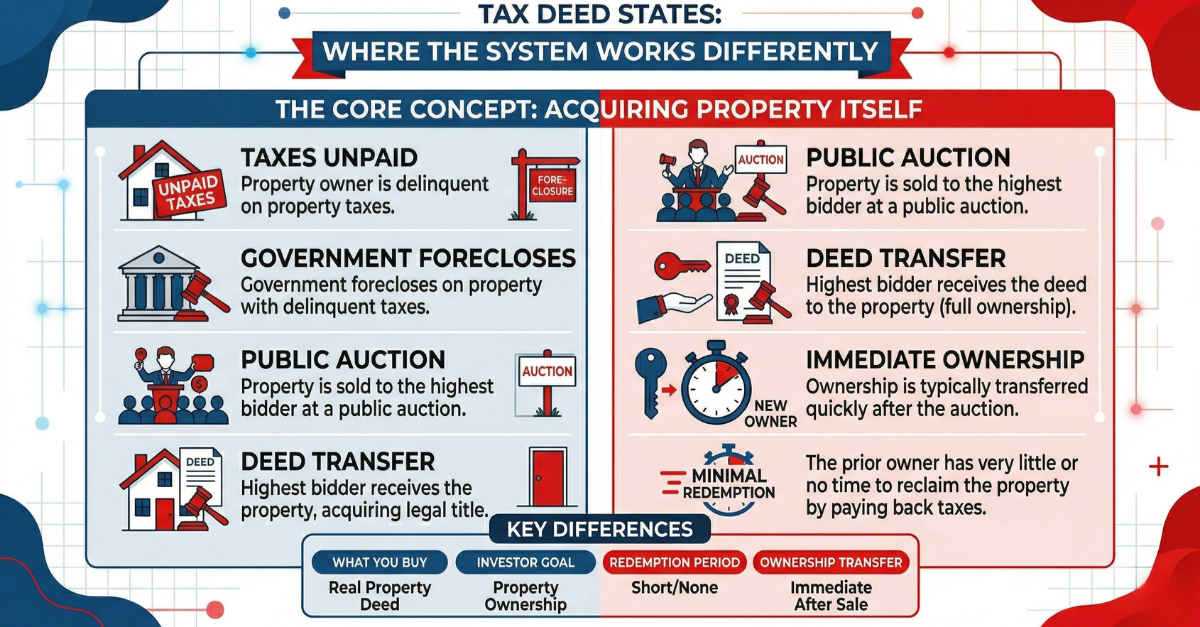
In a tax deed state, the government skips the certificate step. When property taxes go unpaid, the government eventually seizes the property and auctions it off directly. The investor buys the property itself rather than the debt claim. This is a fundamentally different investment model that involves more capital, more risk, and a different due diligence process.
Hybrid States: Tax Lien and Tax Deed Combined
Some states use a combination of both systems. These are commonly called redeemable deed states. The investor purchases a deed to the property, but the original owner still has a window of time to reclaim it by paying the debt plus penalties. Georgia and Texas are the most commonly cited examples of this hybrid approach.
Understanding whether you are looking at tax lien and tax deed states, or a pure version of either, directly affects how you should evaluate opportunities. The United Tax Liens blog covers these distinctions in detail for investors who want to go deeper.
The Complete List of Tax Lien Certificate States
The following states are classified as tax lien states where investors can purchase certificates at public auctions. Each state has its own rules for interest rates, redemption timelines, and auction formats.
Alabama
Alabama is a tax lien state with interest rates that can reach up to 12% annually. Auctions are held at the county level, and the redemption period is typically three years. The state offers a relatively accessible entry point for newer investors.
Arizona
Arizona is consistently ranked as one of the most investor-friendly tax lien states in the country. The state caps interest rates at 16% and runs well-organized county-level auctions. The redemption period is generally three years. The legal framework is clear, the auction process is transparent, and the market is large enough to find quality opportunities across multiple counties.
For investors looking to understand what structured investing in markets like Arizona actually looks like in practice, reading real investor testimonials can help set realistic expectations.
Colorado
Colorado uses a premium bidding system where investors compete by bidding a premium above the tax debt. The base interest rate is set by the state. Redemption periods vary by county, and the state has a strong legal framework for certificate holders. Colorado can be competitive in urban markets like Denver but less saturated in rural counties.
Florida
Florida is one of the most active tax lien certificate states in the country. Most counties conduct fully online auctions, making it accessible to remote investors across the United States. Interest rates can go up to 18%, and auctions are held on a regular and predictable schedule throughout the year.
The combination of high inventory, online access, and predictable processes makes Florida a popular starting market. The Tax Lien Wealth Builders services page includes educational content on navigating high-volume markets like Florida.
Illinois
Illinois stands out in the tax lien states list for its high interest rate ceiling. The state allows returns of up to 36% through a penalty-based system. The auction format in Illinois is bid-down interest, meaning investors compete by offering the lowest rate they are willing to accept.
Illinois redemption periods are typically two to three years. The high rate potential attracts competition, particularly in Cook County and the Chicago metro area. Investors who want to target Illinois markets benefit from education resources at Tax Lien Wealth Builders before placing bids in high-competition environments.
Indiana
Indiana holds its tax lien auctions annually in the fall. The state has a bid-down interest rate system with a ceiling of 10% to 15% depending on the year and county. Redemption periods are typically one year, which gives investors faster liquidity compared to states with longer timelines.
Iowa
Iowa is a tax lien state with a fixed interest rate structure. The state sets a maximum rate and auctions are conducted at the county level. Iowa tends to be less competitive than larger states like Florida or Illinois, which can benefit investors who do thorough research on rural markets.
Kentucky
Kentucky has a relatively straightforward tax lien process. The state conducts county-level auctions and offers redemption periods that typically extend to two to three years. Interest rates are competitive and the legal framework is well-defined.
Maryland
Maryland operates a competitive tax lien auction system with interest rates that vary by county. Baltimore City and Montgomery County tend to attract significant investor interest due to property values and inventory. The state has a redemption period of up to two years and requires careful legal compliance during the foreclosure process.
Mississippi
Mississippi is a tax lien state with auctions held annually at the county level. Interest rates and specific procedures vary by county, and redemption periods typically extend up to two years. The state is less commonly discussed in national investor circles, which can mean less competition in some markets.
Missouri
Missouri combines both tax lien and tax deed opportunities depending on the county. Some counties sell certificates while others move directly to tax deed sales. Investors need to understand the specific rules for each county they target.
Montana
Montana is a tax lien state with interest rates set at a flat percentage by the state. Auctions are held at the county level and the redemption period is typically five years, which is longer than most states. The extended timeline means more interest accrues, but capital is tied up for a longer period.
Nebraska
Nebraska conducts online auctions in most counties and offers a competitive interest rate structure. The redemption period is typically two to three years, and the state has a clear legal framework for certificate holders.
New Jersey
New Jersey uses a premium bidding auction system. Investors compete by offering the highest premium above the tax debt, and the interest rate is fixed by state law at up to 18%. New Jersey also allows what is called a subsequent lien, where the investor can pay future tax bills on the same property and add them to the certificate.
New Jersey has a strong foreclosure process for investors, but it requires strict legal compliance and attention to timelines. The United Tax Liens coaching program can help investors understand how to navigate complex state systems like New Jersey's.
North Dakota
North Dakota is a tax lien state with a straightforward auction process. The state has a redemption period of up to three years and offers predictable legal procedures for investors.
Ohio
Ohio auctions are held at the county level and vary in format across the state. Some counties use online platforms and some conduct in-person auctions. Interest rates and timelines vary by county, making research essential before committing capital.
Oklahoma
Oklahoma is a tax lien state with annual auctions. The state has a redemption period of two years and offers competitive interest rates. Oklahoma's markets tend to be less saturated than coastal states.
South Carolina
South Carolina is considered a hybrid state that leans toward the tax lien model. The state auctions delinquent tax obligations and provides a one-year redemption period. The high penalty rates can make South Carolina attractive to investors who want faster liquidity.
South Dakota
South Dakota holds annual tax lien auctions with interest rates that can reach competitive levels. The state has a relatively simple process and clear legal framework.
West Virginia
West Virginia conducts annual tax lien auctions with a redemption period that can extend to several years. The state has a mix of urban and rural markets, and research is essential to identify quality opportunities.
Wyoming
Wyoming is a tax lien state with a straightforward auction process. The state has a redemption period of four years and fixed interest rates, making it a longer-term investment market.
Ready to explore which tax lien markets are right for your investment goals? Contact a United Tax Liens coach to get personalized guidance based on your budget, timeline, and risk tolerance.
Tax Deed States: Where the System Works Differently
For completeness, it is worth knowing which states do not sell tax lien certificates and instead conduct tax deed sales. In these states, investors buy the actual property rather than the debt certificate.
States That Use Tax Deed Auctions
The following states are primarily tax deed states: Alaska, Arkansas, California, Georgia (redeemable deed), Hawaii, Idaho, Kansas, Maine, Michigan, Minnesota, Nevada, New Mexico, New York, North Carolina, Oregon, Pennsylvania, Tennessee, Texas (redeemable deed), Utah, Virginia, Washington, and Wisconsin.
If you are specifically interested in tax lien certificate investing rather than property acquisition, these states are generally outside the scope of your strategy. The United Tax Liens blog breaks down the distinctions between these systems in more detail.
Why the Distinction Matters for Investors
Many beginner investors search for tax lien states list resources without realizing that the state they are interested in may actually be a tax deed state. Getting this wrong before your first auction can mean researching properties, registering for auctions, and investing time in a market that does not match your investment model.
Before committing to any market, verify the classification directly through the county tax office or with an educational resource like Tax Lien Wealth Builders, which covers state-by-state rules as part of its investor education system.
How to Evaluate Tax Lien States as an Investor
Once you know which states sell tax lien certificates, the next step is evaluating which ones are the right fit for your investment strategy. Not every tax lien state is equally accessible, competitive, or profitable for every type of investor.
Interest Rate Ceilings
Interest rate ceilings vary significantly across tax lien certificate states. Illinois tops the list at 36%, while states like Wyoming and Indiana sit closer to 10% to 15%. However, a higher rate ceiling does not automatically mean higher returns. In highly competitive markets, bid-down auctions often push actual rates far below the legal maximum.
Investors who want to understand the relationship between rate ceilings and actual auction outcomes should explore educational resources at United Tax Liens before selecting a primary market.
Redemption Period Length
Redemption periods determine how long your capital is tied up before you receive repayment. Montana has one of the longest at five years, while Indiana and South Carolina offer shorter timelines closer to one year. The right redemption period depends on your liquidity needs and how quickly you want to recycle capital into new investments.
Auction Format: Bid-Down vs. Premium Bidding
Tax lien states use two primary auction formats. In bid-down interest states like Illinois and Florida, investors compete by offering the lowest interest rate they are willing to accept. In premium bidding states like New Jersey and Colorado, investors compete by offering the most money above the tax amount owed.
Each format affects your return calculation differently. The United Tax Liens services page outlines how these auction dynamics affect investment outcomes for different types of investors.
Market Competition Levels
Some tax lien states, particularly Florida and Illinois, attract institutional investors and well-funded bidders who drive competition in major counties. This competition reduces returns for individual investors who do not have strategies to compete effectively. States with less national visibility can offer better opportunities for self-directed investors who do their research.
Legal Complexity and Foreclosure Procedures
If a property owner never redeems the lien, the investor may need to initiate foreclosure proceedings to claim the property. The legal process for doing this varies enormously by state. Some states have streamlined procedures, while others require court filings, waiting periods, and attorney involvement that can take years.
Understanding the foreclosure path in your target state before you bid is not optional. The team at United Tax Liens can connect investors with resources that clarify the legal process for different markets.
Not sure which state fits your situation? Browse the United Tax Liens services page to learn more about how structured investment guidance works.
Tax Lien Rates by State: What the Numbers Actually Mean
One of the most searched topics in tax lien investing is tax lien rates by state. Investors naturally want to know where the highest returns are available. But the interest rate ceiling is only one part of the return equation.
The Gap Between Legal Maximum and Actual Auction Rate
In a bid-down interest state, the legal maximum is the starting point, not the outcome. If twenty investors are competing for the same certificate in a Florida county, the rate will be bid down far below the 18% maximum. The actual rate achieved depends on how many investors are competing and how aggressively they bid.
In premium bidding states, the premium paid at auction is a direct cost that reduces your effective return. If you pay a $500 premium on a $2,000 lien at a fixed 18% interest rate, your actual return on invested capital is lower than the stated rate suggests.
State Interest Rate Summary
Here is a practical overview of interest rate ceilings across major tax lien certificate states:
- Illinois: up to 36% (penalty-based)
- Florida: up to 18%
- New Jersey: up to 18%
- Arizona: up to 16%
- Indiana: up to 15%
- Colorado: state-set base rate plus auction dynamics
- Montana: fixed state rate over a four to five year period
- Iowa: fixed rate with county-level variation
For current and verified rate information by state, the Tax Lien Wealth Builders blog publishes updated state-by-state breakdowns for active investors.
Factoring In Time and Liquidity
A 36% rate over three years on a small lien may produce a smaller total dollar return than a 16% rate that redeems in six months on a larger certificate. When evaluating tax lien rates by state, always calculate the total return on invested capital over the actual expected timeline, not just the annual rate ceiling.
Practical Steps for Getting Started in a Tax Lien State
Once you have identified target states, the path from research to first investment involves several practical steps that every new investor should understand before participating in their first auction.
Step 1: Verify the State Classification
Confirm that your target state is a tax lien state before investing any time in county-level research. State classifications can be confirmed through the county tax assessor or treasurer office website, or through investor education platforms like United Tax Liens.
Step 2: Research County-Level Rules
Even within a tax lien state, rules vary by county. Some counties within the same state may run online auctions while others require in-person attendance. Registration requirements, deposit amounts, and auction schedules all vary. Contact each target county directly or use platforms that aggregate this information.
Step 3: Analyze Individual Properties
Every certificate is tied to a specific property. Before bidding, research the property's location, estimated market value, physical condition, and any other outstanding liens or code violations. A certificate tied to a structurally damaged building in a declining neighborhood is a very different investment than one tied to a well-maintained residential property.
The United Tax Liens coaching team helps investors build a property research framework before their first auction so they are not making these decisions under time pressure.
Step 4: Understand the Redemption and Foreclosure Path
Before bidding, know what happens if the owner pays and what happens if they do not. How long is the redemption period? What legal steps are required to foreclose? Who is responsible for filing notices and meeting deadlines? These answers vary by state and sometimes by county.
Step 5: Start Small and Build Experience
Many experienced tax lien investors recommend starting with smaller certificates in less competitive counties. This approach limits downside risk while allowing new investors to learn the auction process, property research, and certificate management before scaling up.
Educational platforms like Tax Lien Wealth Builders are built around helping investors move from zero knowledge to first investment with structured guidance rather than trial and error.
Want a step-by-step roadmap for your first tax lien investment? Learn how United Tax Liens supports investors through the full process from state selection to certificate management.
Common Questions About Tax Lien States
What States Sell Tax Lien Certificates?
The primary tax lien certificate states include Arizona, Colorado, Florida, Illinois, Indiana, Iowa, Kentucky, Maryland, Mississippi, Missouri, Montana, Nebraska, New Jersey, North Dakota, Ohio, Oklahoma, South Carolina, South Dakota, West Virginia, and Wyoming. Alabama also operates as a tax lien state. Rules and specifics vary by state and county.
Can I Invest in Multiple States at the Same Time?
Yes. Many experienced investors build portfolios across multiple tax lien certificate states to diversify their exposure. Different states offer different rate structures, redemption timelines, and competition levels, which means spreading across markets can balance risk and improve overall portfolio performance.
Managing certificates across multiple states does require more organizational discipline. The United Tax Liens services page describes how structured investing support can simplify multi-state portfolio management.
Are Online Tax Lien Auctions Available in All States?
No. Online auction availability varies by state and county. Florida has led the way in migrating to fully online auction systems, but many other states still conduct in-person or hybrid auctions. Before registering for any auction, confirm the format directly with the county or through an updated investor resource like the United Tax Liens blog.
What Is the Safest Tax Lien State for Beginners?
Arizona and Florida are frequently cited as the most beginner-friendly tax lien states because of their transparent legal frameworks, organized auction systems, and large inventory of available certificates. That said, no state is risk-free, and the quality of individual certificate research matters more than state selection alone.
For investors who want personalized guidance on where to start, connecting with a United Tax Liens coach is one of the most direct ways to get an informed recommendation based on your specific situation.
How Do Tax Lien Deed States Differ From Pure Tax Lien States?
In a tax lien deed state or hybrid state, the investor purchases a deed to the property but the original owner retains a right to reclaim it within a set period. This is different from a pure tax lien state where the investor holds a certificate against the debt rather than any form of deed to the property. Tax Lien Wealth Builders blog covers how to approach redeemable deed markets differently from certificate markets.
Final Thoughts: Choosing Your First Tax Lien State
The tax lien states list is a starting point, not a destination. Knowing which states sell tax lien certificates tells you where the opportunity exists. Building a real investment strategy requires understanding interest rates, auction formats, redemption periods, legal compliance, and property-level research for each market you target.
The investors who succeed in tax lien investing are not necessarily the ones who pick the highest-rate state. They are the ones who understand their market deeply, research every certificate before bidding, and approach the process with patience and structure.
Whether you are looking at Florida for its online auction access, Illinois for its high rate potential, or Arizona for its legal clarity, the fundamentals of quality research and structured investing remain constant across every market. The United Tax Liens team works with investors across all major tax lien certificate states and can help you identify which market best fits your goals.
For additional educational content on tax lien investing, the Tax Lien Wealth Builders services page provides structured learning resources that complement hands-on investment experience.
Ready to take the next step? Visit United Tax Liens to explore available resources, investor testimonials, and coaching options designed to help you invest in tax lien certificates with confidence.