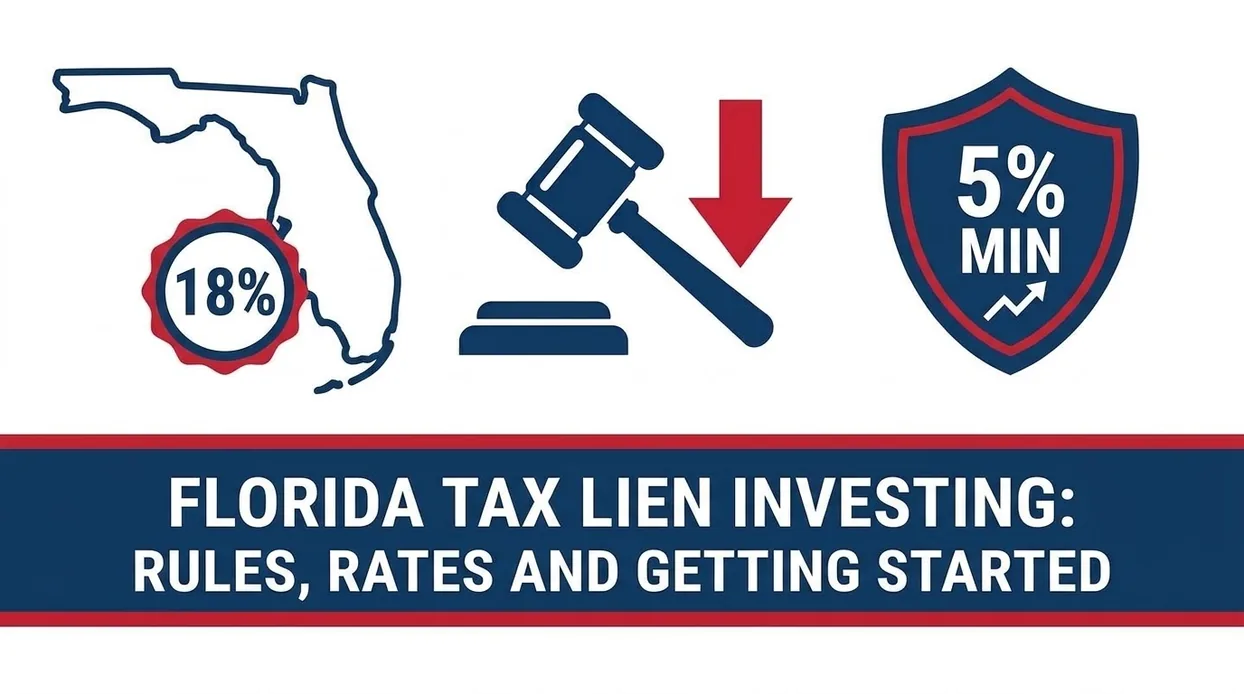
Florida tax lien investing means buying a county's claim for unpaid property taxes at an annual auction, then earning interest when the owner pays it off. This guide from United Tax Liens (UTL) is for beginner investors weighing Florida, and it covers how the certificates work, the 18% cap and 5% minimum return, where to bid, and the risks that catch first-timers. Every rule comes from Chapter 197 of the Florida Statutes, and the sale numbers come from county records.
Is Florida a Tax Lien or Tax Deed State?
Florida is both, in sequence. It is a tax lien certificate state first, because counties sell certificates at the annual sale rather than selling the property itself. It becomes a tax deed state second, because a certificate holder who waits long enough can force a public auction of the property. The rules for both stages sit in Chapter 197 of the Florida Statutes.
Stage one: the tax lien certificate sale
At the certificate sale, the county tax collector auctions the unpaid tax bill on each delinquent parcel. The winner pays the delinquent amount and receives a tax certificate. That certificate is a lien claim that earns interest. It does not transfer ownership, give you the right to enter the property, or entitle you to rent.
Most certificates end here. The owner pays the back taxes plus interest, the county pays you, and the certificate is closed. Your profit is the interest.
Stage two: the tax deed auction
A certificate holder may apply for a tax deed once two years have passed since April 1 of the year the certificate was issued. The county clerk of the circuit court then advertises and runs a public auction of the property. This is a separate business with its own costs and risks, so this guide keeps it short.
For a certificate you hold, the opening bid at the deed sale is the redemption amount plus costs and fees, and on homestead property it also includes one-half of the assessed value (s. 197.502(6), F.S.). The full breakdown is in UTL's Florida tax deed sales guide.
Why a tax lien sits ahead of a mortgage
Florida law makes property taxes a first lien, superior to all other liens on the parcel, running from January 1 of the year the taxes were levied (s. 197.122, F.S.). In plain terms, the tax claim gets paid ahead of every other lien, a mortgage included.
Why the deed is not the usual outcome
Many beginners imagine buying a certificate and ending up with a property for the price of a tax bill. That is the exception. Any person, including the owner or a mortgage holder, can redeem a certificate at any time before the deed is issued (s. 197.472(1), F.S.).
Even when a deed sale happens, the certificate holder bids like everyone else, and the property goes to the highest bidder (s. 197.542(2), F.S.). Plan around the interest. Treat a deed as an upside you are prepared for, not the reason you bought.
Certificate stage vs. deed stage at a glance
| Tax lien certificate | Tax deed | |
|---|---|---|
| Who runs it | County tax collector | County clerk of the circuit court |
| What you buy | A lien claim on unpaid taxes | Title to the property |
| How you win | Lowest interest rate bid | Highest bid at public auction |
| What you earn | Interest, 5% minimum on most certificates | The property, or your costs back if you are outbid |
| Main rules | ss. 197.432, 197.472, F.S. | ss. 197.502, 197.542, F.S. |
If you are still deciding between the two approaches, UTL's guides on tax lien vs. tax deed states and tax lien vs. tax deed investing cover the trade-offs. The full list of tax deed states shows where Florida's second stage fits nationally. UTL's ranking of the best tax lien states for investors shows how Florida compares with other lien states.
How Florida Tax Lien Certificates Work
A Florida tax lien certificate is a county-issued lien on a parcel for unpaid property taxes, sold at auction to the investor who accepts the lowest interest rate. The investor pays the delinquent amount up front, the county uses it to cover the taxes, and the investor gets repaid with interest when the owner redeems. If you are new to the instrument itself, start with UTL's explainer on what a tax lien certificate is.
Who does what: the offices involved
Several county offices touch every certificate, and knowing which one handles what saves time.
- County tax collector: bills and collects property taxes, advertises delinquent parcels, runs the certificate sale, takes redemption payments, and pays certificate holders.
- County property appraiser: sets the assessed value of each parcel and issues the apportionment certificate when a parcel is partly redeemed.
- Clerk of the circuit court: records the tax deed application, advertises and runs the tax deed auction, and issues the deed.
- Title or abstract company: produces the property information report required before a tax deed sale, which determines who must be notified.
Your research starts at the property appraiser's site and the tax collector's records, and your money moves through the tax collector. You deal with the clerk only if you pursue a deed.
How a property ends up at the sale
Florida property owners owe taxes for a given year by the end of March of the following year. Unpaid bills become delinquent on April 1. The tax collector then advertises each delinquent parcel once a week for three weeks and must sell certificates on or before June 1, or the 60th day after delinquency, whichever is later (s. 197.402(3), F.S.).
The advertised amount includes interest at 18% per year from the delinquency date, plus advertising and sale costs. The certificate's face amount also includes the tax collector's 5% commission. You pay the face amount when you win.
What you are actually buying
You are buying the right to be repaid, with interest, by the property owner or by the proceeds of a later tax deed sale. You are not buying a house, a lot, or any piece of one. The owner keeps possession and ownership throughout the redemption period.
That makes this a fixed-income style investment, not a property flip. Your outcome depends on the interest rate you win, how quickly the owner pays, and whether the parcel is worth enough to back your claim.
How bidding works
Bidding in Florida is a bid-down auction. Each certificate starts at the 18% statutory maximum, and bidders offer to accept a lower rate. The lowest rate wins. Rates run from 0% to 18% in quarter-percent steps, so the lowest bid above zero is 0.25% (s. 197.432, F.S.; Escambia's buyer information page lists the same 0% to 18% range in quarter-percent steps).
- Lowest rate wins. If two bidders offer 0.25%, the tax collector breaks the tie with a method the county selects, such as first bid received or a random-number generator.
- No bidders means the county takes it. A certificate nobody bids on is struck to the county at the maximum rate allowed by Chapter 197, which is 18%.
- Zero percent is legal. A 0% bid wins on rate alone but carries no minimum-interest protection, a trap covered in the interest section below.
What happens after you win
The county may require a deposit before you bid, and you must pay in full within 48 hours of the electronic notice. A late or missing payment can cost you the deposit and your right to keep bidding (s. 197.432(7), F.S.). Deposit rules differ by county. Escambia County, for example, requires a 10% ACH deposit and bidder registration through LienHub, including an electronic IRS Form W-9, as listed on its buyer information page.
If a winning bid is canceled, the tax collector reoffers the certificate at the same sale when it has not yet adjourned. If the sale has adjourned, the certificate is reoffered at a later sale after the parcel is advertised again (s. 197.432(8), F.S.).
Reading the sale list
After each sale, the tax collector keeps a list of the certificates sold. For each one it records the sale date, certificate number, owner name, property description, purchaser name, interest rate bid, and sale amount (s. 197.432(9), F.S.). Many counties publish sale results. Where they do not, ask the tax collector's office what the list shows.
That record lets you study how earlier sales cleared in a county: which rates won, which parcels drew 0.25% and which drew higher bids, and how many bidders are active. A first-time bidder who reviews last year's results sees the competition before spending a dollar.
The lifecycle in six steps
- April 1: the prior year's property taxes become delinquent.
- Advertising: the tax collector publishes the delinquent list for three consecutive weeks.
- Sale: certificates are auctioned by lowest interest rate, no later than about June 1.
- Redemption: the owner can pay the tax collector at any time before a tax deed is issued. You are paid face amount plus interest.
- Deed application: if the certificate is still unredeemed after two years, you may apply for a tax deed.
- Expiry: if no deed application is filed within seven years, the certificate is canceled.
| Ready to Start Investing the Right Way?
UTL's self-paced courses cover how tax lien investing works, from picking a state to bidding at auction. |
Interest Rates and Redemption Periods
The Florida tax lien interest rate is capped at 18% per year, but competitive bidding pushes most winning rates far lower. Whatever rate you win, the law guarantees most certificates a minimum of 5% of face value if the owner redeems. The certificate stays alive until the owner redeems, a tax deed is issued, or the certificate expires seven years after issuance.
The 18% cap and what bidders actually win
The statutory ceiling is 18% per year (s. 197.172(2), F.S.). The number that matters is the rate that wins. Hillsborough County, home of Tampa, publishes its sale results, and they show how bid-down works in practice.
- In 2025 the weighted average winning rate was 2.46%, up from 1.73% in 2024 and 0.87% in 2023.
- In 2023, 79.3% of certificates sold at the 0.25% floor. By 2025 that share had fallen to 51.8%.
- In 2025, 154 certificates went unsold and were struck to the county.
Source: Hillsborough County Tax Collector sale summary. This is one county, and results differ by county and by year, so check the sale results for any county you plan to bid in.
Read the data honestly. In Hillsborough, most certificates went for a small fraction of the 18% headline. A higher winning rate means no one was willing to take that parcel for less, so find out why before you bid.
The 5% minimum interest rule
When an owner redeems a certificate and the interest earned at the bid rate is less than 5% of the face amount, the owner pays a mandatory minimum of 5% of the face amount instead (s. 197.472(2), F.S.). The rule covers county-held and individually held certificates, with one exception: certificates won with a 0% bid do not get the minimum. During the first 60 days after delinquency, a certificate may not bear interest, and the minimum cannot be levied (s. 197.172(2), F.S.).
Hypothetical example: you win a certificate with a $3,000 face amount at a 0.25% bid. At the bid rate you would earn $7.50 a year. If the owner redeems after four months, the 5% minimum applies, and you receive $150 in interest, or about 15% annualized.
If the owner waits two years, you still receive the $150 minimum, which works out to about 2.5% a year. The money is the same, so the faster the owner pays, the better your annualized return.
This is why so many bidders accept 0.25%. At the floor, the 5% minimum becomes the real return. If a bidder wins at a higher rate such as 8%, the interest at the bid rate only overtakes the minimum after about seven and a half months, and above that point you earn the bid rate pro rata.
Annualized figures here are approximations. The tax collector's redemption statement controls the actual payout.
Four hypothetical outcomes on the same certificate
The easiest way to see how bid rate and timing interact is to run one $3,000 certificate through four cases. The figures are hypothetical, assume simple pro-rata interest, and subtract the $6.25 redemption fee from the payout.
| Case | Interest paid | Net after $6.25 fee | Approx. annualized return |
|---|---|---|---|
| 0.25% bid, owner redeems in 4 months | $150 (5% minimum) | $143.75 | About 14% |
| 0.25% bid, owner redeems in 24 months | $150 (5% minimum) | $143.75 | About 2.4% |
| 8% bid, owner redeems in 12 months | $240 (bid rate) | $233.75 | About 7.8% |
| 18% bid, owner redeems in 6 months | $270 (bid rate) | $263.75 | About 17.6% |
The first two cases are the same certificate and the same dollars, yet the annualized result differs by a factor of six because of timing. The fourth case looks best, but an 18% winner often means the parcel drew little interest from other bidders, so a high return can come with a parcel you would rather not hold. Judge each rate against the parcel, not in isolation.
How redemption works
Any person can redeem a certificate at any time after it is issued and before a tax deed is issued. The redeeming person pays the tax collector the face amount plus interest, costs, and charges (s. 197.472(1), F.S.). The collector receives a $6.25 fee for each certificate redeemed, and pays the certificate holder the amount received, less that fee, within 15 business days.
A parcel can be partly redeemed only if the portion can be identified by legal description and is supported by a sales contract or recorded deed. The property appraiser must issue an apportionment certificate within 15 days of the collector's written request.
Redemption is the outcome you are underwriting. For most certificates, the owner or a mortgage lender pays, and you are repaid in cash.
How long a certificate lasts
A certificate holder may apply for a tax deed two years after April 1 of the year of issuance (s. 197.502(1), F.S.). If no deed application is filed, the certificate becomes null and void and is canceled seven years after the date of issuance, which Chapter 197 defines as the first day of the advertised sale. The cancellation rule applies only if no other administrative or legal proceeding, such as a bankruptcy, is on record (s. 197.482, F.S.).
In practice, that gives you three possible outcomes: the owner redeems and you earn interest, you apply for a tax deed after year two, or you hold until the certificate expires worthless. Plan for the first, understand the second, and avoid the third. UTL's guide to how long tax liens last covers expiration rules in other states.
Florida tax lien quick reference
| Item | Florida rule | Source |
|---|---|---|
| Maximum interest rate | 18% per year | s. 197.172(2) |
| Bid range | 0% to 18%, quarter-percent steps | s. 197.432 |
| Minimum redemption interest | 5% of face amount (not for 0% bids) | s. 197.472(2) |
| Redemption fee to collector | $6.25 per certificate | s. 197.472(3) |
| Payment after electronic notice | Within 48 hours | s. 197.432(7) |
| Earliest tax deed application | 2 years after April 1 of the year of issuance | s. 197.502(1) |
| Tax deed application fee | $75, plus any online application cost | s. 197.502(1) |
| Certificate expiry | 7 years after issuance if no deed application | s. 197.482 |
| Tax deed auction deposit | 5% of the bid or $200, whichever is greater; balance due within 24 hours | s. 197.542(2) |
To see how Florida's structure compares with other states, UTL's tax lien interest rates by state comparison puts the numbers side by side.
Where to Find Florida Auctions
Each of Florida's 67 counties runs its own tax certificate sale through its county tax collector, usually online, once a year in late spring. There is no single statewide Florida tax lien auction. To find a sale, you check each county's tax collector website for the sale notice, bidder registration rules, and the platform it uses.
County tax collectors run the sales
Chapter 197 sets the deadline and the basic rules, but each county sets its own bidder registration, deposit amount, bidding platform, and payment procedure. That is why two Florida counties can look very different to a first-time bidder. Hillsborough and Escambia, for example, both sell through LienHub, but each county sets its own deposit, registration, and bidding rules.
Online platforms and registration
Most certificate sales are conducted online, and registration happens before the sale opens. Expect to complete an IRS Form W-9, fund a deposit, and learn the platform's batch bidding process. Escambia's rules show the pattern: bidders register on LienHub, place bids item by item, and the lowest rate wins. A buyer who does not make the required deposit is not awarded the certificates they won.
Two county examples side by side
County rules differ. These two examples, taken from each county's own pages, show what to look for. Confirm current rules before you register.
| Item | Hillsborough County | Escambia County |
|---|---|---|
| Bidding site | LienHub | LienHub |
| Bid range | 0% to 18%, 0.25% steps | 0% to 18%, 0.25% steps |
| Deposit | Check Hillsborough's LienHub bidding rules | 10% ACH deposit for expected purchases |
| Registration | Check Hillsborough's LienHub bidding rules | Online, with an electronic IRS Form W-9 |
The point is not any single number. Deposit, platform, and registration steps are county decisions, so read the rules for the county you pick and register well before the sale.
When the sales happen
Under s. 197.402(3), Florida tax lien sales must happen on or before June 1, or the 60th day after delinquency, whichever is later. For taxes that became delinquent on April 1, 2026, those sales have already taken place. The next cycle begins when the 2026 tax year becomes delinquent on April 1, 2027, with advertising roughly three weeks before each county's sale. Watch county tax collector sites in spring 2027 for notices and registration deadlines.
How to track upcoming sales
Counties do not announce sales in one central place, so build a routine for the counties you follow.
- Bookmark each county tax collector's tax certificate page and check it every few weeks as spring approaches.
- Watch for the three weekly delinquent-tax advertisements, which are your signal that the sale is close.
- Write down the registration deadline, the deposit deadline, and the sale date the day the notice goes up.
- Review the previous year's sale results so you know what competitive rates looked like.
County-held certificates
Certificates that receive no bid are struck to the county at 18%. Those county-held certificates are not on the auction block anymore, but they remain part of the market. Ask each tax collector whether it sells county-held certificates and how. UTL's guide to over-the-counter tax liens explains the general idea and the trade-offs of buying outside an auction.
Tax deed auctions
If a certificate holder applies for a deed, the clerk of the circuit court advertises and runs the sale, often electronically. The winning bidder posts a nonrefundable deposit of 5% of the bid or $200, whichever is greater, and pays the balance, documentary stamps, and recording fees within 24 hours (s. 197.542(2), F.S.). That is a different registration process and a different set of risks, covered in the Florida tax deed sales guide.
If nobody bids and the certificate holder does not pay within 30 days, the clerk lists the land as lands available for taxes. The county then has a 90-day right to buy it at the opening bid, and after that anyone may buy it at that price (s. 197.502(7), F.S.).
Questions to ask before you register with a county
- Which platform runs the sale, and when does registration close?
- What deposit does the county require, and how is it paid (ACH, wire)?
- How long do you have to pay after winning?
- What is the county's bidding format, including batch or round structure?
- Does the county sell county-held certificates, and how?
How to Get Started With Florida Tax Lien Investing
The safest way to start is with one county, a small budget, and a parcel-by-parcel research routine before you bid. Start by learning the rules and the platform, then practice on the research side before you commit real money. The steps below take you from zero to your first winning bid.
Step-by-step plan
- Set a budget. You pay the full face amount of every certificate you win, and the county may require a deposit first. UTL's guide on how much money you need to start tax lien investing breaks down the numbers.
- Pick one or two counties. Choose based on how many certificates are offered, the platform, and how close you can get to the parcels. A mid-sized county is easier to learn than the largest.
- Read the rules. Read Chapter 197 and each county's bidder rules. The deposit and payment deadlines cost beginners the most.
- Register early. Complete the W-9, set up the platform account, and fund the deposit before the registration deadline.
- Research every parcel. Never bid on a certificate you have not looked up (see the checklist below).
- Bid and pay on time. Bid only on certificates you would be comfortable holding for two years, then pay within the county's deadline.
- Track each certificate. Record the redemption date, the interest paid, and the two-year and seven-year dates.
What to check on every parcel
- Assessed value vs. face amount. The property should be worth many times what you pay. Compare the county property appraiser's value to the certificate's face amount.
- Property type. Vacant lots, small slivers of land, and parcels with limited use deserve extra scrutiny, because the value backing your claim may be thin.
- Homestead status. At a tax deed sale, the opening bid on homestead property includes one-half of the assessed value, which changes the economics of the deed stage.
- Prior-year taxes. Other unpaid years and other certificates on the same parcel show whether the owner has been paying.
- Recorded liens and bankruptcies. Check the county clerk's records for other liens or a bankruptcy, which can hold up your timeline.
- Physical condition. Use satellite and street imagery to rule out vacant, damaged, or unusable land. Keep every check in a written due diligence checklist.
How to choose your first county
Pick a county you can research from your desk. Four filters narrow the field quickly.
- Certificate volume. Larger counties offer thousands of certificates and attract more bidders, which pushes rates toward the 0.25% floor. Smaller counties offer fewer certificates and sometimes less competition, but also less choice.
- Platform. A county on a platform you already understand removes one learning curve. Review any demo or past sale material the county offers.
- Parcel mix. Residential parcels with homes behave differently from vacant lots. Browse the property appraiser's site to see what is typical in the county.
- Rules and costs. Compare the deposit size and payment window against the cash you can move quickly.
Keep a certificate log from day one
Track each certificate in a simple sheet. Useful columns are county, parcel ID, certificate number, sale date, bid rate, face amount paid, date paid, redemption date, interest received, and the dates two years and seven years after issuance. The log answers one question per certificate: is it earning, is it near the deed window, or is it near expiry? Anyone who buys at more than one county sale needs it quickly.
Start small and learn the platform
Your first sale is for learning. Bid on a small number of certificates, watch how the platform handles batches, and note how quickly owners redeem. Watching a full sale first shows you the platform and the winning rates before any money is at risk. For a wider look at the basics, see UTL's complete tax lien investing guide.
What your first year could look like
Because Florida sells certificates once a year, you can use the months before the next sale to prepare. This is a sample plan, not a requirement.
- Now through February 2027: read Chapter 197, shortlist two counties, and study their past sale results and parcel types.
- March 2027: open your platform account, complete the W-9, and confirm the deposit and payment rules.
- April 2027: taxes become delinquent. Watch for the county's advertisement and registration deadline.
- Late spring 2027: fund the deposit and bid on a small number of researched parcels.
- After the sale: log each certificate and record every redemption.
| Work 1-on-1 With an Active Tax Lien Investor
Our coaches are current investors, not theorists. They will help you avoid the mistakes that cost beginners thousands. |
What to Watch Out For
The biggest risks in Florida tax lien investing are low returns after bid-down, capital tied up in certificates that never redeem, parcels that are not worth the claim, and missed deadlines that cost you your deposit. None of them are secrets. Each one is avoidable if you know it going in.
Returns can be thin
When more than half of a large county's certificates sell at the 0.25% floor, the 5% minimum, not 18%, is the return many bidders actually earn. If the owner redeems quickly, that works well. If the owner waits two years, your annualized return drops toward 2.5%, before the $6.25 redemption fee. Run the numbers on your actual face amount before you bid, and compare the return to what your money earns elsewhere.
UTL's tax lien investing pros and cons lays out the trade-offs.
Your money can be tied up
You pay the face amount upfront and cannot force the owner to pay. Florida even bars certificate holders from contacting the owner to encourage or demand payment until two years after April 1 of the year the certificate was issued (s. 197.432(13), F.S.). Capital is locked until redemption, the deed process, or expiry. Do not commit money you may need for other purposes in the next two years.
Redeemed money can sit idle
Fast redemption is good for your annualized return, but it creates a reinvestment problem. If an owner pays off your certificate in the summer, the cash comes back months before the next sale, and there may be nothing comparable to buy until the following spring. Count the idle time when you compare Florida certificates with other places to put the same money.
A certificate is only as good as the parcel
A certificate on a low-value or unusable parcel can be worth less than the face amount you paid. If the owner never redeems and the property would not sell for enough at a tax deed auction to cover your claim, your recovery is at risk. This is why parcel research matters more than the interest rate.
The deed stage costs money
If you apply for a tax deed, you pay a tax deed application fee of $75 (plus any online application cost), plus the cost of a title company or abstract company property information report that identifies who must be notified (s. 197.502, F.S.). If you do not pay the sale costs within 30 days after the clerk's notice, the tax collector cancels the application. The deed stage is a project in its own right.
The title report also drives notice. Before a deed sale, Chapter 197 requires notice to the legal titleholders of record, mortgagees and other lienholders, contract-for-deed vendees, and the person assessed on the last tax roll. That process gives owners and lenders a real chance to pay, which is one more reason most certificates end in redemption rather than a deed.
Deadlines and deposits
Missing the 48-hour payment window after winning a certificate can cost you the deposit and bar you from further bidding. Treat the county's payment instructions as a hard deadline, not a guideline.
Platform quirks and bidding mistakes
Online certificate sales move fast, and each platform has its own batch or round structure. Escambia's rules say bids are placed before the sale and may be adjusted as groups of certificates are awarded. If you do not understand how a county's platform awards winners, you can win more than you planned to buy or lose parcels you wanted. Read the platform's help pages, and size your bids to the deposit you have funded.
Errors and voided certificates
If a certificate is voided and refunded, the holder receives simple interest at 8% a year or the bid rate, whichever is less (s. 197.432(11), F.S.). That is usually fine, but it means you cannot rely on a high bid rate if the sale is later undone.
Taxes on your interest
Interest you earn is income. Speak with a licensed CPA or tax advisor about how it is reported before you invest.
| Learn the Fundamentals Before Your First Bid
Start with UTL's complete guide to how tax liens, certificates, and auctions work. |
Frequently Asked Questions
Is Florida tax lien investing profitable?
It can be, but there is no guarantee, and returns are modest in competitive counties. Many certificates clear near 0.25%, where the 5% minimum interest is the real payout. Profit depends on how fast owners redeem, your parcel research, and how much capital you can leave tied up.
What interest rate do Florida tax lien certificates pay?
The maximum is 18% per year, and bidders compete by offering lower rates, down to 0%. In Hillsborough County, the 2025 weighted average winning rate was 2.46%. Redeemed certificates pay at least 5% of face, except those bought with a 0% bid and those redeemed in the first 60 days after delinquency.
How long does it take to get paid on a Florida tax lien?
You are paid when the owner redeems, which can be a few months or up to two years or more. After redemption, the tax collector pays the holder within 15 business days of receiving the funds, less a $6.25 fee.
Can I get the property if the owner does not pay?
Not automatically. After two years, you can apply for a tax deed, which leads to a public auction run by the county clerk. You can bid at that auction, but another bidder may outbid you.
When are Florida tax lien certificate sales held?
Counties must sell certificates on or before June 1, or the 60th day after delinquency, whichever is later. Taxes become delinquent on April 1, and sales usually run in late spring, with advertising about three weeks before.
How much money do I need to start?
You pay the full face amount of each certificate you win, and many counties require a deposit before bidding. Escambia County, for example, requires a 10% deposit via ACH. Start Florida tax lien investing with a budget you can leave tied up for two years.
| ⚠ Earnings Disclaimer
Earnings Disclaimer: United Tax Liens provides real estate education and training only. We do not guarantee investment results or income. Individual outcomes vary based on effort, market conditions, and individual skill. Investing of any kind carries risk. This content is for educational purposes only and does not constitute legal, tax, or financial advice. Consult licensed professionals before making investment decisions. |
Related Reading: Complete Tax Lien Investing Guide | Tax Lien vs. Tax Deed States | Florida Tax Deed Sales | Over-the-Counter Tax Liens | Tax Lien Interest Rates by State