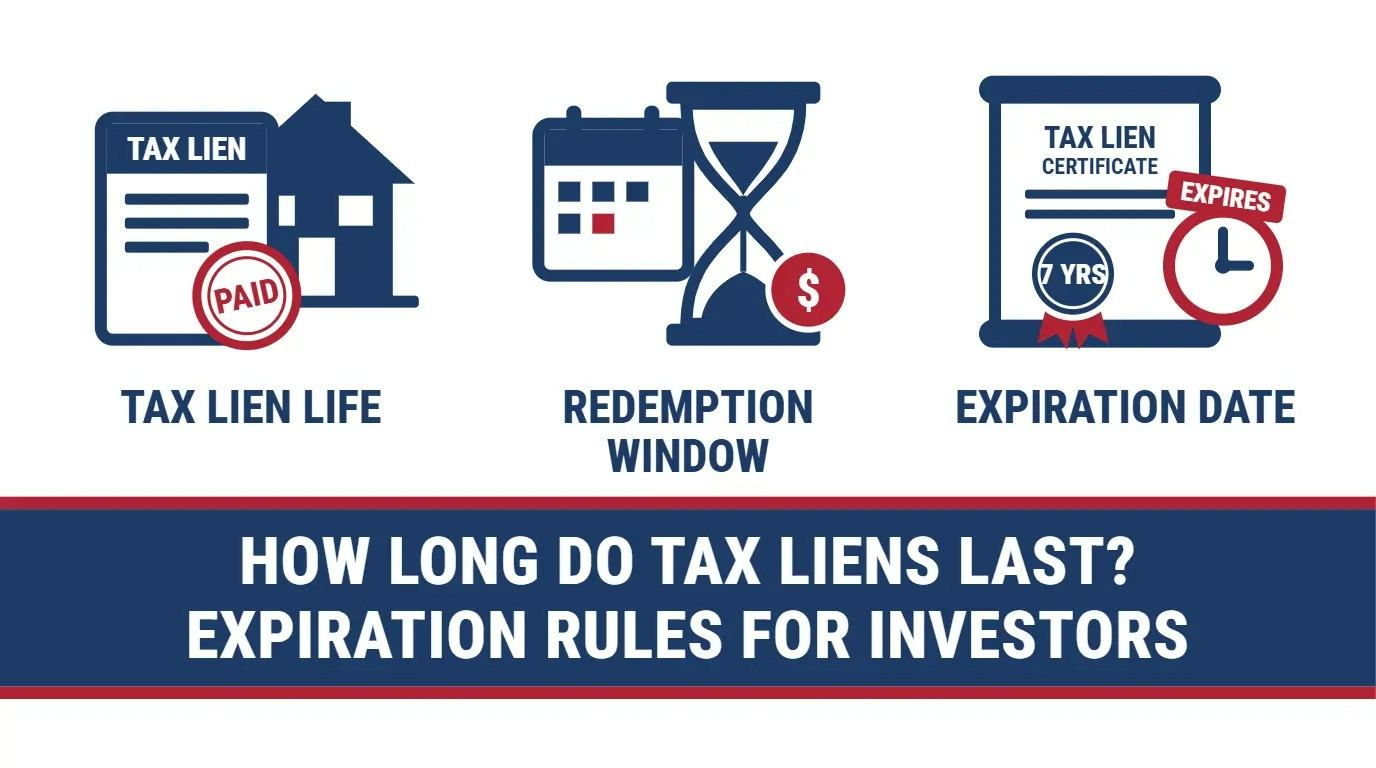
How long do tax liens last? A property tax lien lasts until the taxes are paid or the law bars it, while a tax lien certificate has its own clock that in Florida ends seven years after the first day of the sale unless a deed application or another proceeding is on record. This guide is for new investors who want to know how long certificates can last by state, what happens when they expire and how a federal tax lien differs.
Last reviewed against the current Florida, Colorado and Arizona statutes and the IRS website on September 30, 2026. This guide is educational and is not legal, tax or investment advice. Lien rules differ by state and change over time, so confirm them with the county before you buy.
How Long Do Tax Liens Last?
A tax lien on a property lasts until the tax is paid or the law bars it, and a tax lien certificate has its own clock under the state's statute. The two are not the same thing, and the certificate's clock decides how long an investor's purchase stays valid.
The Lien and the Certificate
In Florida, section 197.122 keeps the tax lien in force from January 1 of the tax year until it is discharged by payment or barred under chapter 95. Section 197.482 separately cancels a certificate once it expires. Our guide to what a tax lien certificate is explains the product an investor actually buys.
Tax Lien Life vs. Redemption Period
The redemption period is how long the owner has to repay and clear the lien, and the certificate's life is how long the investor's certificate stays valid before the law cancels it. They run on separate clocks. In Florida, for example, the owner can redeem before a tax deed is issued, unless full payment for the deed has been made to the clerk, while the certificate expires seven years after the first day of the sale. Our guide to the tax lien redemption period covers redemption details by state.
How Long Does a Tax Lien Certificate Last in Florida?
A Florida tax lien certificate lasts seven years from the date it is issued. Section 197.482 defines the issue date as the first day of the tax certificate sale as advertised, and it makes the certificate null and void and canceled if no tax deed has been applied for and no other administrative or legal proceeding, including a bankruptcy, is of record. The tax collector notes the cancellation date in its records.
The Seven-Year Rule
The seven years start on the first day of the sale, because the statute defines the issue date that way. Section 197.4725 adds that a county-held certificate bought after the sale keeps its original issue date for deed application timing. Section 197.482 also says the expiration rule does not apply to deferred payment tax certificates.
When You Can Apply for a Deed
A certificate holder can apply for a tax deed two years after April 1 of the year the certificate was issued, under section 197.502. Applying is what protects the certificate from expiring, because the statute cancels a certificate only when no deed has been applied for and no other proceeding is of record. The application starts a separate process, and our Florida tax deed sales guide explains what follows.
A Sample Timeline
The example below is hypothetical. Suppose a Florida sale starts on June 1, 2027. The certificate is issued on that date, the earliest deed application is two years after April 1, 2027, so after April 1, 2029, and the certificate expires on June 1, 2034 if no deed application or other proceeding is of record.
| Ready to Start Investing the Right Way?
UTL's courses show you exactly what you need to do to get started with tax lien investing. |
How Long Do Tax Liens Last in Other States?
Other states set different expiration rules, and a certificate can last from several years to fifteen. The table lists the expiration period for four states, each taken from the state's statute. Our tax lien interest rates by state comparison covers more states.
| State | Expiration period | Statute |
|---|---|---|
| Florida | The certificate is null and void and canceled 7 years after the first day of the sale if no tax deed has been applied for and no other proceeding is of record | Section 197.482 |
| Colorado | A lien created by a tax certificate does not remain a lien longer than 15 years after original issuance, and no treasurer's deed issues after that unless an application is pending; the statute has exceptions for county-held certificates and certain assignments | C.R.S. 39-11-148 |
| Arizona | A foreclosure action may be brought starting 3 years after the sale and no later than 10 years after the last day of the month the lien was acquired; the period extends 12 months if a law or court order prohibits filing | A.R.S. 42-18201(A) |
| Illinois | The certificate or deed is void with no right to reimbursement unless the deed is taken out and recorded within 1 year after the redemption period expires, and time a court prevents the deed is excluded | 35 ILCS 200/22-85 |
Check the Statute Before You Rely on a Table
Statutes change, so treat any table, including this one, as a starting point. The Arizona rule is in A.R.S. 42-18201, and the Gilpin County Treasurer says Colorado's treasurer's deed process changed on July 1, 2024. Read the current statute and your county's page before you buy.
What Happens When a Tax Lien Certificate Expires?
When a certificate expires, the state's statute cancels it or voids it, and the wording differs by state. Florida makes an expired certificate null and void and requires the tax collector to cancel it. Colorado requires the treasurer to issue a certificate of cancellation, and Illinois calls a certificate or deed that misses its deadline absolutely void with no right to reimbursement. Plan as if an expired certificate returns nothing, and confirm with the tax collector how a specific certificate would be handled.
How to Avoid Expiration
The certificate can be protected by acting before its deadline. In Florida, applying for a tax deed puts a proceeding of record, and so does another administrative or legal proceeding such as a bankruptcy. Deed applications have their own costs, so decide well before the deadline whether you want to apply. Our overview of the risks of buying tax liens explains what to weigh.
Track Every Date
Tracking prevents most expiration problems. Record the issue date, the earliest deed application date and the expiration date for every certificate on the day you buy it. Our guide to tracking tax lien redemptions shows one way to keep the records.
| Keep Every Certificate Date in One Place
Use our redemption tracking guide to record issue, deed and expiration dates for every certificate you buy. |
Do Federal Tax Liens Expire?
A federal tax lien is the IRS's claim against a taxpayer's property, and an investor does not buy it at a county sale. The IRS releases the lien within 30 days after the debt is paid in full. It generally has 10 years from the date a tax was assessed to collect it, called the Collection Statute Expiration Date, and certain events can extend that period, so read the IRS guidance on the time it can collect taxes for your situation.
Mistakes to Avoid With Tax Lien Timelines
Four mistakes are easy to make when you are learning how long tax liens last: mixing up the certificate's life and the redemption period, assuming a late purchase restarts the certificate, relying on an old article and forgetting to record dates. Each one can be avoided with a plan made before you invest.
- Mixing up the clocks: the certificate's expiration and the owner's redemption period are separate.
- Assuming a late purchase restarts the clock: in Florida, a county-held certificate keeps its original issue date for deed timing.
- Trusting old sources: statutes and county processes change, as Colorado's treasurer's deed process did in 2024.
- Not recording dates: an expired certificate is canceled or void, so keep every date in one place.
United Tax Liens offers online courses and coaching for new tax lien investors, led by a team of active tax lien and deed investors, so you can learn the process before you invest.
| Have Questions Before You Invest?
Contact a United Tax Liens coach with your questions before you commit your first dollar. |
Key Terms
Tax lien certificate: A claim on a property for unpaid taxes that an investor buys from the county. It pays interest if the owner redeems and does not transfer ownership.
Issue date: The date a certificate is treated as issued. In Florida it is the first day of the tax certificate sale as advertised.
Certificate expiration: The point at which the law cancels or voids a certificate. In Florida it is seven years after the issue date if no deed application or other proceeding is of record.
Redemption: The owner's right to repay the tax debt, plus interest and costs, and clear the lien.
Tax deed application: A certificate holder's request to start the process that can lead to a tax deed sale. In Florida it can be made two years after April 1 of the issue year.
Collection Statute Expiration Date: The date the IRS can no longer collect a federal tax assessment, generally 10 years after assessment unless extended.
Frequently Asked Questions About How Long Tax Liens Last
How long do tax liens last for investors?
A tax lien certificate lasts as long as state law says. In Florida it expires seven years after the first day of the sale unless a tax deed application or another proceeding is of record, in Colorado the lien created by a certificate lasts up to 15 years, and other states set different periods.
Do all states put an expiration date on tax lien certificates?
The examples in this guide show that the rules differ. Florida cancels a certificate after seven years, Colorado limits the certificate's lien to 15 years, Arizona limits the time to bring a foreclosure action to 10 years and Illinois voids a certificate or deed that misses its recording deadline. Read the statute for the state where you plan to invest.
Do tax liens ever expire on the property?
Florida's statute says the tax lien continues from January 1 of the tax year until it is discharged by payment or barred under chapter 95. Section 197.482 separately cancels a certificate seven years after issuance if no deed application or other proceeding is of record.
What happens if a tax lien certificate expires?
In Florida, an expired certificate is null and void and the tax collector cancels it. The statute does not describe a payment to the holder, so confirm with the tax collector before you rely on any return.
How long does an IRS tax lien last?
The IRS releases a federal tax lien within 30 days after the debt is paid in full. It generally has 10 years from assessment to collect, so those two events set the practical life of the lien.
Key Takeaways
- Before you buy, answer “how long do tax liens last” for your state, because the certificate's expiration and the redemption period are separate clocks.
- Record the issue date, the earliest deed application date and the expiration date for every certificate on the day you buy it.
- Decide well before year seven in Florida whether you will apply for a tax deed, since the application is what keeps a certificate from expiring.
- Read the current statute for your state, because expiration rules such as Colorado's 15-year limit and Illinois's one-year recording deadline are specific to each state.
- Plan as if an expired certificate returns nothing, and confirm with the tax collector how a specific certificate would be handled.
- Do not confuse a county tax lien certificate with an IRS tax lien, which follows its own rules and a 10-year collection period.
| ⚠ Earnings Disclaimer
Earnings Disclaimer: United Tax Liens provides real estate education and training only. We do not guarantee investment results or income. Individual outcomes vary based on effort, market conditions, and individual skill. Investing of any kind carries risk. This content is for educational purposes only and does not constitute legal, tax, or financial advice. Consult licensed professionals before making investment decisions. |
Related Reading: Tax Lien Investing Guide | The Tax Lien Redemption Period Explained | Earnings Disclosure