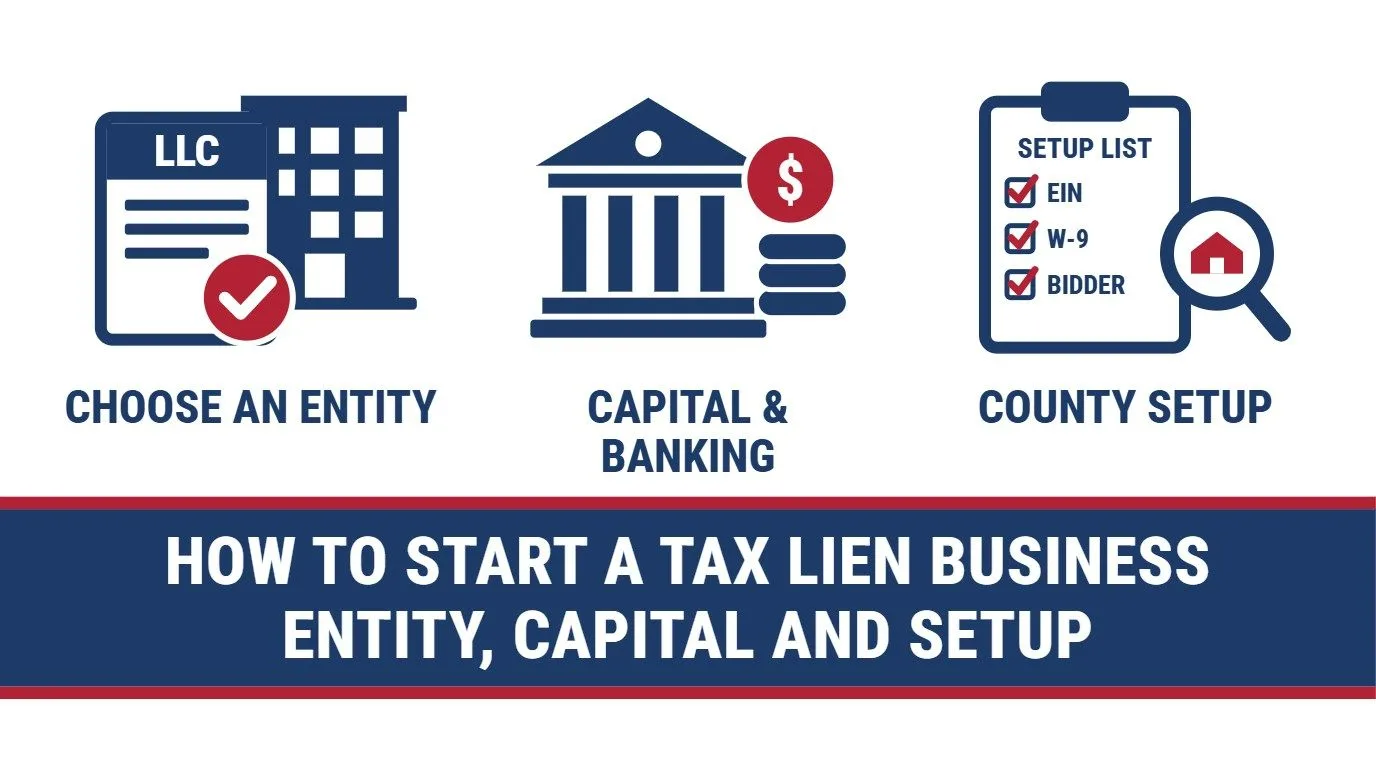
How do you start a tax lien business? You choose a legal structure, set aside capital for deposits and certificates, get a tax ID if you need one and a business bank account, and build a record-keeping system before your first bid. This guide is for new investors who want to run tax lien investing as a business, and it walks through seven setup steps, the tax basics and the mistakes to avoid.
Last reviewed against the SBA, the IRS and the 2026 Florida Statutes on October 29, 2026. This guide is educational and is not legal, tax or investment advice. Entity and tax rules differ by state and by situation, so talk to an attorney and a CPA before you form a business.
What Is a Tax Lien Business?
A tax lien business, sometimes called a tax lien investing business, is tax lien investing that you organize as a business, with its own structure, bank account and records. Its work is buying tax lien certificates at county sales, holding them until the owner redeems and tracking every date and dollar. The certificate does not transfer ownership, so the business earns interest and does not manage property while it holds a lien. Our tax lien investing guide explains the product itself, so this article stays on how to organize it.
How Do You Start a Tax Lien Business?
You start a tax lien business in seven steps: choose an entity, register it, get an EIN and a bank account if you need them, decide your capital, choose a county, build your team and set up your tracking system. The order below follows the SBA's business guide and county buyer rules.
Step 1: Choose Your Entity
A tax lien business can operate as a sole proprietorship, a partnership, an LLC or a corporation, and the right choice depends on your liability, taxes and costs. The Small Business Administration says your business structure affects how much you pay in taxes, your ability to raise money, the paperwork you file and your personal liability, and it recommends consulting business counselors, attorneys and accountants.
| Structure | What the SBA says about liability | What the SBA says about taxes and cost |
|---|---|---|
| Sole proprietorship | Not a separate entity, so business and personal assets and liabilities are not separate | Automatic if you do business without registering; easy to form |
| LLC | Protects personal assets from lawsuits and bankruptcy in most instances | Profits and losses pass through to personal income; members are considered self-employed |
| Partnership | Limited liability partnerships give every owner limited liability; limited partnerships have one general partner with unlimited liability | Profits pass through to personal tax returns |
| Corporation (C corp) | A separate legal entity that offers the strongest protection | Pays income tax on its profits; costs more to form and needs more record-keeping |
Step 2: Register the Business and Check Local Rules
Register the business with your state if your structure requires it. The SBA says local governments determine registration, licensing and permitting requirements, so check your state, county and city websites for what applies to you.
Step 3: Get an EIN and Open a Business Bank Account
Get an EIN if your structure or your bank requires one. The SBA says a business needs a federal tax ID if it, for example, pays employees or operates as a corporation or partnership, and that an EIN is used to open a bank account and apply for licenses and permits. The IRS EIN tool is free, and the IRS warns that you never have to pay a fee for an EIN.
Open a business bank account when you are ready to start accepting or spending money as your business. The SBA says a business account helps you stay legally compliant and protected, and it keeps your deposits and payouts in one place for your CPA.
| Ready to Start Investing the Right Way?
UTL's courses show you exactly what you need to do to get started with tax lien investing. |
Step 4: Decide How Much Capital to Start With
Your capital covers the deposit, the certificates you win and a reserve for the next sale. Counties set deposits by rule, and Florida shows how fast the balance comes due: Orange County requires the greater of $1,000 or 10% of intended purchases, and section 197.432 requires payment within 48 hours of the county's notice. Put these numbers in a simple tax lien business plan: your budget, your first county and the sale dates. Our guide on how much money you need to start tax lien investing breaks down budgets in detail.
Step 5: Choose Your First County and Register With It
Choose one county first, then register on its auction platform and submit a Form W-9. The W-9 is the IRS's Request for Taxpayer Identification Number and Certification, and it asks for your name and tax ID, so ask your CPA which tax ID belongs on the form for your entity. Orange County's tax collector requires a W-9 and reports interest on a Form 1099-INT.
The county pages reviewed for this guide (Orange, Pasco and Escambia) ask for registration and a Form W-9 and do not list an LLC as a requirement. These are Florida examples, and other states differ. Our guide to how to pick the right county for your first investment explains how to compare counties.
Step 6: Build Your Team
Build a small team of professionals before you fund your first deposit. The SBA says consulting business counselors, attorneys and accountants can prove helpful when you choose a structure, and a CPA can answer entity and tax questions as your certificates grow. On tax deeds, the Duval County Clerk says title searches and quiet-title suits are the buyer's responsibility, which is where a title company and a lawyer come in. Our guides to how to find a lawyer for your tax lien team and how to work with title companies effectively cover both.
Step 7: Set Up Your Research and Tracking System
Track every certificate from the day you buy it. Record the county, the certificate number, the parcel ID, the issue date, the amount paid, the deed application date and the expiration date. Our guide to building a tax lien research system shows how to organize both your research and your records.
| Pick Your First County Before You Raise Capital
Compare county rules, competition and research access with our guide to choosing your first county. |
Tax Benefits of Investing Through an LLC
An LLC's tax features are entity-level, and the SBA describes them in general terms. The SBA says an LLC's profits and losses pass through to the owners' personal income without corporate taxes, while a corporation pays income tax on its profits. It also says LLC members are considered self-employed and must pay self-employment tax contributions toward Medicare and Social Security, and that an LLC can suit owners who want a lower tax rate than they would pay with a corporation. Ask a CPA how those rules apply to interest income in your state, and read our guide to tax strategies for tax lien investors for the detail.
What Are the Tax Basics for Interest Income?
Interest earned on a tax lien is generally taxable income. The IRS says in its Topic 403 guidance that most interest you receive is taxable income in the year it becomes available to you, and that you must report taxable interest even if you do not receive a Form 1099-INT. Read the IRS interest received guidance, and remember that this section is general information and not tax advice.
What Mistakes Should a New Investor Avoid?
Four mistakes are easy to make when you start: mixing personal and business money, committing more capital than you can fund on short notice, assuming an LLC removes all risk and skipping the tracking system. Each one can be avoided with a plan made before your first bid.
- Mixing money: use the business account for every deposit, purchase and payout.
- Overcommitting capital: a missed payment deadline can cost you your deposit.
- Assuming an LLC covers everything: the SBA says an LLC protects personal assets in most instances, not in every case.
- Skipping tracking: unrecorded dates lead to missed deadlines.
United Tax Liens offers online courses and coaching for new tax lien investors, led by a team of active tax lien and deed investors, so you can learn the process before you invest.
| Have Questions Before You Invest?
Contact a United Tax Liens coach with your questions before you commit your first dollar. |
Key Terms
EIN: An Employer Identification Number, the federal tax ID for a business. The IRS issues it free.
LLC: A limited liability company, a business structure that the SBA says protects personal assets in most instances.
Sole proprietorship: A business that is not registered as another structure and is not separate from its owner.
Form W-9: The IRS form counties use to collect a bidder's name and tax ID, titled Request for Taxpayer Identification Number and Certification.
Deposit: Money a bidder funds before a sale. Counties set the amount, such as 10% of intended purchases.
Tax lien certificate: A claim on a property for unpaid taxes that an investor buys from the county. It pays interest if the owner redeems and does not transfer ownership.
Frequently Asked Questions About Starting a Tax Lien Business
Do I need an LLC to start a tax lien business?
The county pages reviewed for this guide ask for registration and a Form W-9 and do not list an LLC as a requirement. A tax lien business LLC is a choice about liability and taxes, so talk to an attorney and a CPA about your situation.
How much money do I need to start a tax lien business?
The amount depends on the county's deposit rule and how many certificates you plan to buy. Florida counties such as Orange, Pasco and Escambia ask for deposits of at least 10% of intended purchases, and the balance is due within 48 hours. Our guide on how much money you need to start breaks down the numbers.
Do I need an EIN for a tax lien business?
It depends on your structure and your bank. The SBA says a business needs a federal tax ID if it pays employees or operates as a corporation or partnership, and an EIN is used to open a bank account and apply for licenses. The IRS issues EINs free, so use the IRS tool and avoid sites that charge a fee.
Do I need a business license?
Licensing depends on where you are. The SBA says local governments determine registration, licensing and permitting requirements, so check your state, county and city websites.
Can I run a tax lien business part time?
Yes, if you can meet the county's deadlines. Florida holds its certificate sale once a year, on or before June 1, and the work between sales is research, record keeping and tracking dates, so start with one county.
Key Takeaways
- Decide your business structure on purpose, and talk to an attorney and a CPA before you form a tax lien business.
- Get an EIN if your structure or bank requires one, and open a business bank account before you fund your first deposit.
- Plan capital around the county's deposit rule and the 48-hour payment deadline, and keep a reserve for the next sale.
- Register with each county's auction platform and submit your Form W-9 using the name and tax ID your CPA tells you to use for your entity.
- Record the issue date, deed date and expiration date for every certificate on the day you buy it.
- Ask a CPA how interest income from your certificates will be reported for your entity.
| ⚠ Earnings Disclaimer
Earnings Disclaimer: United Tax Liens provides real estate education and training only. We do not guarantee investment results or income. Individual outcomes vary based on effort, market conditions, and individual skill. Investing of any kind carries risk. This content is for educational purposes only and does not constitute legal, tax, or financial advice. Consult licensed professionals before making investment decisions. |
Related Reading: Tax Lien Investing Guide | How Much Money Do You Need to Start Tax Lien Investing? | Earnings Disclosure