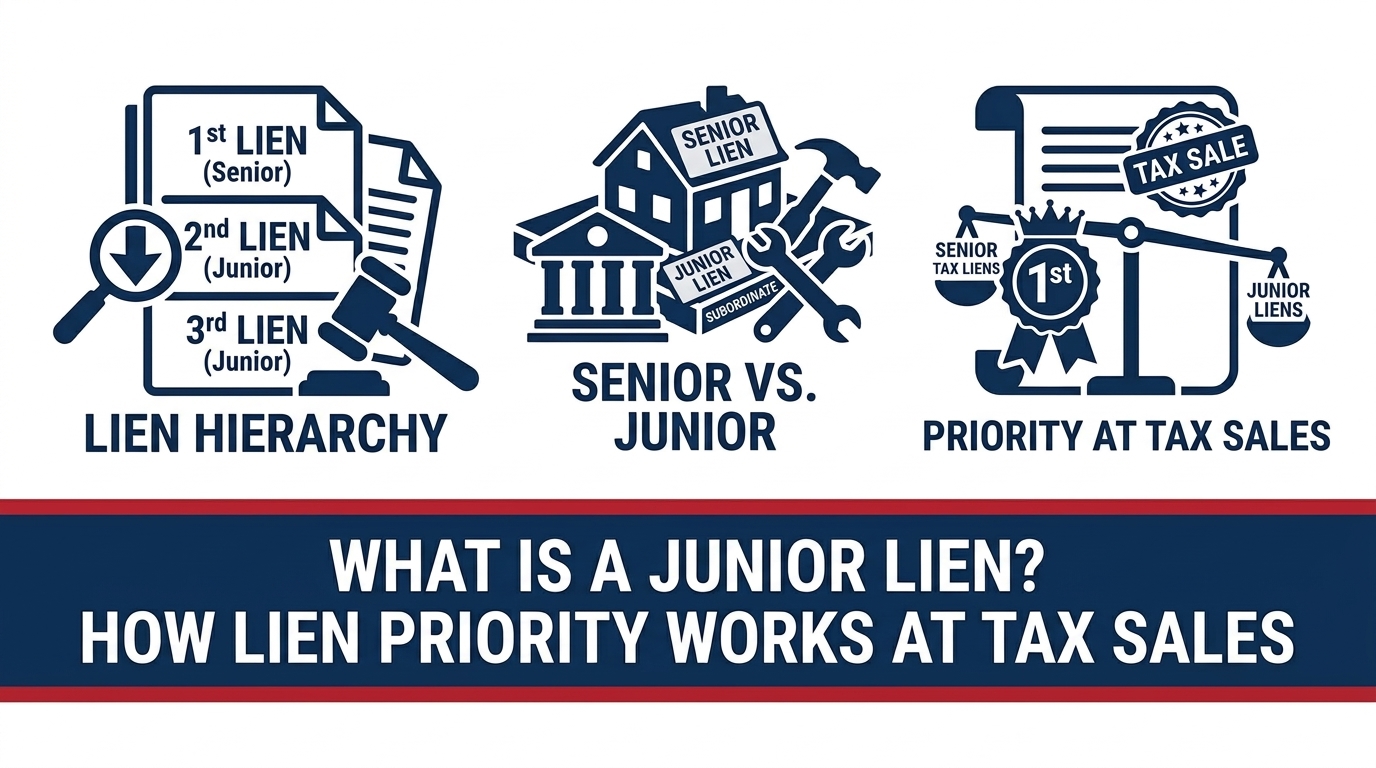
A junior lien is a lien that ranks behind one or more other liens on the same property, so it is paid only after the senior liens are satisfied. This guide is for new tax lien investors who want to know where junior liens sit at tax sales and what happens to them, and it covers how priority is set, what Florida's statutes say about junior liens at a tax deed sale and how to check a property.
Last reviewed against the 2026 Florida Statutes and the Cornell Legal Information Institute on September 30, 2026. This guide is educational and is not legal, tax or investment advice. Lien rules differ by state, so confirm them with a licensed attorney or title company before you buy.
What Is a Junior Lien?
A junior lien is a lien on a property that ranks lower in priority than another lien on the same property. The Cornell Legal Information Institute defines it as a security interest subordinate to another security interest, and the higher-ranked claim is called a senior lien. The senior lien is paid in full before the junior lien receives anything.
The Short Definition
Priority decides who is paid first when a property is sold or foreclosed. If the sale brings in less money than the total debt, the senior lien takes its share first and the junior lien is paid only from what is left. A junior lienholder can therefore recover less than it is owed, or nothing, even though its claim is valid.
Senior and Junior Are Relative
A lien is not junior or senior by nature. The Legal Information Institute notes that a lien can be junior to an older lien and senior to a newer one at the same time. Under the first-in-time rule, a second mortgage recorded after a first mortgage is junior to it and senior to a judgment lien recorded after the second mortgage.
| Position | What it means | Example |
|---|---|---|
| Senior lien | Paid before the liens ranked below it | A first mortgage recorded before other liens |
| Junior lien | Paid only after the liens ranked above it | A second mortgage or a later judgment lien |
| Both at once | Junior to older liens and senior to newer ones | A second mortgage that sits between a first mortgage and a later judgment |
Common Examples of Junior Liens
- Second mortgage: a mortgage recorded after the first mortgage ranks behind it.
- Judgment lien: in Florida, a judgment becomes a lien when a certified copy is recorded, so a judgment recorded after a mortgage ranks behind that mortgage.
- Construction lien: section 713.07 gives an encumbrance recorded before the notice of commencement priority over the construction lien.
- HOA lien: section 720.3085 says an HOA lien reaches a first mortgage of record only from the date its claim of lien is recorded.
These are examples, and the full list of lien types is covered in our guide to the types of liens in real estate.
How Is Lien Priority Set?
Lien priority is set mainly by recording date, with exceptions written into statutes. The Legal Information Institute says priority is generally determined by the first-in-time rule, with the date of recording deciding the order, and that a statute can make an exception, especially for federal and state tax liens.
First in Time
Recording is how a claim becomes visible to the world, so the earliest recorded claim ranks first under the first-in-time rule. Florida's recording statute, section 695.01, says an unrecorded mortgage is not effective against later purchasers or creditors who had no notice. A lender that wants a senior position records the mortgage promptly.
Statutory Exceptions
Some liens follow their own rules instead of the recording date. In Florida, section 197.122 makes property taxes a first lien, superior to all other liens, from January 1 of the tax year. Section 713.07 sets a construction lien's priority from the recorded notice of commencement, and section 720.3085 lets an HOA lien reach a first mortgage of record only from the recording of a claim of lien. A lien's type therefore matters as much as its date.
| Ready to Start Investing the Right Way?
UTL's courses show you exactly what you need to do to get started with tax lien investing. |
Where Do Junior Liens Sit at a Tax Sale?
At a tax sale, junior liens sit behind the property tax lien. In Florida, the tax lien is a first lien, superior to all other liens, so a mortgage, a judgment lien or an HOA claim ranks behind the taxes even if it was recorded earlier. Other states set their own rules, so confirm the statute where the property is located.
What This Means for a Tax Lien Certificate Holder
A tax lien certificate represents the tax lien, which is the senior claim. Our guide to what a tax lien certificate is covers the product in full. The certificate holder does not own the property, and the owner or another party can repay the tax debt and end the lien.
Junior Lienholders Can Pay the Taxes
A junior lienholder has a reason to protect its position, and Florida law gives it a way. Under section 197.472, a person may redeem a tax certificate at any time after it is issued and before a tax deed is issued by paying the tax collector the face amount plus interest, costs and charges. When a junior lienholder redeems, the certificate holder is repaid with interest. Our guide to the tax lien redemption period explains how redemption timing works.
What Happens to Junior Liens in a Florida Tax Deed Sale?
In a Florida tax deed sale, junior lienholders get notice, their liens do not survive the deed unless the statute names them, and they can claim surplus money if the property sells for more than the amount owed. Each step comes from a statute you can read, and our Florida tax deed sales guide covers the full process. This section uses Florida as its working example, and other states set their own rules.
Junior Lienholders Are Notified
The law requires notice before the sale to lienholders and mortgagees of record where an address is listed on the recorded document or designated with the Department of State. Under section 197.502(4), the tax collector's statement names the persons to be notified, and section 197.522 requires the clerk to mail notice by certified mail at least 20 days before the sale. A failure to receive notice does not affect the validity of the tax deed.
What the Statute Says About Liens After the Deed
Florida's tax deed statute cuts off claims on the property, with named exceptions. Section 197.552 says that, except as the chapter specifically provides, no right, interest, restriction or covenant survives the issuance of a tax deed. The one lien exception it names is a lien of record held by a municipal or county governmental unit, special district or community development district that is not satisfied when the sale proceeds are disbursed. A recorded mortgage or judgment lien is not on that list, but confirm the result for a specific property with an attorney.
Surplus Funds and Lienholder Claims
When a property sells for more than the certificate holder's statutory bid, section 197.582 pays the surplus to governmental liens first. The clerk holds the balance for the persons who were notified, and to the extent possible senior claimants are paid in full before junior claimants or the former owner. Claimants have 120 days to file, and our guide to county surplus funds explains the claim process.
What Does a Junior Lien Mean for a Tax Lien Investor?
A junior lien on a property tells you who else has a stake in the outcome, and it does not change your senior position. In Florida, the certificate holder's tax lien ranks ahead of the junior claims. What the junior liens change is the picture around your investment.
- More parties have a reason to act: a lienholder who is notified before a deed sale can pay the taxes to protect its own claim.
- A deed sale can pay junior claimants: surplus above the certificate holder's statutory bid goes to governmental liens, then to senior and junior claimants, then to the former owner.
- Some claims can follow a deed buyer: a governmental lien of record can survive a Florida tax deed.
- Priority is not value: a senior position on a property worth less than the tax debt still protects little.
Our overview of the risks of buying tax liens explains how experienced investors weigh those limits.
| Research Every Property Before You Bid
Use our property research guide to review taxes owed, liens and property condition before you enter a bid. |
How Do You Check for Junior Liens on a Property?
Check for junior liens by searching the county's official records for the parcel and its owner, then confirm what you find with a title company or attorney. Mortgages, judgments and construction liens are protected by recording, so the county's records are where they show up. Our guide to how to research property tax liens before you bid walks through the full routine. Take it one property at a time and finish the lien search before you set a price.
Mistakes to Avoid With Junior Liens
Four mistakes are easy to make when you are learning about junior liens: assuming an older lien always ranks first, assuming a junior lien always survives a tax sale, skipping the records search and copying one state's rules into another. Each one can be avoided with a plan made before you invest.
- Assuming older means senior: property taxes rank first in Florida regardless of when other liens were recorded.
- Assuming junior liens survive: Florida's tax deed statute says no right or interest survives the deed, except the governmental liens it names.
- Skipping the records search: liens that are recorded but not obvious can affect what a deed buyer takes.
- Copying one state's rules: priority, redemption and surviving liens vary by state.
United Tax Liens offers online courses and coaching for new tax lien investors, led by a team of active tax lien and deed investors, so you can learn the process before you invest.
| Have Questions Before You Invest?
Contact a United Tax Liens coach with your questions before you commit your first dollar. |
Key Terms
Junior lien: A lien that ranks behind one or more other liens on the same property and is paid only after the liens above it are satisfied.
Senior lien: A lien that ranks ahead of other liens and is paid first.
Subordination: An agreement or process that lets another creditor move ahead of a lien. The IRS describes it for federal tax liens.
Redemption: The right of the owner, or in Florida any person, to pay the tax debt plus interest and costs and clear a tax certificate before a deed is issued.
Surplus funds: Money bid above the certificate holder's statutory amount at a Florida tax deed sale, paid out to lienholders and others under section 197.582.
Lien of record: A lien that has been recorded in the county's official records.
Frequently Asked Questions About Junior Liens
What is a junior lien in real estate?
A junior lien is a lien that ranks behind one or more other liens on the same property. It is paid only after the senior liens are satisfied, so a junior lienholder can recover less than it is owed if the property sells for too little.
Is a second mortgage a junior lien?
Yes, when it is recorded after the first mortgage it is junior to it, because it ranks behind the first mortgage by recording date. It can also be senior to a lien that is recorded after it. Confirm the actual order in the county's records.
Is a tax lien a junior lien?
In Florida, no. Section 197.122 makes property taxes a first lien, superior to all other liens. Other states set their own rules, so check the statute where the property is located.
Do junior liens survive a tax deed sale in Florida?
Under section 197.552, no right or interest survives a tax deed except as the chapter provides, and the exception it names is a governmental lien of record that is not satisfied when the sale proceeds are disbursed. A recorded mortgage or judgment lien is not named as surviving, but confirm the result with an attorney.
Can a junior lienholder pay the property taxes?
Yes. Under section 197.472, a person may redeem a Florida tax certificate before a tax deed is issued by paying the tax collector the face amount plus interest, costs and charges. Paying protects the junior lienholder's position and repays the certificate holder.
Who gets the surplus after a tax deed sale?
Under section 197.582, governmental liens are paid first, and the clerk holds the balance for the persons who were notified. To the extent possible, senior claimants are paid in full before junior claimants or the former owner, and claims must be filed within 120 days.
Key Takeaways
- Know what a junior lien is: a lien that ranks behind other liens on the same property and is paid only after the senior liens are satisfied.
- Confirm the priority rules for your state, since recording dates decide some rankings and statutes create exceptions such as property taxes.
- Treat property taxes as first in Florida under section 197.122, and confirm how other states rank them.
- Expect junior lienholders to be notified before a Florida tax deed sale, and know they can redeem the certificate to protect their claims.
- Search the county's official records for every lien on a parcel before you commit money, and ask an attorney what survives a deed sale.
- Do not treat a senior position as a guarantee, since the property's value and the owner's timing still decide what you are paid.
| ⚠ Earnings Disclaimer
Earnings Disclaimer: United Tax Liens provides real estate education and training only. We do not guarantee investment results or income. Individual outcomes vary based on effort, market conditions, and individual skill. Investing of any kind carries risk. This content is for educational purposes only and does not constitute legal, tax, or financial advice. Consult licensed professionals before making investment decisions. |
Related Reading: Tax Lien Investing Guide | Understanding County Surplus Funds | Earnings Disclosure