United Tax Liens

How long do tax liens last? A property tax lien lasts until the taxes are paid or the law bars it, while a tax lien certificate has its own clock that in Florida ends seven years after the first day of the sale unless a deed application or another proceeding is on record. This guide is for new investors who want to know how long certificates can last by state, what happens when they expire and how a federal tax lien differs.

Last reviewed against the current Florida, Colorado and Arizona statutes and the IRS website on September 30, 2026. This guide is educational and is not legal, tax or investment advice. Lien rules differ by state and change over time, so confirm them with the county before you buy.

How Long Do Tax Liens Last?

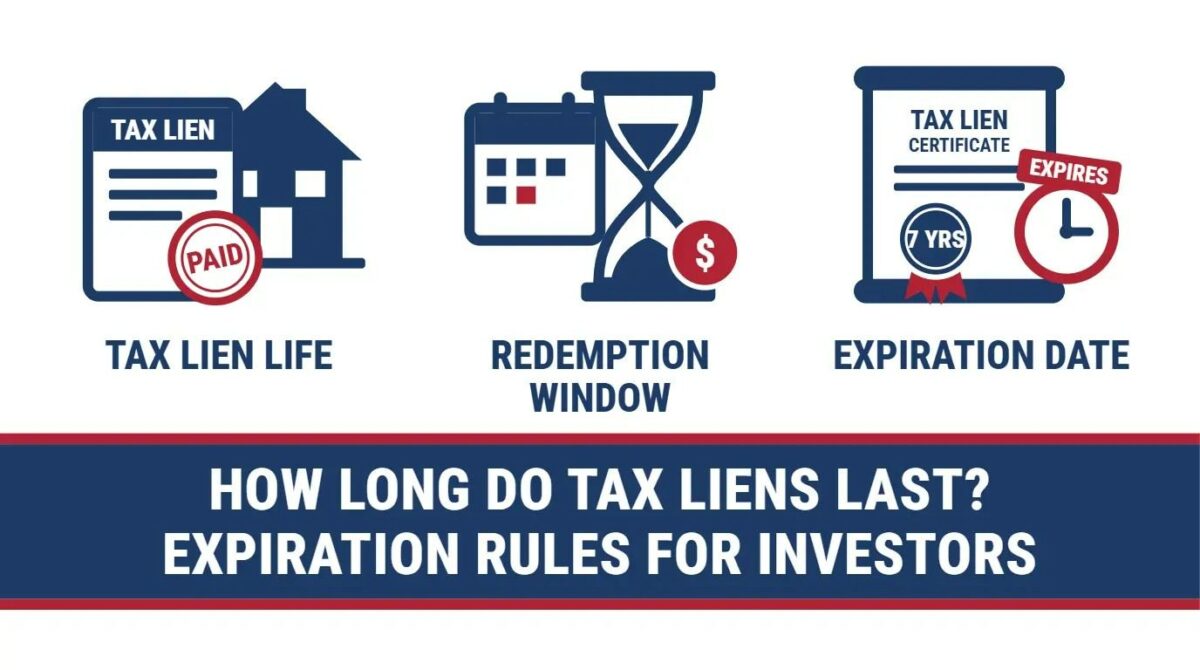
A tax lien on a property lasts until the tax is paid or the law bars it, and a tax lien certificate has its own clock under the state's statute. The two are not the same thing, and the certificate's clock decides how long an investor's purchase stays valid.

The Lien and the Certificate

In Florida, section 197.122 keeps the tax lien in force from January 1 of the tax year until it is discharged by payment or barred under chapter 95. Section 197.482 separately cancels a certificate once it expires. Our guide to what a tax lien certificate is explains the product an investor actually buys.

Tax Lien Life vs. Redemption Period

The redemption period is how long the owner has to repay and clear the lien, and the certificate's life is how long the investor's certificate stays valid before the law cancels it. They run on separate clocks. In Florida, for example, the owner can redeem before a tax deed is issued, unless full payment for the deed has been made to the clerk, while the certificate expires seven years after the first day of the sale. Our guide to the tax lien redemption period covers redemption details by state.

How Long Does a Tax Lien Certificate Last in Florida?

A Florida tax lien certificate lasts seven years from the date it is issued. Section 197.482 defines the issue date as the first day of the tax certificate sale as advertised, and it makes the certificate null and void and canceled if no tax deed has been applied for and no other administrative or legal proceeding, including a bankruptcy, is of record. The tax collector notes the cancellation date in its records.

The Seven-Year Rule

The seven years start on the first day of the sale, because the statute defines the issue date that way. Section 197.4725 adds that a county-held certificate bought after the sale keeps its original issue date for deed application timing. Section 197.482 also says the expiration rule does not apply to deferred payment tax certificates.

When You Can Apply for a Deed

A certificate holder can apply for a tax deed two years after April 1 of the year the certificate was issued, under section 197.502. Applying is what protects the certificate from expiring, because the statute cancels a certificate only when no deed has been applied for and no other proceeding is of record. The application starts a separate process, and our Florida tax deed sales guide explains what follows.

A Sample Timeline

The example below is hypothetical. Suppose a Florida sale starts on June 1, 2027. The certificate is issued on that date, the earliest deed application is two years after April 1, 2027, so after April 1, 2029, and the certificate expires on June 1, 2034 if no deed application or other proceeding is of record.


Ready to Start Investing the Right Way?

UTL's courses show you exactly what you need to do to get started with tax lien investing.

→ Explore UTL's Training Programs


How Long Do Tax Liens Last in Other States?

Other states set different expiration rules, and a certificate can last from several years to fifteen. The table lists the expiration period for four states, each taken from the state's statute. Our tax lien interest rates by state comparison covers more states.

State Expiration period Statute
Florida The certificate is null and void and canceled 7 years after the first day of the sale if no tax deed has been applied for and no other proceeding is of record Section 197.482
Colorado A lien created by a tax certificate does not remain a lien longer than 15 years after original issuance, and no treasurer's deed issues after that unless an application is pending; the statute has exceptions for county-held certificates and certain assignments C.R.S. 39-11-148
Arizona A foreclosure action may be brought starting 3 years after the sale and no later than 10 years after the last day of the month the lien was acquired; the period extends 12 months if a law or court order prohibits filing A.R.S. 42-18201(A)
Illinois The certificate or deed is void with no right to reimbursement unless the deed is taken out and recorded within 1 year after the redemption period expires, and time a court prevents the deed is excluded 35 ILCS 200/22-85


Check the Statute Before You Rely on a Table

Statutes change, so treat any table, including this one, as a starting point. The Arizona rule is in A.R.S. 42-18201, and the Gilpin County Treasurer says Colorado's treasurer's deed process changed on July 1, 2024. Read the current statute and your county's page before you buy.

What Happens When a Tax Lien Certificate Expires?

When a certificate expires, the state's statute cancels it or voids it, and the wording differs by state. Florida makes an expired certificate null and void and requires the tax collector to cancel it. Colorado requires the treasurer to issue a certificate of cancellation, and Illinois calls a certificate or deed that misses its deadline absolutely void with no right to reimbursement. Plan as if an expired certificate returns nothing, and confirm with the tax collector how a specific certificate would be handled.

How to Avoid Expiration

The certificate can be protected by acting before its deadline. In Florida, applying for a tax deed puts a proceeding of record, and so does another administrative or legal proceeding such as a bankruptcy. Deed applications have their own costs, so decide well before the deadline whether you want to apply. Our overview of the risks of buying tax liens explains what to weigh.

Track Every Date

Tracking prevents most expiration problems. Record the issue date, the earliest deed application date and the expiration date for every certificate on the day you buy it. Our guide to tracking tax lien redemptions shows one way to keep the records.


Keep Every Certificate Date in One Place

Use our redemption tracking guide to record issue, deed and expiration dates for every certificate you buy.

→ Read the Tracking Guide


Do Federal Tax Liens Expire?

A federal tax lien is the IRS's claim against a taxpayer's property, and an investor does not buy it at a county sale. The IRS releases the lien within 30 days after the debt is paid in full. It generally has 10 years from the date a tax was assessed to collect it, called the Collection Statute Expiration Date, and certain events can extend that period, so read the IRS guidance on the time it can collect taxes for your situation.

Mistakes to Avoid With Tax Lien Timelines

Four mistakes are easy to make when you are learning how long tax liens last: mixing up the certificate's life and the redemption period, assuming a late purchase restarts the certificate, relying on an old article and forgetting to record dates. Each one can be avoided with a plan made before you invest.

  • Mixing up the clocks: the certificate's expiration and the owner's redemption period are separate.
  • Assuming a late purchase restarts the clock: in Florida, a county-held certificate keeps its original issue date for deed timing.
  • Trusting old sources: statutes and county processes change, as Colorado's treasurer's deed process did in 2024.
  • Not recording dates: an expired certificate is canceled or void, so keep every date in one place.

United Tax Liens offers online courses and coaching for new tax lien investors, led by a team of active tax lien and deed investors, so you can learn the process before you invest.


Have Questions Before You Invest?

Contact a United Tax Liens coach with your questions before you commit your first dollar.

→ Contact a UTL Coach


Key Terms

Tax lien certificate: A claim on a property for unpaid taxes that an investor buys from the county. It pays interest if the owner redeems and does not transfer ownership.

Issue date: The date a certificate is treated as issued. In Florida it is the first day of the tax certificate sale as advertised.

Certificate expiration: The point at which the law cancels or voids a certificate. In Florida it is seven years after the issue date if no deed application or other proceeding is of record.

Redemption: The owner's right to repay the tax debt, plus interest and costs, and clear the lien.

Tax deed application: A certificate holder's request to start the process that can lead to a tax deed sale. In Florida it can be made two years after April 1 of the issue year.

Collection Statute Expiration Date: The date the IRS can no longer collect a federal tax assessment, generally 10 years after assessment unless extended.

Frequently Asked Questions About How Long Tax Liens Last

How long do tax liens last for investors?

A tax lien certificate lasts as long as state law says. In Florida it expires seven years after the first day of the sale unless a tax deed application or another proceeding is of record, in Colorado the lien created by a certificate lasts up to 15 years, and other states set different periods.

Do all states put an expiration date on tax lien certificates?

The examples in this guide show that the rules differ. Florida cancels a certificate after seven years, Colorado limits the certificate's lien to 15 years, Arizona limits the time to bring a foreclosure action to 10 years and Illinois voids a certificate or deed that misses its recording deadline. Read the statute for the state where you plan to invest.

Do tax liens ever expire on the property?

Florida's statute says the tax lien continues from January 1 of the tax year until it is discharged by payment or barred under chapter 95. Section 197.482 separately cancels a certificate seven years after issuance if no deed application or other proceeding is of record.

What happens if a tax lien certificate expires?

In Florida, an expired certificate is null and void and the tax collector cancels it. The statute does not describe a payment to the holder, so confirm with the tax collector before you rely on any return.

How long does an IRS tax lien last?

The IRS releases a federal tax lien within 30 days after the debt is paid in full. It generally has 10 years from assessment to collect, so those two events set the practical life of the lien.

Key Takeaways

  • Before you buy, answer “how long do tax liens last” for your state, because the certificate's expiration and the redemption period are separate clocks.
  • Record the issue date, the earliest deed application date and the expiration date for every certificate on the day you buy it.
  • Decide well before year seven in Florida whether you will apply for a tax deed, since the application is what keeps a certificate from expiring.
  • Read the current statute for your state, because expiration rules such as Colorado's 15-year limit and Illinois's one-year recording deadline are specific to each state.
  • Plan as if an expired certificate returns nothing, and confirm with the tax collector how a specific certificate would be handled.
  • Do not confuse a county tax lien certificate with an IRS tax lien, which follows its own rules and a 10-year collection period.


⚠ Earnings Disclaimer

Earnings Disclaimer: United Tax Liens provides real estate education and training only. We do not guarantee investment results or income. Individual outcomes vary based on effort, market conditions, and individual skill. Investing of any kind carries risk. This content is for educational purposes only and does not constitute legal, tax, or financial advice. Consult licensed professionals before making investment decisions.


Related Reading: Tax Lien Investing Guide | The Tax Lien Redemption Period Explained | Earnings Disclosure

A junior lien is a lien that ranks behind one or more other liens on the same property, so it is paid only after the senior liens are satisfied. This guide is for new tax lien investors who want to know where junior liens sit at tax sales and what happens to them, and it covers how priority is set, what Florida's statutes say about junior liens at a tax deed sale and how to check a property.

Last reviewed against the 2026 Florida Statutes and the Cornell Legal Information Institute on September 30, 2026. This guide is educational and is not legal, tax or investment advice. Lien rules differ by state, so confirm them with a licensed attorney or title company before you buy.

What Is a Junior Lien?

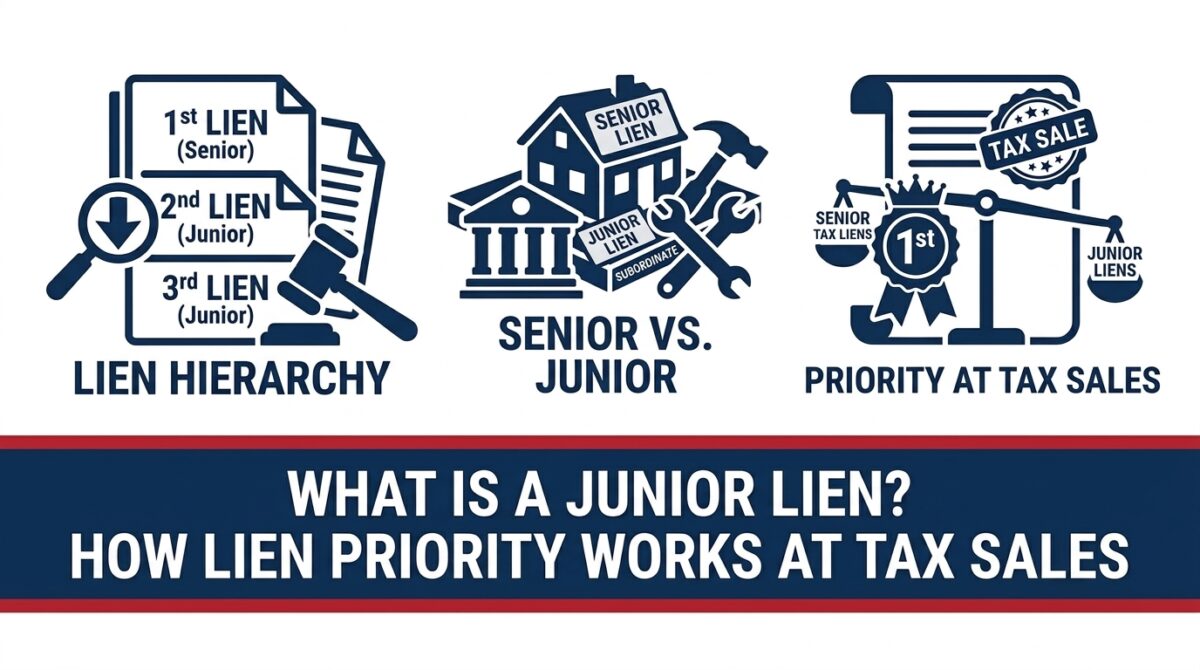
A junior lien is a lien on a property that ranks lower in priority than another lien on the same property. The Cornell Legal Information Institute defines it as a security interest subordinate to another security interest, and the higher-ranked claim is called a senior lien. The senior lien is paid in full before the junior lien receives anything.

The Short Definition

Priority decides who is paid first when a property is sold or foreclosed. If the sale brings in less money than the total debt, the senior lien takes its share first and the junior lien is paid only from what is left. A junior lienholder can therefore recover less than it is owed, or nothing, even though its claim is valid.

Senior and Junior Are Relative

A lien is not junior or senior by nature. The Legal Information Institute notes that a lien can be junior to an older lien and senior to a newer one at the same time. Under the first-in-time rule, a second mortgage recorded after a first mortgage is junior to it and senior to a judgment lien recorded after the second mortgage.

Position What it means Example
Senior lien Paid before the liens ranked below it A first mortgage recorded before other liens
Junior lien Paid only after the liens ranked above it A second mortgage or a later judgment lien
Both at once Junior to older liens and senior to newer ones A second mortgage that sits between a first mortgage and a later judgment


Common Examples of Junior Liens

  • Second mortgage: a mortgage recorded after the first mortgage ranks behind it.
  • Judgment lien: in Florida, a judgment becomes a lien when a certified copy is recorded, so a judgment recorded after a mortgage ranks behind that mortgage.
  • Construction lien: section 713.07 gives an encumbrance recorded before the notice of commencement priority over the construction lien.
  • HOA lien: section 720.3085 says an HOA lien reaches a first mortgage of record only from the date its claim of lien is recorded.

These are examples, and the full list of lien types is covered in our guide to the types of liens in real estate.

How Is Lien Priority Set?

Lien priority is set mainly by recording date, with exceptions written into statutes. The Legal Information Institute says priority is generally determined by the first-in-time rule, with the date of recording deciding the order, and that a statute can make an exception, especially for federal and state tax liens.

First in Time

Recording is how a claim becomes visible to the world, so the earliest recorded claim ranks first under the first-in-time rule. Florida's recording statute, section 695.01, says an unrecorded mortgage is not effective against later purchasers or creditors who had no notice. A lender that wants a senior position records the mortgage promptly.

Statutory Exceptions

Some liens follow their own rules instead of the recording date. In Florida, section 197.122 makes property taxes a first lien, superior to all other liens, from January 1 of the tax year. Section 713.07 sets a construction lien's priority from the recorded notice of commencement, and section 720.3085 lets an HOA lien reach a first mortgage of record only from the recording of a claim of lien. A lien's type therefore matters as much as its date.


Ready to Start Investing the Right Way?

UTL's courses show you exactly what you need to do to get started with tax lien investing.

→ Explore UTL's Training Programs


Where Do Junior Liens Sit at a Tax Sale?

At a tax sale, junior liens sit behind the property tax lien. In Florida, the tax lien is a first lien, superior to all other liens, so a mortgage, a judgment lien or an HOA claim ranks behind the taxes even if it was recorded earlier. Other states set their own rules, so confirm the statute where the property is located.

What This Means for a Tax Lien Certificate Holder

A tax lien certificate represents the tax lien, which is the senior claim. Our guide to what a tax lien certificate is covers the product in full. The certificate holder does not own the property, and the owner or another party can repay the tax debt and end the lien.

Junior Lienholders Can Pay the Taxes

A junior lienholder has a reason to protect its position, and Florida law gives it a way. Under section 197.472, a person may redeem a tax certificate at any time after it is issued and before a tax deed is issued by paying the tax collector the face amount plus interest, costs and charges. When a junior lienholder redeems, the certificate holder is repaid with interest. Our guide to the tax lien redemption period explains how redemption timing works.

What Happens to Junior Liens in a Florida Tax Deed Sale?

In a Florida tax deed sale, junior lienholders get notice, their liens do not survive the deed unless the statute names them, and they can claim surplus money if the property sells for more than the amount owed. Each step comes from a statute you can read, and our Florida tax deed sales guide covers the full process. This section uses Florida as its working example, and other states set their own rules.

Junior Lienholders Are Notified

The law requires notice before the sale to lienholders and mortgagees of record where an address is listed on the recorded document or designated with the Department of State. Under section 197.502(4), the tax collector's statement names the persons to be notified, and section 197.522 requires the clerk to mail notice by certified mail at least 20 days before the sale. A failure to receive notice does not affect the validity of the tax deed.

What the Statute Says About Liens After the Deed

Florida's tax deed statute cuts off claims on the property, with named exceptions. Section 197.552 says that, except as the chapter specifically provides, no right, interest, restriction or covenant survives the issuance of a tax deed. The one lien exception it names is a lien of record held by a municipal or county governmental unit, special district or community development district that is not satisfied when the sale proceeds are disbursed. A recorded mortgage or judgment lien is not on that list, but confirm the result for a specific property with an attorney.

Surplus Funds and Lienholder Claims

When a property sells for more than the certificate holder's statutory bid, section 197.582 pays the surplus to governmental liens first. The clerk holds the balance for the persons who were notified, and to the extent possible senior claimants are paid in full before junior claimants or the former owner. Claimants have 120 days to file, and our guide to county surplus funds explains the claim process.

What Does a Junior Lien Mean for a Tax Lien Investor?

A junior lien on a property tells you who else has a stake in the outcome, and it does not change your senior position. In Florida, the certificate holder's tax lien ranks ahead of the junior claims. What the junior liens change is the picture around your investment.

  • More parties have a reason to act: a lienholder who is notified before a deed sale can pay the taxes to protect its own claim.
  • A deed sale can pay junior claimants: surplus above the certificate holder's statutory bid goes to governmental liens, then to senior and junior claimants, then to the former owner.
  • Some claims can follow a deed buyer: a governmental lien of record can survive a Florida tax deed.
  • Priority is not value: a senior position on a property worth less than the tax debt still protects little.

Our overview of the risks of buying tax liens explains how experienced investors weigh those limits.


Research Every Property Before You Bid

Use our property research guide to review taxes owed, liens and property condition before you enter a bid.

→ Read the Property Research Guide


How Do You Check for Junior Liens on a Property?

Check for junior liens by searching the county's official records for the parcel and its owner, then confirm what you find with a title company or attorney. Mortgages, judgments and construction liens are protected by recording, so the county's records are where they show up. Our guide to how to research property tax liens before you bid walks through the full routine. Take it one property at a time and finish the lien search before you set a price.

Mistakes to Avoid With Junior Liens

Four mistakes are easy to make when you are learning about junior liens: assuming an older lien always ranks first, assuming a junior lien always survives a tax sale, skipping the records search and copying one state's rules into another. Each one can be avoided with a plan made before you invest.

  • Assuming older means senior: property taxes rank first in Florida regardless of when other liens were recorded.
  • Assuming junior liens survive: Florida's tax deed statute says no right or interest survives the deed, except the governmental liens it names.
  • Skipping the records search: liens that are recorded but not obvious can affect what a deed buyer takes.
  • Copying one state's rules: priority, redemption and surviving liens vary by state.

United Tax Liens offers online courses and coaching for new tax lien investors, led by a team of active tax lien and deed investors, so you can learn the process before you invest.


Have Questions Before You Invest?

Contact a United Tax Liens coach with your questions before you commit your first dollar.

→ Contact a UTL Coach


Key Terms

Junior lien: A lien that ranks behind one or more other liens on the same property and is paid only after the liens above it are satisfied.

Senior lien: A lien that ranks ahead of other liens and is paid first.

Subordination: An agreement or process that lets another creditor move ahead of a lien. The IRS describes it for federal tax liens.

Redemption: The right of the owner, or in Florida any person, to pay the tax debt plus interest and costs and clear a tax certificate before a deed is issued.

Surplus funds: Money bid above the certificate holder's statutory amount at a Florida tax deed sale, paid out to lienholders and others under section 197.582.

Lien of record: A lien that has been recorded in the county's official records.

Frequently Asked Questions About Junior Liens

What is a junior lien in real estate?

A junior lien is a lien that ranks behind one or more other liens on the same property. It is paid only after the senior liens are satisfied, so a junior lienholder can recover less than it is owed if the property sells for too little.

Is a second mortgage a junior lien?

Yes, when it is recorded after the first mortgage it is junior to it, because it ranks behind the first mortgage by recording date. It can also be senior to a lien that is recorded after it. Confirm the actual order in the county's records.

Is a tax lien a junior lien?

In Florida, no. Section 197.122 makes property taxes a first lien, superior to all other liens. Other states set their own rules, so check the statute where the property is located.

Do junior liens survive a tax deed sale in Florida?

Under section 197.552, no right or interest survives a tax deed except as the chapter provides, and the exception it names is a governmental lien of record that is not satisfied when the sale proceeds are disbursed. A recorded mortgage or judgment lien is not named as surviving, but confirm the result with an attorney.

Can a junior lienholder pay the property taxes?

Yes. Under section 197.472, a person may redeem a Florida tax certificate before a tax deed is issued by paying the tax collector the face amount plus interest, costs and charges. Paying protects the junior lienholder's position and repays the certificate holder.

Who gets the surplus after a tax deed sale?

Under section 197.582, governmental liens are paid first, and the clerk holds the balance for the persons who were notified. To the extent possible, senior claimants are paid in full before junior claimants or the former owner, and claims must be filed within 120 days.

Key Takeaways

  • Know what a junior lien is: a lien that ranks behind other liens on the same property and is paid only after the senior liens are satisfied.
  • Confirm the priority rules for your state, since recording dates decide some rankings and statutes create exceptions such as property taxes.
  • Treat property taxes as first in Florida under section 197.122, and confirm how other states rank them.
  • Expect junior lienholders to be notified before a Florida tax deed sale, and know they can redeem the certificate to protect their claims.
  • Search the county's official records for every lien on a parcel before you commit money, and ask an attorney what survives a deed sale.
  • Do not treat a senior position as a guarantee, since the property's value and the owner's timing still decide what you are paid.


⚠ Earnings Disclaimer

Earnings Disclaimer: United Tax Liens provides real estate education and training only. We do not guarantee investment results or income. Individual outcomes vary based on effort, market conditions, and individual skill. Investing of any kind carries risk. This content is for educational purposes only and does not constitute legal, tax, or financial advice. Consult licensed professionals before making investment decisions.


Related Reading: Tax Lien Investing Guide | Understanding County Surplus Funds | Earnings Disclosure

The main types of liens in real estate are property tax liens, mortgages, construction liens, homeowners' association liens, judgment liens and federal tax liens, and each one is paid in an order set by the law and by when it was recorded. This guide is for new investors who want to understand how those liens differ and why a property tax lien sits at the front of the line in Florida. It also explains what that priority does and does not do for someone who buys a tax lien.

Last reviewed against the 2026 Florida Statutes and the IRS website on September 30, 2026. This guide is educational and is not legal, tax or investment advice. Lien rules differ by state, so confirm them with a licensed attorney or title company before you buy.

What Is a Lien in Real Estate?

A lien is a legal claim on a property that secures a debt, and the claim stays with the property until the debt is paid or the lien is removed. The property owner can still live in the property or sell it, but the lienholder's claim has to be dealt with. Investors care about liens because the claims on a property decide who gets paid and in what order.

Voluntary and Involuntary Liens

Liens fall into two broad groups depending on how they start. A voluntary lien exists because the owner agreed to it, and a mortgage is the standard example. An involuntary lien arises without the owner's consent, either by law, as with property taxes, or through a creditor's action, as with a court judgment.

Why Investors Need to Understand Them

A tax lien investor buys a lien, so the ranking of every other claim on the property affects the deal. A property with several liens shows who else has a claim and who may act if the taxes go unpaid. Reading the liens on a parcel is part of judging how safe your money is.

What Are the Main Types of Liens in Real Estate?

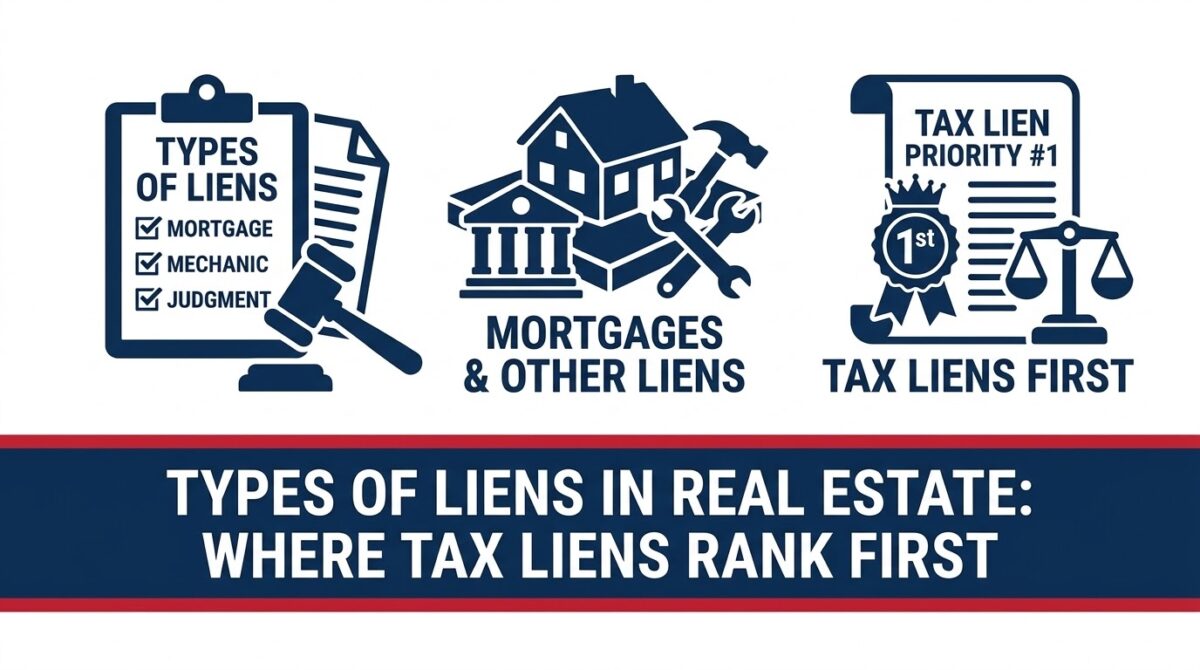
The six main types of liens for investors to know are property tax, mortgage, construction, homeowners' association, judgment and federal tax liens. The table shows how each one arises and gives a Florida example of its priority rule, since Florida's statutes are easy to check. This guide uses Florida as its worked example, and other states set their own priority rules.

Lien type How it arises Florida example
Property tax lien Attaches by law when property taxes are levied Section 197.122: a first lien, superior to all other liens, from January 1 of the tax year
Mortgage lien The owner pledges the property to secure a loan Section 695.01: an unrecorded mortgage is not effective against later purchasers or creditors without notice
Construction lien A contractor or supplier is not paid for work on the property Section 713.07: priority runs from the recorded notice of commencement, or from the claim of lien if none was filed
HOA lien An association claims unpaid assessments under its governing documents Section 720.3085: relates back to the recorded declaration, but for first mortgages of record it takes effect when the claim of lien is recorded
Judgment lien A court judgment is recorded against the owner's real property Section 55.10: a lien when a certified copy is recorded, for 10 years and extendable for another 10
Federal tax lien The IRS claims unpaid federal tax after assessment, notice and non-payment IRS: covers all property, including real estate, and a public notice alerts other creditors


Property Tax Liens

A property tax lien is the government's claim for unpaid real estate taxes, and it attaches by law without any action by the owner or the county. In Florida, section 197.122 makes taxes a first lien, superior to all other liens, and the lien runs from January 1 of the year the taxes were levied until they are paid or barred by law. This is the lien that tax lien investors buy through a tax certificate.

Mortgage Liens

A mortgage lien is created when a borrower pledges a property to secure a loan. Because the owner agrees to it, it is a voluntary lien. Florida's recording statute says an unrecorded mortgage is not effective against later purchasers or creditors who had no notice, so a lender that wants protection records the mortgage.

Construction Liens

A construction lien, often called a mechanic's lien, protects contractors, laborers and suppliers who are not paid for work on a property. Under section 713.07, these liens take priority from the recording of the notice of commencement, and a claim recorded before that time keeps priority over them. The date of recording therefore decides the order between a construction lien and a mortgage.

HOA and Condominium Assessment Liens

A homeowners' association can hold a lien for unpaid assessments when its governing documents allow it. Under section 720.3085, that lien relates back to the recording of the community's declaration, except that it only takes effect against first mortgages of record when the association records a claim of lien. Condominium law adds limits: section 718.116 caps a first mortgagee's liability for old assessments at the lesser of 12 months of unpaid common expenses and regular assessments or 1% of the original mortgage debt, under conditions the statute sets.

Judgment Liens

A judgment lien follows a court ruling in favor of a creditor. In Florida, a judgment becomes a lien on real property in a county when a certified copy is recorded in the official records, and the lien lasts an initial 10 years and can be extended for another 10 under section 55.10. A judgment that is never recorded in that county does not become a lien on its real property.

Federal Tax Liens

A federal tax lien is the IRS's legal claim against a person's property when they fail to pay a tax debt. The IRS says the lien exists after it assesses the liability, sends a notice and demand for payment, and the taxpayer neglects or refuses to pay, and that it covers real estate, personal property and financial assets. The IRS files a public Notice of Federal Tax Lien to alert other creditors, and its guide to understanding a federal tax lien explains releases and subordination.


Ready to Start Investing the Right Way?

UTL's courses show you exactly what you need to do to get started with tax lien investing.

→ Explore UTL's Training Programs


How Does Lien Priority Work?

Lien priority is the order in which claims on a property are paid, and it depends on the type of lien, the date it was recorded and the statutes of the state. A lien that ranks ahead of the others is senior, and a lien that ranks behind is junior. The order matters most when a property is sold, foreclosed or auctioned for less than the total debt.

Recording Dates Set Many Rankings

Some priority questions come down to which claim was recorded first. Florida's recording statute protects later purchasers and creditors from unrecorded interests, and section 713.07 ties a construction lien's priority to a recording date. Recording is also how a court judgment becomes a lien on real property in Florida.

Recording does not settle every case. The HOA rule above shows a lien that relates back to an earlier document, and property taxes rank first regardless of when other liens were recorded. Each lien type has its own rule, so read the statute for the lien in front of you.

Why Property Taxes Rank First

Property tax liens rank first because the law places them ahead of other claims. Florida's statute calls them a first lien, superior to all other liens, and the lien exists from January 1 of the tax year. In Arizona, the author of an article in the Arizona School of Real Estate and Business writes that property taxes have the highest lien priority by law and that federal tax liens rank by the order recorded. That is one practitioner's summary, so check your own state's statutes.

Other states may treat particular liens differently, so treat the first position for taxes as a pattern to confirm in your own state and not as a rule for every state.

Senior Liens vs. Junior Liens

A senior lien is paid before a junior lien, and a lien is junior to every lien ranked above it. In Florida, a property tax lien is senior to every other lien on the parcel, and section 713.07(3) shows how recording order creates the rest: an encumbrance recorded before a construction lien attaches has priority over that lien. The IRS adds that a subordination can let other creditors move ahead of a federal tax lien.

Where Do Tax Liens Rank Among the Types of Liens?

Tax liens rank first among the types of liens on a property in Florida, and that first position is what a tax lien certificate represents. The certificate does not make you the owner. It gives you the county's tax claim and the right to be repaid with interest if the owner redeems. Our guide to what a tax lien certificate is covers the product in full.

What Priority Means for a Tax Lien Investor

First position means the taxes come out ahead of mortgages, judgments and other claims when the property is sold or the lien is resolved. When the owner or another party pays the tax debt, the lien is redeemed and the certificate holder is repaid with interest. That is why the lien is described as a strong claim and not a guaranteed payout.

What Happens to Other Liens After a Deed Sale

The effect on other liens depends on the state and the sale. In Florida, section 197.552 says liens held by governmental units and special districts can survive a tax deed sale if they are not satisfied from the proceeds, so a deed buyer can inherit some claims. Money bid above the certificate holder's statutory amount is paid out under section 197.582, and our guide to county surplus funds explains who can claim it. Our Florida tax deed sales guide covers the deed stage.

What Priority Does Not Guarantee

Priority decides who is paid first, and it does not decide whether there is enough money to pay anyone. A first lien on a property worth less than the tax debt protects little. Priority also does not shorten the wait, because the owner decides when to repay. Our overview of the risks of buying tax liens explains how experienced investors weigh those limits, and our guide to tax lien vs tax deed investing shows how the two products differ.


Research Every Property Before You Bid

Use our property research guide to review taxes owed, liens and property conditions before you enter a bid.

→ Read the Property Research Guide


How to Check What Liens Are on a Property

Check a property's liens by searching the county's official records for the parcel and its owner, then confirm what you find with a title company or attorney. Judgments, mortgages and construction liens are protected by recording, so the county's records are where they show up, and the tax collector's records show other tax certificates on the same parcel. Our guide to how to research property tax liens before you bid walks through the full routine.

Mistakes to Avoid With Liens

Four mistakes are easy to make when you are learning about liens: assuming every lien ranks by date, assuming priority means payment, skipping the records search and forgetting that rules differ by state. Each one can be avoided with a plan made before you invest.

  • Assuming date order always wins: property taxes and some HOA liens follow their own rules.
  • Assuming priority means payment: a first lien on a low-value property may still not be repaid in full.
  • Skipping the records search: liens that are recorded but not obvious can affect a deed buyer.
  • Copying one state's rules: priority, redemption and surviving liens vary by state.

United Tax Liens offers online courses and coaching for new tax lien investors, led by a team of active tax lien and deed investors, so you can learn the process before you invest.


Have Questions Before You Invest?

Contact a United Tax Liens coach with your questions before you commit your first dollar.

→ Contact a UTL Coach


Key Terms

Lien: A legal claim on a property that secures a debt.

Lien priority: The order in which claims on a property are paid, set by the type of lien, its recording date and state law.

Recording: Filing a document in the county's official records so others have notice of it.

Redemption: The owner's right to repay a tax debt, plus interest and costs, and clear a tax lien.

Tax lien certificate: A claim on a property for unpaid taxes that an investor buys from the county. It pays interest if the owner redeems and does not transfer ownership.

Federal tax lien: The IRS's legal claim against a person's property when they fail to pay a federal tax debt.

Frequently Asked Questions About Types of Liens

What are the main types of liens on real estate?

The main types are property tax liens, mortgage liens, construction liens, homeowners' association liens, judgment liens and federal tax liens. Some are voluntary, like a mortgage, and others arise by law or through a court, like taxes and judgments.

Which lien has priority?

It depends on the type of lien and the state. In Florida, property taxes are a first lien, superior to all other liens, and other liens generally follow their own statutes and recording dates. Confirm the rules in your state before you rely on a ranking.

Do tax liens come before mortgages?

In Florida, yes. Section 197.122 makes property taxes a first lien, superior to all other liens, so a tax lien ranks ahead of a mortgage. Other states differ in the details, so check the statute where the property is located.

Can a lien be removed?

Yes. A lien is removed when the debt is paid or the lien is otherwise released, and the release is recorded where the lien was recorded. The IRS says it releases a federal tax lien within 30 days after the tax debt is paid in full, and other options such as discharge or subordination exist in some cases.

What does lien priority mean?

Lien priority is the order in which claims on a property are paid. It depends on the type of lien, the date it was recorded and the statutes of the state, and in Florida property taxes are a first lien, superior to all other liens.

Key Takeaways

  • Learn the six main types of liens, property tax, mortgage, construction, HOA, judgment and federal tax, before you evaluate any property.
  • Read the statute for each lien type in your state, because priority rules differ and recording dates do not settle every case.
  • Remember that property tax liens rank first in Florida and treat that as a state-specific rule to confirm elsewhere.
  • Search the county's official records and the tax collector's records for every lien on a parcel before you commit money.
  • Do not treat first position as a guarantee, since the property's value and the owner's timing still decide what you are paid.
  • Ask a title company or attorney what survives a sale before you buy a deed.
⚠ Earnings Disclaimer

Earnings Disclaimer: United Tax Liens provides real estate education and training only. We do not guarantee investment results or income. Individual outcomes vary based on effort, market conditions, and individual skill. Investing of any kind carries risk. This content is for educational purposes only and does not constitute legal, tax, or financial advice. Consult licensed professionals before making investment decisions.


Related Reading: Tax Lien Investing Guide | What Is a Tax Lien Certificate? | Earnings Disclosure

Tax yield investments are investments that earn a return from unpaid property taxes, either as interest on a tax lien certificate or as profit from a property bought at a tax deed sale. This guide is for aspiring investors who want to understand how those returns work, what drives them and what can go wrong before they commit money. It explains the concepts, the differences between lien and deed states, the risks, the tax basics and how to start.

Last reviewed against the 2026 Florida Statutes and the sources named in the text on September 30, 2026. This guide is educational and is not legal, tax or investment advice. Rules differ by state and county, so confirm them with the county before every purchase.

What Are Tax Yield Investments?

Tax yield investments are investments whose return comes from delinquent property taxes. When an owner does not pay a property tax bill, the local government can sell the debt, or sell the property, to an investor. The investor's yield is the interest earned on a tax lien or the profit made on a tax deed property.

The Short Definition

A tax yield investment is either a tax lien certificate or a tax deed. A tax lien certificate is a claim on a property for unpaid taxes that pays interest when the owner repays. A tax deed is ownership of the property itself, bought at an auction after the owner fails to pay. The two products share a source, unpaid property taxes, and they behave very differently.

Why Governments Create These Investments

Local governments depend on property tax revenue, so they need a way to collect when owners do not pay. Selling the debt to an investor gets the county its money quickly, and the investor takes on the wait for repayment. In Florida, for example, section 197.122 of the Florida Statutes makes unpaid property taxes a first lien that ranks ahead of other liens on the property. That priority is what gives a certificate its collateral.

Priority is a feature of the lien and not a promise of profit. A first lien on a property worth less than the tax debt protects little, which is why research comes before any bid.

Where the Yield Comes From

Yield comes from one of three sources, depending on the product and the state.

  •  Interest paid by the owner when a tax lien is redeemed.
  • Profit from selling or renting a property acquired through a tax deed.
  • Profit from a property acquired when a lien is foreclosed and the owner never redeems.

In a lien, the return comes from the first source, and that interest is the tax lien yield, which the investor earns only if the owner redeems. The Arizona School of Real Estate and Business published an article by a practitioner who says the majority of liens are redeemed by the owner and only a small share end with the bidder acquiring the property. That is one practitioner's view of Arizona, so treat it as a rough guide and not a national figure.

The third source, foreclosure, works differently in each state. In Arizona, A.R.S. 42-18201 allows a foreclosure action to be brought starting three years after the sale. In Florida, the equivalent step is a tax deed application, which is allowed two years after April 1 of the year the certificate was issued. In both states the step is separate from earning interest, it costs money and it does not always succeed, so treat it as a possible outcome and not as the plan.

The Parties in Every Deal

Every tax yield investment involves the same four parties, and each wants something different. Knowing who they are helps you see where your money and your risk sit.

Party Role What they want
County or tax collector Runs the sale and collects the tax debt To recover unpaid taxes and costs
Property owner Owes the taxes and can repay to keep the property To keep the property and end the debt
Other lienholders Hold mortgages or other claims on the property To protect their own claims, often by paying the taxes
Investor Buys the lien or the deed A return on the money, after costs and time


The owner and the other lienholders are the most likely source of a lien payout. When one of them pays the tax debt, the lien is redeemed and the investor is repaid with interest. That is why a lien is described as an income product and a deed is described as a property product.

How Does a Tax Yield Investment Work From Start to Finish?

A tax yield investment moves through the same stages in most states: a tax goes unpaid, the county sells the debt, the owner has a chance to repay, and an unpaid lien can lead to a deed. The details change by state, and Florida shows the sequence clearly.

Stage One: The Tax Goes Unpaid

Property taxes become delinquent on a fixed date, and the county then publishes the unpaid accounts. In Florida, taxes become delinquent on April 1, and the tax collector advertises the delinquent list before the annual sale. Owners can still pay before the sale, so some advertised parcels drop off the list before bidding starts.

Stage Two: The County Sells the Debt

The county sells a tax lien certificate to the investor who wins the auction. The investor pays the unpaid taxes and costs, and the county receives its money. The certificate is a lien and not a deed, so the owner keeps the property while the lien is outstanding.

Stage Three: The Owner Can Repay

The owner can redeem the lien by paying the county the amount due plus interest, and the county pays the investor. Redemption windows differ by state, and the investor cannot control when the owner pays. In Florida, the certificate holder may not contact the owner until two years after April 1 of the year the certificate was issued.

Stage Four: An Unpaid Lien Can Lead to a Deed

If nobody redeems, the certificate holder may be able to start the process that leads to a tax deed sale. In Florida, the holder applies for a tax deed and the Clerk of the Circuit Court runs a public auction. The certificate holder does not automatically receive the property, and other bidders can win it.

Stage Five: The Deed Buyer Owns the Result

The winner of a tax deed auction receives a deed and takes the property as it is. The Duval County Clerk, for example, says it does not guarantee clear title. From that point the return depends on what the buyer does with the property.

Which States Sell Liens, Deeds or Both?

States fall into three broad groups: lien states, deed states and hybrid states. Which group your state belongs to decide what you can buy and how the return works.

  • Lien states sell tax lien certificates to investors, and the investor earns interest if the owner redeems. Illinois is a lien state where investors bid a penalty down instead of an interest rate.
  • Deed states sell the property itself at a tax deed auction after the owner fails to pay.
  • Hybrid states sell liens first and hold a deed sale only if a lien goes unredeemed. Florida is a hybrid state.

Some deed states add a redemption period after the sale, which lets the former owner buy the property back. Georgia is one example: United Tax Lien's guide to its rules is titled “Georgia Tax Deed Sales: How Redeemable Deeds and the 20% Penalty Work.” Rules like this change what a deed buyer can count on, so read your state's statutes before you plan around a purchase.

Never assume one state's rules apply in another. The county's own page and the state's statutes are the sources that count.

How Tax Lien Returns Work

A tax lien return is interest on the money you pay to clear the owner's taxes, and it is earned only if and when the owner redeems. Your tax lien yield is that interest measured against the money you pay and the time it is tied up. The certificate's face value is the amount you pay, the interest rate is set by the state's rules or by your bid, and the payout arrives when the owner repays the county.

What You Buy and What You Earn

You buy a certificate for the delinquent taxes plus the costs of the sale, and the certificate earns interest until it is redeemed. Under Chapter 197 of the Florida Statutes, the face amount includes the delinquent taxes, interest, advertising costs and the costs of the sale. The Florida Statutes, Chapter 197 set those rules for every Florida county.

The certificate does not transfer ownership. Your job during the hold is to wait and keep records, because the owner decides when to repay.

How States Decide What a Lien Pays

States use different systems to decide how much a certificate pays, and the system shapes a return more than most other factors. Three patterns are worth knowing.

  • Bid-down systems: investors bid the interest rate down from a ceiling, and the lowest rate wins. Florida and Arizona both work this way.
  • Penalty systems: investors bid a penalty down instead of an interest rate. Illinois works this way, and the penalty applies for each six-month period the lien stays unpaid.
  • Other systems: some states use a rate fixed by statute or different bidding rules, and the details change by state.

A bid-down auction rewards the lowest rate you are willing to accept and punishes the highest you are willing to chase. Every step you bid away improves your chance of winning and lowers the return you keep. Our tax lien interest rates by state comparison lists each state's system side by side, and the real math behind tax lien ROI walks through the calculations.

Why Time Matters

A tax lien yield depends on how long the money is tied up as well as on the rate. The same rate can look very different when the owner repays quickly and when the certificate sits for years. Some states also add a minimum payout that protects early redemption, and the value of that protection depends on when the owner pays.

Redemption timing is not in your control. Plan for the slow case, and treat a quick repayment as a bonus.

What Your Tax Lien Yield Depends On

Four things decide your tax lien yield, and only some of them are in your hands.

  • The rate: set by the state's system or by your own bid.
  • The wait: how long the owner takes to repay.
  • The competition: how many other investors are bidding on the same parcels.
  • The collateral: what the property behind the lien is worth if the owner never repays.

You control the rate you are willing to accept and the parcels you choose. You do not control the wait, and you influence the competition only by choosing where to bid.


Ready to Start Investing the Right Way?

UTL's courses show you exactly what you need to do to get started with tax lien investing.

→ Explore UTL's Training Programs


How Tax Deed Returns Work

A tax deed return is the profit you make on a property bought at a tax deed sale, after every cost of buying, clearing and selling or holding it. There is no interest rate. You buy an asset, and the return depends on what you pay and what the asset is worth.

What You Buy

A tax deed sale sells the property itself. In Florida, the Clerk of the Circuit Court runs the sale, and the winner receives a tax deed. The deed stage in that state only starts after a tax certificate goes unredeemed and the holder applies for a deed.

Deed sales are sold as is in the counties reviewed for this guide. The Duval County Clerk says it does not guarantee clear title, and Orange County's Comptroller says the same. Buying a deed means taking the property with whatever problems it has.

How the Opening Bid Sets the Price

The opening bid at a Florida deed sale is built from the tax debt and the costs of the sale, and it is not a market price. Under section 197.542, it equals the amount needed to redeem the certificate, plus the applicant's costs, plus interest and notice costs. On homestead property, half of the latest assessed value is added.

Other bidders can push the price higher, and the price at which the auction closes sets your cost. The opening bid is a floor and not a forecast.

Where the Profit Comes From

Profit on a deed comes from the gap between your all-in cost and the property's value when you sell it, or from the income it earns while you hold it. There are two common routes.

  • Resale: buy, clear title, make repairs and sell at market price.
  • Rental or hold: buy, clear title and collect rent while the property's value changes over time.

Both routes depend on the property, the local market and your skill, so a deed return has more moving parts than a lien return.

Costs That Reduce a Deed Return

Several costs sit on top of the winning bid, and some of them are large. The main ones are listed below.

Fees at closing: the Duval County Clerk lists recording fees, proof of publication and documentary stamps that are based on the winning bid.

  • Title and legal work: the Duval Clerk says clear title may require a quiet-title lawsuit, and those fees are on top of the price.
  • Condition and occupancy: repairs, clean-up and getting a former occupant out all cost time and money.
  • Carrying costs: taxes, insurance and utilities continue until you sell or rent.

Some liens can survive a tax deed sale, so check the property's records before you bid.

After the Sale: Redemption, Possession and Surplus

Winning a deed auction does not end the process. Several rules decide whether you keep the property, when you can use it and what happens to any money bid above the opening price.

  • Redemption: the Duval County Clerk and the Orange County Comptroller both say an owner can redeem until the office receives your full payment, and if the owner redeems, the property is not sold to you.
  • Payment deadlines: section 197.542 requires payment within 24 hours, excluding weekends and legal holidays, and counties set their own cutoffs. Missing the deadline costs your deposit and can get you banned from future auctions.
  • Recording: the Duval Clerk says deeds are recorded seven to ten business days after the sale, and Orange County's Comptroller says the deed is typically issued within 24 hours of final payment.
  • Possession: the statute gives the buyer the right to immediate possession once the deed is signed and recorded, and if the occupant refuses to leave, the buyer can ask the circuit court for a writ of assistance.
  • Disputes: the Duval Clerk warns that a former owner can dispute the sale in court, and a judge would then decide ownership.
  • Surplus: under section 197.582, money bid above the certificate holder's statutory amount goes first to governmental lienholders and is then held for people with an interest in the property, so overbidding builds no equity for you.
  • Unsold properties: a property that receives no bid can end up on the lands available for taxes list, where the Duval Clerk says anyone can buy it for the opening bid plus omitted years' taxes after 90 days.

Tax Lien vs Tax Deed Returns: Which Yield Fits Your Goals?

When you compare tax lien vs tax deed returns, a lien is the more passive of the two products, and a deed suits investors who want property and can handle the work. Neither fits everyone. The right choice depends on your capital, your time, your appetite for risk and the state you plan to use.

Factor Tax lien certificate Tax deed
What you buy A lien for unpaid taxes The property
How you earn Interest when the owner redeems Resale or rental profit
Return is set by State rules and your bid Purchase price, costs and market value
Typical involvement Mostly passive after the sale Hands-on work
Main risks Low yield, long waits, thin collateral Title problems, condition, surviving liens
Capital needed Face value of each certificate Full bid plus fees and repairs


Hybrid States and Where the Products Meet

Some states sell both products in sequence. Florida is a hybrid state: it sells tax certificates first, and a deed sale follows only if a certificate goes unredeemed. That gives a lien investor a path to the deed stage after the waiting period, and it gives a deed buyer a source of properties. The states differ, so check which system your state uses before you plan.

Matching the Product to the Investor

For tax yield investments, choosing a product is a decision about how you want to spend your time and money. These questions help you sort it out.

  • Do you want income with little day-to-day work, or are you willing to manage a property?
  • How much money can you leave tied up, and for how long?
  • Can you handle title work, repairs and a possible occupant, or do you want to avoid them?
  • Are you comfortable with a return that depends on when someone else pays?

How Do These Investments Compare With Other Real Estate Strategies?

Tax yield investments sit between lending and owning property, and the comparison helps you decide whether they fit your plan. Each strategy asks for a different mix of money, time and skill.

Compared With Owning Rentals

A rental property asks you to find tenants, manage repairs and carry the property for years. A tax lien asks for none of that, because the owner keeps the property and you wait for repayment. A tax deed puts you back in the landlord's seat, with the added work of clearing title first.

Compared With Buying and Flipping Homes

A flip depends on buying a property, renovating it and selling it, and every step carries cost and delay. A tax deed follows the same path with extra steps at the front, since you must confirm the title and possession before any work starts. A lien skips the renovation entirely, but it also skips the chance of a large gain on the property.

Compared With Lending

A tax lien behaves like a loan secured by a property and repaid by the owner, with the county running the collection process. You do not choose the borrower or set the terms, and the state's rules decide the rate and the timeline. That makes a lien closer to lending than to owning real estate, which is why the collateral matters so much.

What Drives Your Return on Tax Yield Investments?

Five factors decide how much a tax yield investment earns: the rate or price, the holding time, the competition, the value behind the investment and the costs. You control some of them and only influence others.

The Rate or the Price

In a lien, the rate is the biggest lever, and in a deed the purchase price is. Bid too low on a lien and you earn little. Bid too high on a deed and you lose the discount. Set both limits before you enter the auction, and keep to them.

The Holding Time

Every extra month a certificate stays unredeemed reduces what your money earns for each month it is tied up. On a deed, every extra month of title work or repairs adds carrying cost. Time is a cost even when nothing else goes wrong.

The Competition

More bidders push winning lien rates down and winning deed prices up. Online auctions let bidders participate from anywhere, which can widen the pool of competitors. Weigh competition against how easily you can research parcels when you choose a county.

The Value Behind the Investment

A lien is only as strong as the property behind it. Face value has no connection to what the property is worth, so a certificate on a valuable parcel is safer than one on a nearly worthless parcel with the same face value. The gap between what you pay and what the property is worth is the cushion that protects you if the owner never repays.

Fees, Costs and Errors

Fees and mistakes come out of your return. Some states deduct a fee from each lien payout, and counties charge fees on county-held certificates. If a certificate is canceled because of an official error, Florida refunds it with interest at the lesser of a set rate or your bid rate. Costs on deeds run larger, as the closing, title and repair costs above show.

Can You Sell a Certificate Early?

A certificate can sometimes be transferred to another investor, but you should plan as if it cannot. Under section 197.462, a Florida certificate issued to an individual can be transferred at any time before it is redeemed or a tax deed is executed, and the tax collector records the transfer for a small service charge. The price is whatever the two parties agree on, and the county pages reviewed for this guide describe no official marketplace that connects buyers and sellers. Treat a certificate as money you will not need until the owner pays, the certificate expires or you apply for a deed.


Pick the Right County Before You Invest

Compare county rules, competition and research access with our guide to choosing your first county.

→ Read the County Selection Guide


How Do You Evaluate a Tax Yield Opportunity?

Evaluate every opportunity with the same six questions, in the same order, so you compare deals on facts and not on excitement. The answers tell you whether the yield is worth the wait and the risk.

Six Questions to Ask Before You Commit

  1. What do I pay? For a lien, that is the face value plus any fees. For a deed, it is your maximum bid plus closing costs, title work and repairs.
  2. What is the property worth? Compare face value or your all-in cost with the assessed value and, where you can, a market estimate. A wide gap is your cushion.
  3. What else is attached? Check for other certificates, mortgages, liens of record and homestead status.
  4. How long could my money be tied up? Read the redemption rules and expiration date, then assume the slow case.
  5. What happens if the owner never pays? For a lien, that means the deed process and its costs. For a deed, it means you already own the problem.
  6. What is my exit? Decide in advance whether you will wait for redemption, transfer a certificate, sell a property or rent it.

If an opportunity fails any of the six, you have learned something cheaply, and passing is a good result.

How Investors Exit

Investors leave a tax yield investment in one of four ways, and each has a different timeline.

  • The owner redeems and the county pays you.
  • You transfer the certificate to another investor where the state allows it.
  • You apply for a deed and buy or win the property.
  • You sell or rent a deed property you already own.

Planning the exit before you buy keeps you from holding something you cannot leave. A certificate that is close to expiring, or a deed property that cannot be sold, is a position with no good exit.

Research Comes First

Research is where most of the risk is removed. Start with the county's list, then look up each parcel's owner, assessed value, tax history and other claims. Check the property on a map and in street-level imagery, since taxes alone do not show a collapsed building or unbuildable land.

Write down what you find for every parcel you consider, including the ones you skip. A simple record helps you see patterns, such as which property types were redeemed in your county.

Keep a Decision Record

Keep a short record of each opportunity you evaluate, including the ones you pass on. Write down the county, the parcel, what you would pay, what you found in your research and why you decided as you did. After a few months the record shows which kinds of parcels worked in your county and which ones tied up money for too long.

What Are the Pros and Cons?

The main advantage is a return that comes from a government process and not from market swings alone. The main drawbacks are long waits, uncertain timing and the work of researching each property. Our full guide to tax lien investing pros and cons weighs them in detail.

What Are the Risks Behind the Yield?

The main risks are low yield, tied-up capital, thin collateral and missed deadlines, and no return is guaranteed. A deed adds title, condition and cost risks on top of those. Our overview of the risks of buying tax liens explains how experienced investors weigh them.

How Are Tax Lien and Deed Returns Taxed?

Interest earned on a tax lien is generally taxable income, and you should talk to a CPA about how it applies to you. The IRS says in its Topic 403 guidance that most interest you receive is taxable income in the year it becomes available to you, and that you must report all taxable interest on your return even if you do not receive a Form 1099-INT. The IRS interest received guidance also says payers issue Form 1099-INT for payments of $10 or more.

Counties collect the information they need to report your interest. Orange County's tax collector, for example, collects a Form W-9 and reports interest to the IRS. Profit on a tax deed property is a different matter, and the tax treatment depends on what you do with the property, so get professional advice before you buy. This section is general information and not tax advice.

What Should You Check in Your State's Rules?

Read eight items in your state's statutes and your county's pages before you invest, because the rules decide your return and your risk.

  • Rate and bidding method: how the state decides what a lien pays and how you win the certificate.
  • Minimum payout: whether the state protects a lien that is redeemed early.
  • Redemption window: how long the owner can repay, which sets how long your money can be tied up.
  • Deed timing: when a lien can turn into a deed application, and who runs the deed sale.
  • Expiration: how long a certificate lasts if nothing else happens.
  • Homestead rules: how homestead property is treated at the lien and deed stages.
  • Fees and errors: what is deducted from a payout and what happens if a certificate is canceled.
  • Owner contact: whether you are barred from contacting the owner, and for how long.

Illinois, Arizona and Florida each answer these differently, and no state's answers apply to another. Our tax lien interest rates by state comparison is a good starting point for the first item.

How Do You Get Started?

Start by choosing a product and a state, then learn one county's rules well before you put money down. The steps below apply to most markets.

  1. Decide whether you want interest income from liens or property from deeds, using the questions in the comparison section.
  2. Choose one state and read its statutes for the sale rules, rates and redemption periods.
  3. Choose one county, using our guide to how to pick the right county for your first investment.
  4. Set your budget, your maximum price or minimum rate and the amount of capital you can leave tied up.
  5. Register on the county's auction platform and complete any required tax forms.
  6. Research each parcel before you bid, including value, liens and property type.
  7. Bid within your limits, pay on time and record every date that matters.
  8. Track each certificate or property until it is redeemed, sold or rented.

Take it one county at a time. Learning one county's process well prepares you to use the same steps in the next one.

Mistakes to Avoid When You Are New

Four mistakes are easy to make when you are new: chasing the highest possible rate, ignoring how long your money is tied up, skipping property research and forgetting the costs on a deed. Each one can be avoided with a plan made before you invest.

  • Chasing the ceiling: a state's maximum rate is a limit and not an expectation.
  • Ignoring time: a good rate held for years can earn less than a modest rate repaid quickly.
  • Skipping research: face value and opening bids say nothing about a property's condition or value.
  • Forgetting the extras: fees, title work, repairs and carrying costs all reduce a deed return.

United Tax Liens offers online courses and coaching for new tax lien investors, led by a team of active tax lien and deed investors, so you can learn the process before you invest.

Key Terms

Tax lien certificate: A claim on a property for unpaid taxes that an investor buys from the county. It pays interest if the owner redeems and does not transfer ownership.

Tax deed: A deed to the property itself, issued to the winner of a tax deed auction after the owner fails to pay.

Redemption: The owner's right to repay the tax debt, plus interest and costs, and clear the lien or stop the sale.

Face value: The amount an investor pays for a tax lien certificate, made up of the unpaid taxes and the costs of the sale.

Opening bid: The starting amount at a tax deed auction, built from the tax debt and the costs of the sale and not from the property's market value.

Lien priority: The order in which claims on a property are paid. In Florida, unpaid property taxes rank ahead of other liens.

Have Questions Before You Invest?

Contact a United Tax Liens coach with your questions before you commit your first dollar.

→ Contact a UTL Coach


Frequently Asked Questions About Tax Yield Investments

What are tax yield investments?

Tax yield investments are investments that earn a return from delinquent property taxes. They include tax lien certificates, which pay interest when the owner redeems, and tax deeds, which give you ownership of the property after a sale.

What decides how much tax yield investments earn?

For a lien, the state's rate system, your bid, the time the owner takes to repay and the competition decide the tax lien yield. For a deed, your purchase price, your costs and the property's value decide the return. Our comparison of tax lien interest rates by state and our guide to the real math behind tax lien ROI show how the numbers work. No return is guaranteed.

Do you pay taxes on tax lien interest?

Interest on a tax lien is generally taxable income. The IRS says most interest you receive is taxable and must be reported even without a Form 1099-INT. Ask a CPA how it applies to your situation.

Should a beginner start with liens or deeds?

A lien involves less hands-on work than a deed, so it is the simpler place to learn, while a deed adds title and property work. The right choice depends on your goals, your capital and how much time you can spend, so compare tax lien vs tax deed returns before you decide.

How much money do you need to start?

The amount depends on the state, the county and the certificates or properties you choose. A certificate costs its face value, while a deed property needs a full bid plus fees and repairs. Our guide on how much money you need to start tax lien investing breaks down the numbers.

What is the difference between a tax lien and a tax deed?

A tax lien certificate is a claim on a property for unpaid taxes that pays interest if the owner redeems, and the owner keeps the property. A tax deed transfers ownership of the property to the buyer at auction. Some states, including Florida, sell liens first and hold a deed sale only if a certificate goes unredeemed.

Key Takeaways

  • Treat tax yield investments as two products, liens that earn interest and deeds that earn profit on a property, compare tax lien vs tax deed returns for your goals, and learn the rules of one state before you buy.
  • Decide before the auction whether you want interest income or property, and set your minimum rate or maximum price in advance.
  • Research each parcel's value, liens and property type before you commit, since face value says nothing about what the property is worth.
  • Plan for the slow case on redemption, and confirm the deed timing and expiration rules in your state.
  • Budget every cost on a deed, including fees, title work, repairs and carrying costs, and expect a longer timeline than you plan for.
  • Talk to a CPA about how interest and deed profits are taxed before you invest.
⚠ Earnings Disclaimer

Earnings Disclaimer: United Tax Liens provides real estate education and training only. We do not guarantee investment results or income. Individual outcomes vary based on effort, market conditions, and individual skill. Investing of any kind carries risk. This content is for educational purposes only and does not constitute legal, tax, or financial advice. Consult licensed professionals before making investment decisions.


Related Reading: Tax Lien Interest Rates by State | Tax Lien Investing Pros and Cons | Earnings Disclosure